


Page 526 - Concise Pathology for Exam Preparation ( PDFDrive )
P. 526
18  Female Genital System  511


                                                                          Hyaline
                                                                          change


                                                                          Bundles
                                                                          of smooth
                                                                          muscle
                                                                          cells


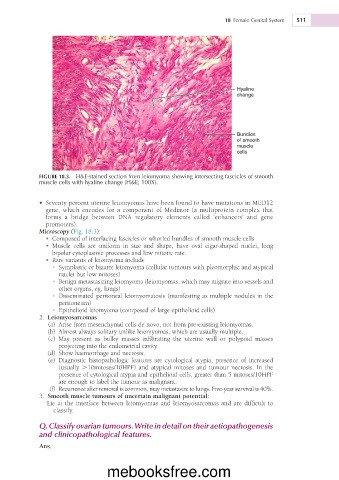
             FIGURE 18.3.  H&E-stained section from leiomyoma showing intersecting fascicles of smooth
             muscle cells with hyaline change (H&E; 100X).


             •  Seventy percent uterine leiomyomas have been found to have mutations in MED12
               gene,  which  encodes  for  a  component  of  Mediator  (a  multiprotein  complex  that
               forms  a  bridge  between  DNA  regulatory  elements  called  ‘enhancers’  and  gene
               promoters).
             Microscopy (Fig. 18.3):
               •  Composed of interlacing fascicles or whorled bundles of smooth muscle cells
               •  Muscle  cells  are  uniform  in  size  and  shape,  have  oval  cigar-shaped  nuclei,  long
                 bipolar cytoplasmic processes and low mitotic rate.
               •  Rare variants of leiomyoma include
                 •  Symplastic or bizarre leiomyoma (cellular tumours with pleomorphic and atypical
                   nuclei but low mitoses)
                 •  Benign metastasizing leiomyoma (leiomyomas, which may migrate into vessels and
                   other organs, eg, lungs)
                 •  Disseminated peritoneal leiomyomatosis (manifesting as multiple nodules in the
                   peritoneum)
                 •  Epithelioid leiomyoma (composed of large epithelioid cells)
               2.  Leiomyosarcomas
                 (a)  Arise from mesenchymal cells de novo, not from pre-existing leiomyomas.
                 (b)  Almost always solitary unlike leiomyomas, which are usually multiple.
                 (c)  May  present  as  bulky  masses  infiltrating  the  uterine  wall  or  polypoid  masses
                   projecting into the endometrial cavity.
                  (d)  Show haemorrhage and necrosis.
                 (e)  Diagnostic  histopathologic  features  are  cytological  atypia,  presence  of  increased
                   (usually  .10mitoses/10HPF)  and  atypical  mitoses  and  tumour  necrosis.  In  the
                   presence of cytological atypia and epithelioid cells, greater than 5 mitoses/10HPF
                   are enough to label the tumour as malignant.
                 (f)  Recurrence after removal is common, may metastasize to lungs. Five-year survival is 40%.
               3.  Smooth muscle tumours of uncertain malignant potential:
               Lie at the interface between leiomyomas and leiomyosarcomas and are difficult to
                 classify.

             Q. Classify ovarian tumours. Write in detail on their aetiopathogenesis
             and clinicopathological features.
             Ans.


                                  mebooksfree.com

