


Page 529 - Concise Pathology for Exam Preparation ( PDFDrive )
P. 529
514    SECTION II  Diseases of Organ Systems


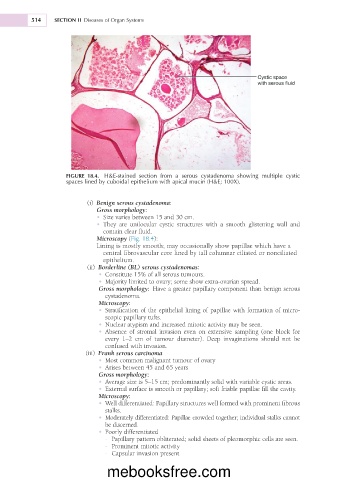
                                                                                Cystic space
                                                                                with serous fluid


                     FIGURE  18.4.  H&E-stained  section  from  a  serous  cystadenoma  showing  multiple  cystic
                     spaces lined by cuboidal epithelium with apical mucin (H&E; 100X).


                            (i)  Benign serous cystadenoma:
                               Gross morphology:
                               •  Size varies between 15 and 30 cm.
                               •  They  are  unilocular  cystic  structures  with  a  smooth  glistening  wall  and
                                 contain clear fluid.
                               Microscopy (Fig. 18.4):
                               Lining is mostly smooth; may occasionally show papillae which have a
                                 central fibrovascular core lined by tall columnar ciliated or nonciliated
                                 epithelium.
                     	      (ii)	 Borderline (BL) serous cystadenomas:
                               •  Constitute 15% of all serous tumours.
                               •  Majority limited to ovary; some show extra-ovarian spread.
                               Gross morphology:  Have a greater papillary component than benign serous
                                 cystadenoma.
                               Microscopy:
                               •  Stratification of the epithelial lining of papillae with formation of micro-
                                 scopic papillary tufts.
                               •  Nuclear atypism and increased mitotic activity may be seen.
                               •  Absence  of  stromal  invasion  even  on  extensive  sampling  (one  block  for
                                 every  1–2  cm  of  tumour  diameter).  Deep  invaginations  should  not  be
                                 confused with invasion.
                           (iii)  Frank serous carcinoma
                               •  Most common malignant tumour of ovary
                               •  Arises between 45 and 65 years
                               Gross morphology:
                               •  Average size is 5–15 cm; predominantly solid with variable cystic areas.
                               •  External surface is smooth or papillary; soft friable papillae fill the cavity.
                               Microscopy:
                               •  Well differentiated: Papillary structures well formed with prominent fibrous
                                 stalks.
                               •  Moderately differentiated: Papillae crowded together; individual stalks cannot
                                 be discerned.
                               •  Poorly differentiated
                                 -  Papillary pattern obliterated; solid sheets of pleomorphic cells are seen.
                                 -  Prominent mitotic activity
                                 -  Capsular invasion present


                                  mebooksfree.com

