


Page 543 - Concise Pathology for Exam Preparation ( PDFDrive )
P. 543
528    SECTION II  Diseases of Organ Systems


                     •	 Genetic	factors:
                       •	 Mutations in BRCA1 (familial breast and ovarian cancer), BRCA2 (familial breast and
                         ovarian cancer), p53 (Li-Fraumeni syndrome) and CHEK2 (responsible for 1% of all
                         breast cancers).
                       •	 Family history of breast cancer (affected first-degree relatives who do not carry an
                         established breast cancer gene mutation).
                       •	 Overexpression of HER2/neu proto-oncogene.
                       •	 Amplification of RAS and MYC genes.
                     •	 Breastfeeding: The longer the duration of breastfeeding, the less the incidence of breast
                       carcinoma.
                     •	 Hormonal	influences: Oestrogen excess (long duration of reproductive life, nulliparity,
                       first child at a late age, increasing age and exogenous oestrogens). Oral contraceptives
                       are not known to be associated with an increased incidence. Oophorectomy decreases
                       the risk by decreasing endogenous oestrogens. Also, drugs like tamoxifen (blocks oes-
                       trogen)  and  aromatase  inhibitors  (decrease  oestrogen  synthesis)  decrease  the  risk  of
                       ER-positive cancers.
                     •	 Environmental	 factors:  Radiation  exposure,  organochlorine  pesticides  (have  oestro-
                       gen-like effects) and alcohol intake.
                     •	 Proliferative	 breast	 disease/carcinoma	 of	 contralateral	 breast	 or	 endometrium
                       (have several common risk factors).
                     •	 Breast	density: High breast density on mammography has a 4–5 times higher risk of
                       ER-positive and ER-negative cancers.
                     •	 Obesity: Obese women less than 40 years have anovulatory cycles and lower progester-
                       one levels thereby reducing the risk, whereas, postmenopausal obesity increases the risk
                       attributed to oestrogen synthesis in the fat depots.
                     Familial	breast	cancer: Many familial cancers and 80–90% of single gene familial breast
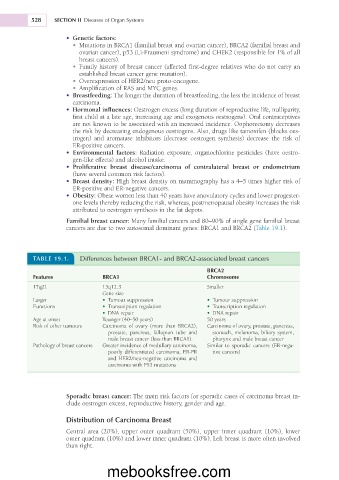
                     cancers are due to two autosomal dominant genes: BRCA1 and BRCA2 (Table 19.1).


           TABLE 19.1.    Differences between BRCA1- and BRCA2-associated breast cancers
                                                                 BRCA2
           Features              BRCA1                           Chromosome
           17q21                 13q12.3                         Smaller
                                 Gene size
           Larger                •  Tumour suppression           •  Tumour suppression
           Functions             •  Transcription regulation     •  Transcription regulation
                                 •  DNA repair                   •  DNA repair
           Age at onset          Younger (40–50 years)           50 years
           Risk of other tumours  Carcinoma  of  ovary  (more  than  BRCA2),   Carcinoma of ovary, prostate, pancreas,
                                  prostate,  pancreas,  fallopian  tube  and   stomach, melanoma, biliary system,
                                  male breast cancer (less than BRCA1).  pharynx and male breast cancer
           Pathology of breast cancers  Greater incidence of medullary carcinoma,   Similar  to  sporadic  cancers  (ER-nega-
                                  poorly  differentiated  carcinoma,  ER-PR   tive cancers)
                                  and  HER2/neu-negative  carcinoma  and
                                  carcinoma with P53 mutations


                     Sporadic	breast	cancer: The main risk factors for sporadic cases of carcinoma breast in-
                     clude oestrogen excess, reproductive history, gender and age.

                     Distribution of Carcinoma Breast
                     Central  area  (20%),  upper  outer  quadrant  (50%),  upper  inner  quadrant  (10%),  lower
                     outer quadrant (10%) and lower inner quadrant (10%). Left breast is more often involved
                     than right.


                                  mebooksfree.com

