


Page 541 - Concise Pathology for Exam Preparation ( PDFDrive )
P. 541
526    SECTION II  Diseases of Organ Systems


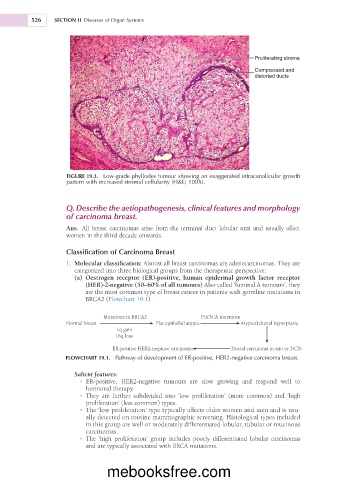
                                                                               Proliferating stroma

                                                                               Compressed and
                                                                               distorted ducts


                     FIGURE 19.3.  Low-grade phyllodes tumour showing an exaggerated intracanalicular growth
                     pattern with increased stromal cellularity (H&E; 100X).


                     Q. Describe the aetiopathogenesis, clinical features and morphology
                     of carcinoma breast.
                     Ans.  All breast carcinomas arise from the terminal duct lobular unit and usually affect
                     women in the third decade onwards.


                     Classification of Carcinoma Breast
                       1.  Molecular	classification:	Almost all breast carcinomas are adenocarcinomas. They are
                        categorized into three biological groups from the therapeutic perspective:
                     	  (a)	 Oestrogen	 receptor	 (ER)-positive,	 human	 epidermal	 growth	 factor	 receptor
                           (HER)-2-negative	(50–60%	of	all	tumours)	Also called ‘luminal A tumours’, they
                           are the most common type of breast cancer in patients with germline mutations in
                           BRCA2 (Flowchart 19.1)

                                 Mutations in BRCA2                                       PIK3CA mutations
                     Normal breast                                           Flat epithelial atypia                             Atypical ductal hyperplasia
                                     1q gain
                                     16q loss
                                    ER-positive HER2-negative carcinoma                            Ductal carcinoma in situ or DCIS
                     FLOWCHART 19.1.  Pathway of development of ER-positive, HER2-negative carcinoma breast.

                        Salient features:
                         •	 ER-positive,  HER2-negative  tumours  are  slow  growing  and  respond  well  to
                           hormonal therapy.
                         •	 They  are  further  subdivided  into  ‘low  proliferation’  (more  common)  and  ‘high
                           proliferation’ (less common) types.
                         •	 The ‘low proliferation’ type typically affects older women and men and is usu-
                           ally detected on routine mammographic screening. Histological types included
                           in this group are well or moderately differentiated lobular, tubular or mucinous
                           carcinomas.
                         •	 The  ‘high  proliferation’  group  includes  poorly  differentiated  lobular  carcinomas
                           and are typically associated with BRCA mutations.


                                  mebooksfree.com

