


Page 542 - Concise Pathology for Exam Preparation ( PDFDrive )
P. 542
19  The Breast  527


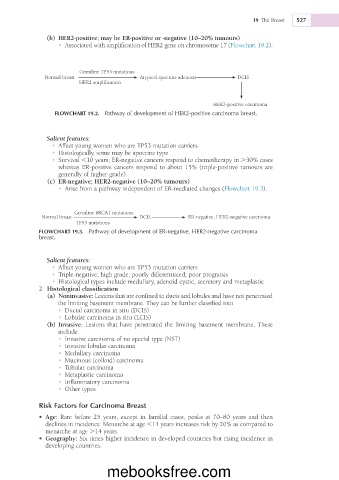
             	 (b)	 HER2-positive;	may	be	ER-positive	or	-negative	(10–20%	tumours)
                   •	 Associated with amplification of HER2 gene on chromosome 17 (Flowchart 19.2).


                         Germline TP53 mutations
               Normal breast                                               Atypical apocrine adenosis                              DCIS
                         HER2 amplification


                                                                   HER2-positive carcinoma
                  FLOWCHART 19.2.  Pathway of development of HER2-positive carcinoma breast.


               Salient features:
                 •	 Affect young women who are TP53 mutation carriers
                 •	 Histologically, some may be apocrine type
                 •	 Survival ,10 years; ER-negative cancers respond to chemotherapy in .30% cases
                   whereas ER-positive cancers respond to about 15% (triple-positive tumours are
                   generally of higher grade).
                (c)  ER-negative;	HER2-negative	(10–20%	tumours)
                   •	 Arise from a pathway independent of ER-mediated changes (Flowchart 19.3).


                        Germline BRCA1 mutations
              Normal breast                                                 DCIS                           ER-negative, HER2-negative carcinoma
                        TP53 mutations
             FLOWCHART 19.3.  Pathway of development of ER-negative, HER2-negative carcinoma
             breast.


               Salient features:
                 •	 Affect young women who are TP53 mutation carriers
                 •	 Triple-negative; high grade; poorly differentiated; poor prognosis
                 •	 Histological types include medullary, adenoid cystic, secretory and metaplastic
               2.  Histological classification
                	(a)	 Noninvasive: Lesions that are confined to ducts and lobules and have not penetrated
                   the limiting basement membrane. They can be further classified into
                   •	 Ductal carcinoma in situ (DCIS)
                   •	 Lobular carcinoma in situ (LCIS)
                	 (b)	 Invasive: Lesions that have penetrated the limiting basement membrane. These
                   include
                   •	 Invasive carcinoma of no special type (NST)
                   •	 Invasive lobular carcinoma
                   •	 Medullary carcinoma
                   •	 Mucinous (colloid) carcinoma
                   •	 Tubular carcinoma
                   •	 Metaplastic carcinoma
                   •	 Inflammatory carcinoma
                   •	 Other types

             Risk Factors for Carcinoma Breast
             •	 Age:  Rare  before  25  years,  except  in  familial  cases,  peaks  at  70–80  years  and  then
               declines in incidence. Menarche at age ,11 years increases risk by 20% as compared to
               menarche at age .14 years.
             •	 Geography: Six times higher incidence in developed countries but rising incidence in
               developing countries.


                                  mebooksfree.com

