


Page 540 - Concise Pathology for Exam Preparation ( PDFDrive )
P. 540
19  The Breast  525


                                                                        Capsule


                                                                        Slit-like ducts


                                                                        Stromal tissue


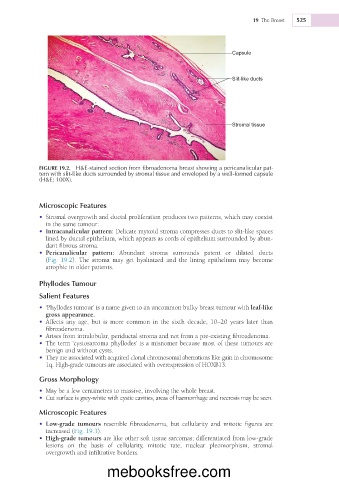
             FIGURE 19.2.  H&E-stained section from fibroadenoma breast showing a pericanalicular pat-
             tern with slit-like ducts surrounded by stromal tissue and enveloped by a well-formed capsule
             (H&E; 100X).


             Microscopic Features
             •	 Stromal overgrowth and ductal proliferation produces two patterns, which may coexist
               in the same tumour:
             •	 Intracanalicular	pattern: Delicate myxoid stroma compresses ducts to slit-like spaces
               lined by ductal epithelium, which appears as cords of epithelium surrounded by abun-
               dant fibrous stroma.
             •	 Pericanalicular	 pattern:  Abundant  stroma  surrounds  patent  or  dilated  ducts
               (Fig.  19.2).  The  stroma  may  get  hyalinized  and  the  lining  epithelium  may  become
               atrophic in older patients.

             Phyllodes Tumour
             Salient Features
             •	 ‘Phyllodes tumour’ is a name given to an uncommon bulky breast tumour with leaf-like
               gross appearance.
             •	 Affects  any  age,  but  is  more  common  in  the  sixth  decade,  10–20  years  later  than
               fibroadenoma.
             •	 Arises from intralobular, periductal stroma and not from a pre-existing fibroadenoma.
             •	 The term ‘cystosarcoma phyllodes’ is a misnomer because most of these tumours are
               benign and without cysts.
             •	 They are associated with acquired clonal chromosomal aberrations like gain in chromosome
               1q. High-grade tumours are associated with overexpression of HOXB13.

             Gross Morphology
             •	 May be a few centimetres to massive, involving the whole breast.
             •	 Cut surface is grey-white with cystic cavities, areas of haemorrhage and necrosis may be seen.
             Microscopic Features

             •	 Low-grade	 tumours  resemble  fibroadenoma,  but  cellularity  and  mitotic  figures  are
               increased (Fig. 19.3).
             •	 High-grade	tumours are like other soft tissue sarcomas; differentiated from low-grade
               lesions  on  the  basis  of  cellularity,  mitotic  rate,  nuclear  pleomorphism,  stromal
               overgrowth and infiltrative borders.


                                  mebooksfree.com

