


Page 566 - Concise Pathology for Exam Preparation ( PDFDrive )
P. 566
20  Endocrinology  551


               •	 Neuromuscular abnormalities, like weakness and fatigue
               •	 Cardiac manifestations, like aortic or mitral valve calcification
               2.  Secondary	hyperparathyroidism
             It may be caused by any condition which is associated with chronic hypocalcaemia.
             Causes:
             •	 Renal failure
             •	 Inadequate dietary intake of calcium
             •	 Steatorrhea
             •	 Vitamin D deficiency
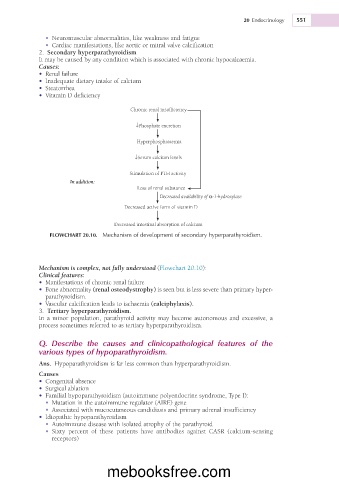
                                         Chronic renal insufficiency


                                           ↓Phosphate excretion

                                           Hyperphosphataemia

                                           ↓Serum calcium levels

                                         Stimulation of PTH activity
                       In addition:
                                           Loss of renal substance
                                                  Decreased availability of α-1-hydroxylase
                                       Decreased active form of vitamin D


                                    Decreased intestinal absorption of calcium
                FLOWCHART 20.10.  Mechanism of development of secondary hyperparathyroidism.


             Mechanism is complex, not fully understood (Flowchart 20.10):
             Clinical features:
             •	 Manifestations of chronic renal failure
             •	 Bone abnormality (renal	osteodystrophy) is seen but is less severe than primary hyper-
               parathyroidism.
             •	 Vascular calcification leads to ischaemia (calciphylaxis).
               3.  Tertiary	hyperparathyroidism.
             In a minor population, parathyroid activity may become autonomous and excessive, a
             process sometimes referred to as tertiary hyperparathyroidism.

             Q.  Describe  the  causes  and  clinicopathological  features  of  the
             various types of hypoparathyroidism.
             Ans.	 Hypoparathyroidism is far less common than hyperparathyroidism.
             Causes
             •	 Congenital absence
             •	 Surgical ablation
             •	 Familial hypoparathyroidism (autoimmune polyendocrine syndrome, Type I):
               •	 Mutation in the autoimmune regulator (AIRE) gene
               •	 Associated with mucocutaneous candidiasis and primary adrenal insufficiency
             •	 Idiopathic hypoparathyroidism
               •	 Autoimmune disease with isolated atrophy of the parathyroid
               •	 Sixty  percent  of  these  patients  have  antibodies  against  CASR  (calcium-sensing
                 receptors)


                                  mebooksfree.com

