


Page 565 - Concise Pathology for Exam Preparation ( PDFDrive )
P. 565
550    SECTION II  Diseases of Organ Systems


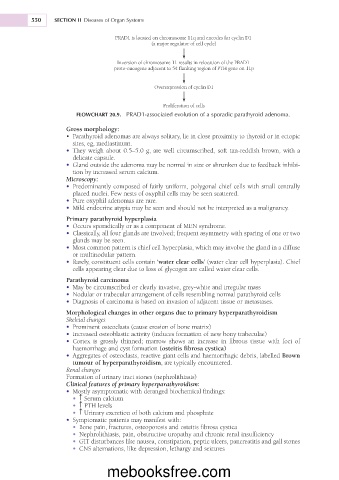
                                    PRAD1 is located on chromosome 11q and encodes for cyclin D1
                                                (a major regulator of cell cycle)


                                     Inversion of chromosome 11 results in relocation of the PRAD1
                                    proto-oncogene adjacent to 5¢ flanking region of PTH gene on 11p

                                                 Overexpression of cyclin D1


                                                   Proliferation of cells
                         FLOWCHART 20.9.  PRAD1-associated evolution of a sporadic parathyroid adenoma.

                     Gross	morphology:
                     •  Parathyroid adenomas are always solitary, lie in close proximity to thyroid or in ectopic
                       sites, eg, mediastinum.
                     •	 They weigh about 0.5–5.0 g, are well circumscribed, soft tan-reddish brown, with a
                       delicate capsule.
                     •	 Gland outside the adenoma may be normal in size or shrunken due to feedback inhibi-
                       tion by increased serum calcium.
                     Microscopy:
                     •	 Predominantly composed of fairly uniform, polygonal chief cells with small centrally
                       placed nuclei. Few nests of oxyphil cells may be seen scattered.
                     •	 Pure oxyphil adenomas are rare.
                     •	 Mild endocrine atypia may be seen and should not be interpreted as a malignancy.
                     Primary	parathyroid	hyperplasia
                     •	 Occurs sporadically or as a component of MEN syndrome.
                     •	 Classically, all four glands are involved; frequent asymmetry with sparing of one or two
                       glands may be seen.
                     •	 Most common pattern is chief cell hyperplasia, which may involve the gland in a diffuse
                       or multinodular pattern.
                     •	 Rarely, constituent cells contain ‘water	clear	cells’ (water clear cell hyperplasia). Chief
                       cells appearing clear due to loss of glycogen are called water clear cells.
                     Parathyroid	carcinoma
                     •	 May be circumscribed or clearly invasive, grey-white and irregular mass
                     •	 Nodular or trabecular arrangement of cells resembling normal parathyroid cells
                     •	 Diagnosis of carcinoma is based on invasion of adjacent tissue or metastases.
                     Morphological	changes	in	other	organs	due	to	primary	hyperparathyroidism
                     Skeletal changes
                     •	 Prominent osteoclasts (cause erosion of bone matrix)
                     •	 Increased osteoblastic activity (induces formation of new bony trabeculae)
                     •	 Cortex  is  grossly  thinned;  marrow  shows  an  increase  in  fibrous  tissue  with  foci  of
                       haemorrhage and cyst formation (osteitis	fibrosa	cystica)
                     •	 Aggregates of osteoclasts, reactive giant cells and haemorrhagic debris, labelled Brown
                       tumour	of	hyperparathyroidism, are typically encountered.
                     Renal changes
                     Formation of urinary tract stones (nephrolithiasis)
                     Clinical features of primary hyperparathyroidism:
                     •	 Mostly asymptomatic with deranged biochemical findings:
                         h
                       •	  Serum calcium
                         h
                       •	  PTH levels
                         h
                       •	  Urinary excretion of both calcium and phosphate
                     •	 Symptomatic patients may manifest with:
                       •	 Bone pain, fractures, osteoporosis and osteitis fibrosa cystica
                       •	 Nephrolithiasis, pain, obstructive uropathy and chronic renal insufficiency
                       •	 GIT disturbances like nausea, constipation, peptic ulcers, pancreatitis and gall stones
                       •	 CNS alternations, like depression, lethargy and seizures


                                  mebooksfree.com

