


Page 564 - Concise Pathology for Exam Preparation ( PDFDrive )
P. 564
20  Endocrinology  549


             •	 Yellow-brown, ovoid, encapsulated, measuring 35–40 mg
             •	 Composed of:
               •	 Chief cells (secrete PTH or parathormone)
               •	 Oxyphil cells (appear at the onset of puberty, but have no known function)
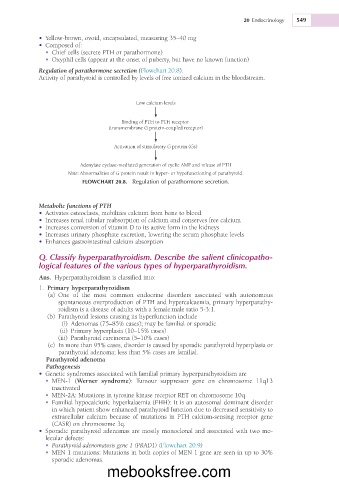
             Regulation of parathormone secretion (Flowchart 20.8).
             Activity of parathyroid is controlled by levels of free ionized calcium in the bloodstream.


                                           Low calcium levels


                                      Binding of PTH to PTH receptor
                                  (transmembrane G protein-coupled receptor)


                                    Activation of stimulatory G protein (Gs)

                          Adenylate cyclase-mediated generation of cyclic AMP and release of PTH
                      Note: Abnormalities of G protein result in hyper- or hypofunctioning of parathyroid.
                          FLOWCHART 20.8.  Regulation of parathormone secretion.


             Metabolic functions of PTH
             •	 Activates osteoclasts, mobilizes calcium from bone to blood
             •	 Increases renal tubular reabsorption of calcium and conserves free calcium
             •	 Increases conversion of vitamin D to its active form in the kidneys
             •	 Increases urinary phosphate excretion, lowering the serum phosphate levels
             •	 Enhances gastrointestinal calcium absorption
             Q. Classify hyperparathyroidism. Describe the salient clinicopatho-
             logical features of the various types of hyperparathyroidism.

             Ans.	 Hyperparathyroidism is classified into:
               1.  Primary	hyperparathyroidism
                 (a)  One  of  the  most  common  endocrine  disorders  associated  with  autonomous
                   spontaneous overproduction of PTH and hypercalcaemia, primary hyperparathy-
                   roidism is a disease of adults with a female:male ratio 5-3:1.
                 (b)  Parathyroid lesions causing its hyperfunction include
                     (i)  Adenomas (75–85% cases); may be familial or sporadic
                    (ii)  Primary hyperplasia (10–15% cases)
                     (iii)  Parathyroid carcinoma (5–10% cases)
                 (c)  In more than 95% cases, disorder is caused by sporadic parathyroid hyperplasia or
                   parathyroid adenoma; less than 5% cases are familial.
               Parathyroid	adenoma
               Pathogenesis
             •	 Genetic syndromes associated with familial primary hyperparathyroidism are
               •	 MEN-1  (Werner	 syndrome):  Tumour  suppressor  gene  on  chromosome  11q13
                 inactivated
               •	 MEN-2A: Mutations in tyrosine kinase receptor RET on chromosome 10q
               •	 Familial hypocalciuric hyperkalaemia (FHH): It is an autosomal dominant disorder
                 in which patient show enhanced parathyroid function due to decreased sensitivity to
                 extracellular  calcium  because  of  mutations  in  PTH  calcium-sensing  receptor  gene
                 (CASR) on chromosome 3q.
             •	 Sporadic parathyroid adenomas are mostly monoclonal and associated with two mo-
               lecular defects:
               •	 Parathyroid adenomatosis gene 1 (PRAD1) (Flowchart 20.9)
               •	 MEN 1 mutations: Mutations in both copies of MEN 1 gene are seen in up to 30%
                 sporadic adenomas.
                                  mebooksfree.com

