


Page 561 - Concise Pathology for Exam Preparation ( PDFDrive )
P. 561
546    SECTION II  Diseases of Organ Systems


                             translocation between chromosomes 10 and 17    formation of RET/PTC
                             fusion gene or NTRK1 fusion gene    activation of MAP kinase pathway.
                           •  Mutations  in  signal  transduction  genes  (RAS  mutations  and  mutations  in  BRAF
                             oncogene).
                     	 (c)	 Medullary	carcinoma
                           •  Sporadic in 80% cases; remainder occur in a setting of MEN IIA or IIB or as familial
                             tumours not associated with MEN syndrome.
                           •	 Familial tumours occurring in MEN Type II are associated with germline muta-
                             tions in RET protooncogene which leads to constitutive activation of tyrosine
                             kinase receptor and cellular proliferation.
                       2.  Environmental	factors
                     •	 Association with ionizing radiation
                     •	 Pre-existing thyroid pathology, eg, nodular goitre, adenomas and Hashimoto thyroiditis.
                     Papillary	Thyroid	Carcinoma
                     Clinical features
                     •	 Most common thyroid malignancy
                     •	 Peak incidence between 20 and 40 years; may be seen at any age
                     •	 Presents as a solitary (cold) nodule
                     •	 In most cases, primary thyroid nodule is asymptomatic and cervical lymph node metastasis
                       is the first manifestation.
                     •	 Primary  thyroid  nodule  may  sometimes  manifest  with  hoarseness,  dysphagia,  cough
                       and dyspnoea.
                     Predisposing factors
                     •	 Previous exposure to ionizing radiation
                     •	 Increased incidence of PTC is observed in Gardner syndrome (familial adenomatous
                       polyposis coli) and Cowden disease (familial goitre and skin haematomas)
                     Gross morphology:
                     •	 Solitary or multifocal; often cystic
                     •	 May be well circumscribed/encapsulated or ill-defined/infiltrative
                     •	 On cut surface, papillary areas are easily identified and appear granular. Areas of fibrosis
                       may be seen
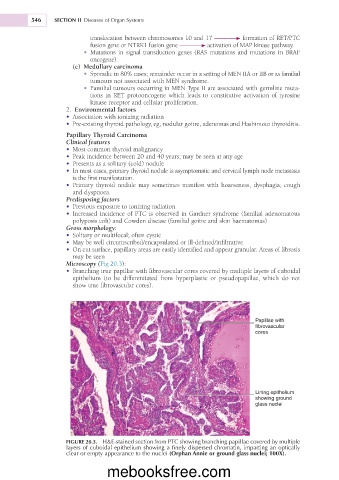
                     Microscopy (Fig 20.3):
                     •	 Branching true papillae with fibrovascular cores covered by multiple layers of cuboidal
                       epithelium  (to  be  differentiated  from  hyperplastic  or  pseudopapillae,  which  do  not
                       show true fibrovascular cores).


                                                                                Papillae with
                                                                                fibrovascular
                                                                                cores


                                                                                Lining epithelium
                                                                                showing ground
                                                                                glass nuclei


                     FIGURE 20.3.  H&E-stained section from PTC showing branching papillae covered by multiple
                     layers of cuboidal epithelium showing a finely dispersed chromatin, imparting an optically
                     clear or empty appearance to the nuclei (Orphan Annie or ground glass nuclei; 100X).


                                  mebooksfree.com

