


Page 568 - Concise Pathology for Exam Preparation ( PDFDrive )
P. 568
20  Endocrinology  553

             Morphology

             Main lesion of Cushing syndrome is found in pituitary and adrenal glands.
             •	 Pituitary glands:
               •	 Changes regardless of the cause of Cushing syndrome
               •	 Most common alteration due to high levels of glucocorticoids is labelled Crooke	hyaline
                 change in which the normal granular basophilic cytoplasm of the ACTH-producing cells
                 in the anterior pituitary is replaced by homogenous lightly basophilic material; the altera-
                 tion is because of accumulation of intermediate	keratin	filaments in the cytoplasm.
             •	 Adrenals: Morphology varies depending on the cause of hypercortisolism. The adrenals
               have one of the following abnormalities:
               •	 Cortical  atrophy  (exogenous  glucocorticoids  cause  suppression  of  endogenous
                 ACTH)
               •	 Diffuse hyperplasia
               •	 Nodular hyperplasia
               •	 Adenoma
               •	 Carcinoma
             Q. Write briefly on the pathogenesis, clinical features and
             morphology of hyperaldosteronism.
             Ans.	 Hyperaldosteronism is a generic term for a group of many closely related syndromes,
             characterized by excessive	aldosterone	secretion. Excessive aldosterone secretion causes
             sodium retention and potassium excretion resulting in hypertension and hypokalaemia.
             Types

             •	 Primary
             •	 Secondary (due to an extra-adrenal cause)
               1.  Primary	hyperaldosteronism
                 (a)  Autonomous overproduction of aldosterone
                 (b)  Resultant  suppression  of  renin–angiotensin  system  and  decreased  plasma  renin
                   activity
                 (c)  Caused by:
                   (i) Adrenocortical neoplasm


                      Adenoma (80%)   Carcinoma (20%)
                      or
                      Conn syndrome
                    (ii)  Primary idiopathic adrenocortical hyperplasia, which is characterized by bilat-
                       eral nodular enlargement.
                     (iii)  Glucocorticoid-remediable hyperaldosteronism (familial), which is caused by
                       a chimeric gene, resulting from fusion of CYP11B1 (11 b-hydroxylase) and
                       CYP11B2 (aldosterone synthase).
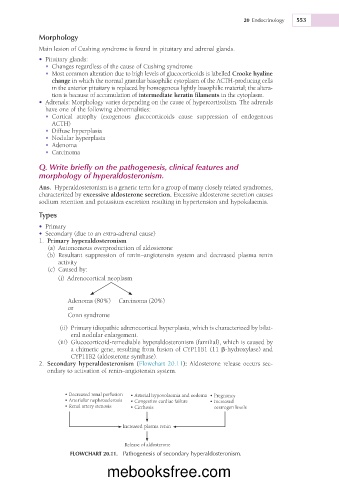
               2.  Secondary	hyperaldosteronism	(Flowchart 20.11): Aldosterone release occurs sec-
                ondary to activation of renin–angiotensin system.


                     • Decreased renal perfusion  • Arterial hypovolaemia and oedema • Pregnancy
                     • Arteriolar nephrosclerosis  • Congestive cardiac failure  • Increased
                     • Renal artery stenosis  • Cirrhosis            oestrogen levels

                                       Increased plasma renin


                                       Release of aldosterone
                       FLOWCHART 20.11.  Pathogenesis of secondary hyperaldosteronism.


                                  mebooksfree.com

