


Page 573 - Concise Pathology for Exam Preparation ( PDFDrive )
P. 573
558    SECTION II  Diseases of Organ Systems


                       10.  Gestational	diabetes
                     Normal	glucose	homoeostasis	regulation	involves	three	steps:
                     •	 Glucose production by liver
                     •	 Uptake and utilization by peripheral tissue
                     •	 Secretion of insulin and counter-regulatory hormones-like glucagon
                     Insulin:
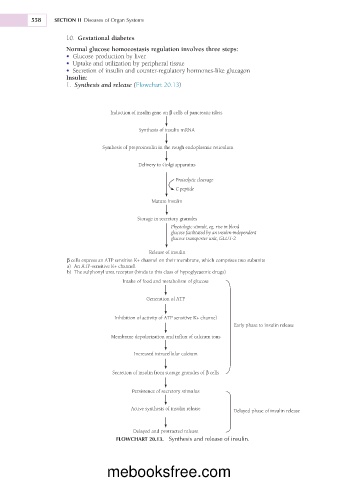
                       1.  Synthesis and release (Flowchart 20.13)


                                   Induction of insulin gene on β cells of pancreatic islets

                                            Synthesis of insulin mRNA


                                 Synthesis of preproinsulin in the rough endoplasmic reticulum

                                            Delivery to Golgi apparatus

                                                       Proteolytic cleavage
                                                        C peptide
                                                Mature insulin


                                           Storage in secretory granules
                                                      Physiologic stimuli, eg, rise in blood
                                                      glucose facilitated by an insulin-independent
                                                      glucose transporter unit, GLUT-2

                                               Release of insulin
                      β cells express an ATP sensitive K+ channel on their membrane, which comprises two subunits
                      a)  An ATP-sensitive K+ channel.
                      b)  The sulphonyl urea receptor (binds to this class of hypoglycaemic drugs)
                                       Intake of food and metabolism of glucose

                                              Generation of ATP

                                    Inhibition of activity of ATP sensitive K+ channel
                                                                         Early phase to insulin release
                                   Membrane depolarization and influx of calcium ions

                                          Increased intracellular calcium


                                    Secretion of insulin from storage granules of β cells


                                          Persistence of secretory stimulus

                                         Active synthesis of insulin release
                                                                         Delayed phase of insulin release

                                          Delayed and protracted release
                                     FLOWCHART 20.13.  Synthesis and release of insulin.


                                  mebooksfree.com

