


Page 574 - Concise Pathology for Exam Preparation ( PDFDrive )
P. 574
20  Endocrinology  559


               Two factors, namely ‘glucose-dependent insulinotropic polypeptide or GIP’ secreted by
                 endocrine k cells located in the small bowel and ‘glucagon-like peptide-1 or GLP-1Z’
                 secreted by L cells located in distal ileum and colon are released immediately after
                 food intake. They are called incretins and their stimulatory effect on secretion of in-
                 sulin from b cells is labelled ‘incretin	effect’. This effect is blunted in Type II diabetes.
               2.  Signalling pathway
                 (a)  Insulin receptor is a tetrameric protein composed of two a and two b chains.
                 (b)  The b subunit cytosolic domain possesses tyrosine kinase activity.
                 (c)  Insulin binds to the extracellular domain of a subunit to activate the b subunit
                   tyrosine kinase, leading to autophosphorylation of the receptor and phosphoryla-
                   tion of several intracellular substrate proteins, eg, family of insulin receptor sub-
                   strate proteins (IRS) proteins, which includes IRS1-4 and GAB1.
                  (d)  The substrate proteins activate multiple downstream signal cascades including PI-
                   3k and MAP kinase pathways, which mediate the several actions of insulin.
                 (e)  Insulin aids in the docking of glucose transporter unit GLUT-4 to the plasma mem-
                   brane (GLUT-4 promotes glucose uptake).
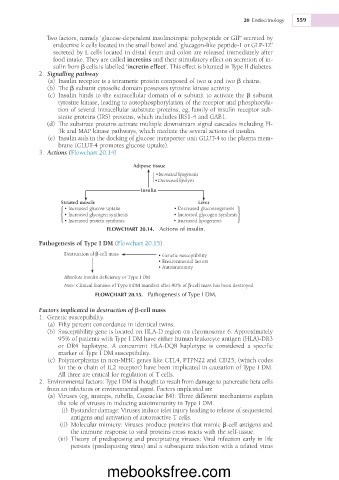
               3.  Actions (Flowchart 20.14)
                                          Adipose tissue
                                                  • Increased lipogenesis
                                                 • Decreased lipolysis
                                            Insulin
                    Striated muscle                           Liver
                       • Increased glucose uptake      • Decreased gluconeogenesis
                     • Increased glycogen synthesis    • Increased glycogen synthesis
                       • Increased protein synthesis    • Increased lipogenesis
                                  FLOWCHART 20.14.  Actions of insulin.

             Pathogenesis	of	Type	I	DM (Flowchart 20.15)
                     Destruction of β-cell mass    • Genetic susceptibility
                                                  • Environmental factors
                                                  • Autoimmunity
                     Absolute insulin deficiency or Type I DM
                     Note: Clinical features of Type I DM manifest after 80% of β-cell mass has been destroyed.
                              FLOWCHART 20.15.  Pathogenesis of Type I DM.

             Factors implicated in destruction of b-cell	mass
               1.  Genetic susceptibility.
                 (a)  Fifty percent concordance in identical twins.
                 (b)  Susceptibility gene is located on HLA-D region on chromosome 6. Approximately
                   95% of patients with Type I DM have either human leukocyte antigen (HLA)-DR3
                   or  DR4  haplotype.  A  concurrent  HLA-DQ8  haplotype  is  considered  a  specific
                   marker of Type I DM susceptibility.
                 (c)  Polymorphisms in non-MHC genes like CTL4, PTPN22 and CD25, (which codes
                   for the a chain of IL2 receptor) have been implicated in causation of Type I DM.
                   All three are critical for regulation of T cells.
              2.  Environmental factors: Type I DM is thought to result from damage to pancreatic beta cells
                from an infectious or environmental agent. Factors implicated are
                 (a)  Viruses (eg, mumps, rubella, Coxsackie B4): Three different mechanisms explain
                   the role of viruses in inducing autoimmunity in Type I DM.
                     (i)  Bystander damage: Viruses induce islet injury leading to release of sequestered
                       antigens and activation of autoreactive T cells.
                    (ii)  Molecular mimicry: Viruses produce proteins that mimic b-cell antigens and
                       the immune response to viral proteins cross reacts with the self-tissue.
                     (iii)  Theory of predisposing and precipitating viruses: Viral infection early in life
                       persists (predisposing virus) and a subsequent infection with a related virus


                                  mebooksfree.com

