


Page 575 - Concise Pathology for Exam Preparation ( PDFDrive )
P. 575
560    SECTION II  Diseases of Organ Systems


                               (precipitating virus) that shares antigenic epitopes, leads to an immune re-
                               sponse against the infected islet cells.
                         (b)  Toxic chemicals
                         (c)  Exposure to cow’s milk in infancy
                          (d)  Cytotoxins
                         (e)  Recent evidence suggests a role for vitamin D in the pathogenesis and prevention
                           of diabetes mellitus.
                       3.  Autoimmune factors: Currently, autoimmunity is considered the major factor in the
                        pathophysiology of Type I DM. Evidence implicating autoimmunity includes
                         (a)  Circulating islet cell (glutamic acid decarboxylase or GAD and antiinsulin) anti-
                           bodies
                         (b)  b cells damage by cytokines (g IFN, TNF and IL1)
                         (c)  Prominent insulitis (including cellular necrosis and lymphocytic infiltration)
                          (d)  Tissue injury caused by macrophages activated by CD4  T cells
                                                                        1
                                                     1
                         (e)  Direct killing of b cells by CD8  T cells
                         (f)  Increased prevalence of Type I DM in patients with other autoimmune diseases,
                           such as Graves disease, Hashimoto thyroiditis and Addison disease.
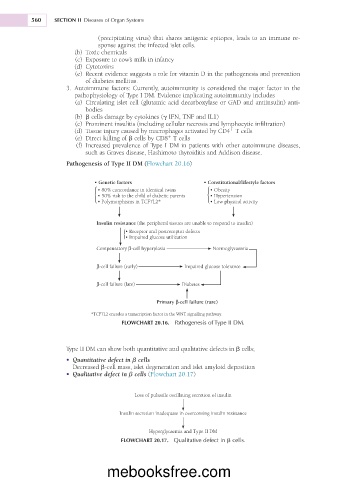
                     Pathogenesis	of	Type	II	DM (Flowchart 20.16)

                              • Genetic factors                 • Constitutional/lifestyle factors
                               • 80% concordance in identical twins  • Obesity
                               • 50% risk to the child of diabetic parents  • Hypertension
                               • Polymorphisms in TCF7L2*         • Low physical activity


                               Insulin resistance (the peripheral tissues are unable to respond to insulin)
                                        • Receptor and postreceptor defects
                                        • Impaired glucose utilization
                               Compensatory β-cell hyperplasia    Normoglycaemia


                               β-cell failure (early)     Impaired glucose tolerance

                               β-cell failure (late)     Diabetes


                                                 Primary β-cell failure (rare)
                             *TCF7L2 encodes a transcription factor in the WNT signalling pathway.
                                      FLOWCHART 20.16.  Pathogenesis of Type II DM.


                     Type II DM can show both quantitative and qualitative defects in b cells;
                     •  Quantitative defect in b cells
                       Decreased b-cell mass, islet degeneration and islet amyloid deposition
                     •  Qualitative defect in b cells (Flowchart 20.17)


                                          Loss of pulsatile oscillating secretion of insulin


                                      Insulin secretion inadequate in overcoming insulin resistance

                                               Hyperglycaemia and Type II DM
                                      FLOWCHART 20.17.  Qualitative defect in b cells.


                                  mebooksfree.com

