


Page 578 - Concise Pathology for Exam Preparation ( PDFDrive )
P. 578
20  Endocrinology  563


             Vascular system:
             •	 Accelerated atherosclerosis (hallmark)
             •	 Gangrene and myocardial infarction
             •	 Hyaline arteriolosclerosis (amorphous hyaline thickening of the wall of the arterioles
               causing narrowing of the lumen)
             •	 Diabetic microangiopathy (diffuse thickening of the basement membrane, most evident
               in the capillaries of the skin, skeletal muscle, retina, renal glomeruli, renal tubules, pe-
               ripheral nerves and placenta)
             Diabetic nephropathy:
             •	 Microalbuminuria: Earliest manifestation of diabetes is the appearance of low amounts of
               albumin in urine (.30 mg/day but ,300 mg/day).
             •	 Glomerular lesions:
               •	 Capillary basement membrane thickening
               •	 Diffuse mesangial sclerosis
               •	 Nodular glomerulosclerosis (Kimmelstiel–Wilson	lesion;	pathognomic	of	diabetes)
             •	 Renal vascular lesions: Renal arteriosclerosis and atherosclerosis
             •	 Pyelonephritis including papillary necrosis (necrotizing papillitis)
             Diabetic ocular complications:
             •	 Retinopathy
             •	 Cataract
             •	 Glaucoma
             Diabetic neuropathy:
             Central and peripheral nervous systems are both affected. It alters both motor and sensory
               functions.
             Defective immunity:
             •	 Enhanced susceptibility to infections
             •	 Defects in neutrophilic function

             Q. Enumerate the criteria for diagnosis of DM. Enlist the investigations
             advocated in a patient of DM.
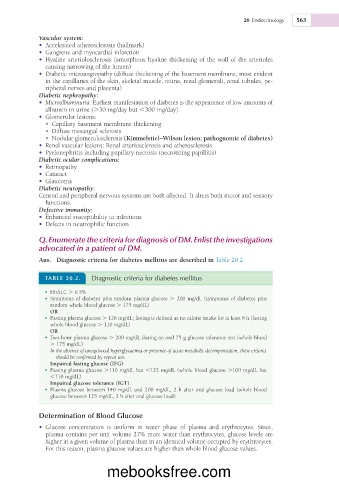
             Ans.	 	Diagnostic	criteria	for	diabetes	mellitus	are	described	in	Table 20.2.


               TABLE 20.2.   Diagnostic criteria for diabetes mellitus

               •  HbA1C . 6.5%
               •  Symptoms of diabetes plus random plasma glucose . 200 mg/dL (symptoms of diabetes plus
                 random whole blood glucose . 175 mg/dL)
                 OR
               •  Fasting plasma glucose . 126 mg/dL; fasting is defined as no calorie intake for at least 8 h (fasting
                 whole blood glucose . 110 mg/dL)
                 OR
               •  Two-hour plasma glucose . 200 mg/dL during an oral 75 g glucose tolerance test (whole blood
                 . 175 mg/dL)
                 In the absence of unequivocal hyperglycaemia or presence of acute metabolic decompensation, these criteria
                  should be confirmed by repeat test.
                 Impaired	fasting	glucose	(IFG)
               •  Fasting plasma glucose .110 mg/dL but ,125 mg/dL (whole blood glucose .100 mg/dL but
                 ,110 mg/dL)
                 Impaired	glucose	tolerance	(IGT)
               •  Plasma glucose between 140 mg/dL and 200 mg/dL, 2 h after oral glucose load (whole blood
                 glucose between 125 mg/dL, 2 h after oral glucose load)

             Determination of Blood Glucose
             •	 Glucose  concentration  is  uniform  in  water  phase  of  plasma  and  erythrocytes.  Since,
               plasma contains per unit volume 27% more water than erythrocytes, glucose levels are
               higher in a given volume of plasma than in an identical volume occupied by erythrocytes.
               For this reason, plasma glucose values are higher than whole blood glucose values.


                                  mebooksfree.com

