


Page 577 - Concise Pathology for Exam Preparation ( PDFDrive )
P. 577
562    SECTION II  Diseases of Organ Systems


                       glycated basement membrane resulting in basement membrane thickening characteristic
                       of diabetic microangiopathy)
                     •	 Shows	resistance	to	proteolytic	digestion	(AGE crosslinked proteins are resistant to
                       protein digestion; thus, decreasing protein removal and enhancing protein deposition)
                     Biologic properties of AGE–RAGE complex
                     •	 Leads to generation of reactive oxygen species and NF-kB activation
                     •	 Induces monocyte emigration
                     •	 Induces cytokine and growth factor secretion
                     •	 Increases vascular permeability and procoagulant activity
                     •	 Increases ECM production and cellular proliferation
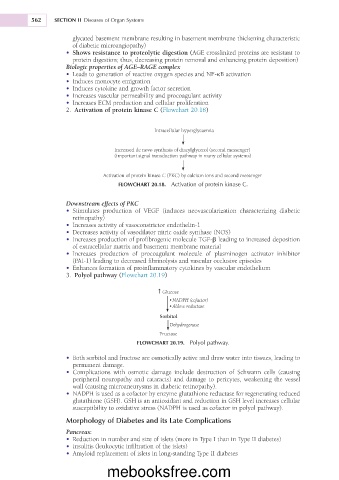
                       2.  Activation	of	protein	kinase	C	(Flowchart 20.18)


                                                 Intracellular hyperglycaemia


                                    Increased de novo synthesis of diacylglycerol (second messenger)
                                    (important signal transduction pathway in many cellular systems)


                                 Activation of protein kinase C (PKC) by calcium ions and second messenger
                                     FLOWCHART 20.18.  Activation of protein kinase C.

                     Downstream effects of PKC
                     •	 Stimulates  production  of  VEGF  (induces  neovascularization  characterizing  diabetic
                       retinopathy)
                     •	 Increases activity of vasoconstrictor endothelin-1
                     •	 Decreases activity of vasodilator nitric oxide synthase (NOS)
                     •	 Increases production of profibrogenic molecule TGF-b leading to increased deposition
                       of extracellular matrix and basement membrane material
                     •	 Increases  production  of  procoagulant  molecule  of  plasminogen  activator  inhibitor
                       (PAI-1) leading to decreased fibrinolysis and vascular occlusive episodes
                     •	 Enhances formation of proinflammatory cytokines by vascular endothelium
                       3.  Polyol	pathway	(Flowchart 20.19)


                                                  ↑ Glucose
                                                     • NADPH (cofactor)
                                                     • Aldose reductase
                                                  Sorbitol
                                                     Dehydrogenase
                                                  Fructose
                                           FLOWCHART 20.19.  Polyol pathway.

                     •	 Both sorbitol and fructose are osmotically active and draw water into tissues, leading to
                       permanent damage.
                     •	 Complications  with  osmotic  damage  include  destruction  of  Schwann  cells  (causing
                       peripheral neuropathy and cataracts) and damage to pericytes, weakening the vessel
                       wall (causing microaneurysms in diabetic retinopathy).
                     •	 NADPH is used as a cofactor by enzyme glutathione reductase for regenerating reduced
                       glutathione (GSH). GSH is an antioxidant and reduction in GSH level increases cellular
                       susceptibility to oxidative stress (NADPH is used as cofactor in polyol pathway).
                     Morphology of Diabetes and its Late Complications
                     Pancreas:
                     •	 Reduction in number and size of islets (more in Type I than in Type II diabetes)
                     •	 Insulitis (leukocytic infiltration of the islets)
                     •	 Amyloid replacement of islets in long-standing Type II diabetes


                                  mebooksfree.com

