


Page 69 - Concise Pathology for Exam Preparation ( PDFDrive )
P. 69
54    SECTION I  General Pathology


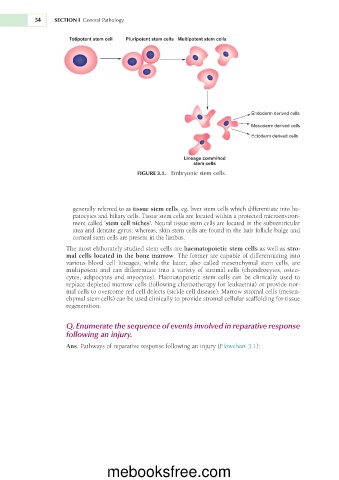
                      Totipotent stem cell  Pluripotent stem cells Multipotent stem cells


                                                                              Endoderm derived cells

                                                                              Mesoderm derived cells
                                                                              Ectoderm derived cells


                                                          Lineage commihed
                                                             stem cells
                                           FIGURE 3.1.  Embryonic stem cells.


                       generally referred to as tissue stem cells, eg, liver stem cells which differentiate into he-
                       patocytes and biliary cells. Tissue stem cells are located within a protected microenviron-
                       ment called ‘stem cell niches’. Neural tissue stem cells are located in the subventricular
                       area and dentate gyrus; whereas, skin stem cells are found in the hair follicle bulge and
                       corneal stem cells are present in the limbus.
                     The most elaborately studied stem cells are haematopoietic stem cells as well as stro-
                     mal cells located in the bone marrow. The former are capable of differentiating into
                     various  blood  cell  lineages,  while  the  latter,  also  called  mesenchymal  stem  cells,  are
                     multipotent and can differentiate into a variety of stromal cells (chondrocytes, osteo-
                     cytes, adipocytes and myocytes). Haematopoietic stem cells can be clinically used to
                     replace depleted marrow cells (following chemotherapy for leukaemia) or provide nor-
                     mal cells to overcome red cell defects (sickle cell disease). Marrow stromal cells (mesen-
                     chymal stem cells) can be used clinically to provide stromal cellular scaffolding for tissue
                     regeneration.


                     Q. Enumerate the sequence of events involved in reparative response
                     following an injury.

                     Ans. Pathways of reparative response following an injury (Flowchart 3.1):


                                  mebooksfree.com

