


Page 88 - Concise Pathology for Exam Preparation ( PDFDrive )
P. 88
4 Haemodynamic Disorders, Thrombosis and Shock 73
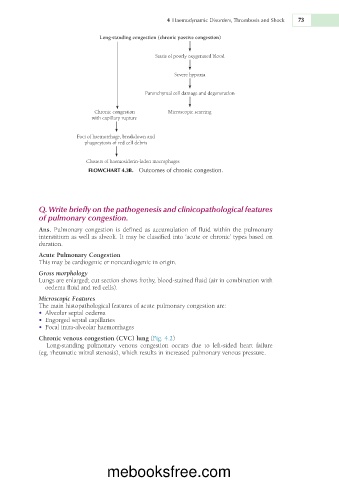
Longstanding congestion (chronic passive congestion)
Stasis of poorly oxygenated blood
Severe hypoxia
Parenchymal cell damage and degeneration
Chronic congestion Microscopic scarring
with capillary rupture
Foci of haemorrhage, breakdown and
phagocytosis of red cell debris
Clusters of haemosiderinladen macrophages
FLOWCHART 4.3B. Outcomes of chronic congestion.
Q. Write briefly on the pathogenesis and clinicopathological features
of pulmonary congestion.
Ans. Pulmonary congestion defined accumulation fluid within the pulmonary
is
of
as
as
It
or
interstitium well alveoli. may be classified into ‘acute chronic’ types based on
as
duration.
Acute Pulmonary Congestion
in
This may cardiogenic noncardiogenic origin.
or
be
Gross morphology
in
Lungs are enlarged; cut section shows frothy, blood-stained fluid (air combination with
oedema fluid and red cells).
Microscopic Features
of
The main histopathological features acute pulmonary congestion are:
• Alveolar septal oedema
• Engorged septal capillaries
• Focal intra-alveolar haemorrhages
Chronic venous congestion (CVC) lung (Fig. 4.2)
Long-standing pulmonary venous congestion occurs due to left-sided heart failure
in
(eg, rheumatic mitral stenosis), which results increased pulmonary venous pressure.
mebooksfree.com

