


Page 92 - Concise Pathology for Exam Preparation ( PDFDrive )
P. 92
4 Haemodynamic Disorders, Thrombosis and Shock 77
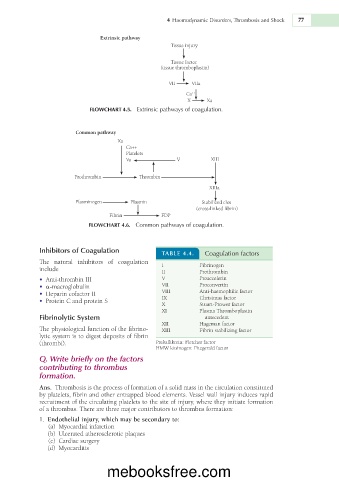
Extrinsic pathway
Tissue injury
Tissue factor
(tissue thromboplastin)
VII VIIa
Ca ++
X Xa
FLOWCHART 4.5. Extrinsic pathways of coagulation.
Common pathway
Xa
Ca++
Platelets
Va V XIII
Prothrombin Thrombin
XIIIa
Plasminogen Plasmin Stabilized clot
(crosslinked fibrin)
Fibrin FDP
FLOWCHART 4.6. Common pathways of coagulation.
Inhibitors of Coagulation TABLE 4.4. Coagulation factors
The natural inhibitors of coagulation
include I II Fibrinogen
Prothrombin
• Anti-thrombin III V Proaccelerin
• a-macroglobulin VII Proconvertin
• Heparin cofactor II VIII Anti-haemophilic factor
• Protein and protein S IX Christmas factor
C
X Stuart-Prower factor
XI Plasma Thromboplastin
Fibrinolytic System antecedent
XII Hageman factor
The physiological function the fibrino- XIII Fibrin stabilizing factor
of
to
is
of
lytic system digest deposits fibrin
(thrombi). Prekallikrein: Fletcher factor
HMW kininogen: Fitzgerald factor
Q. Write briefly on the factors
contributing to thrombus
formation.
in
a
of
is
of
Ans. Thrombosis the process formation solid mass the circulation constituted
by platelets, fibrin and other entrapped blood elements. Vessel wall injury induces rapid
recruitment the circulating platelets the site injury, where they initiate formation
of
to
of
of thrombus. There are three major contributors thrombus formation:
a
to
Endothelial injury, which may be secondary to:
1.
Myocardial infarction
(a)
Ulcerated atherosclerotic plaques
(b)
(c)
Cardiac surgery
(d)
Myocarditis
mebooksfree.com

