


Page 1054 - Hematology_ Basic Principles and Practice ( PDFDrive )
P. 1054
Chapter 59  Clinical Manifestations and Treatment of Acute Myeloid Leukemia  937


            As for the latter, debate continues with regard to dose, number of   Indications for Postremission Hematopoietic
            cycles, and whether or not there is a role for maintenance.  TABLE   Stem Cell Transplantation Based on Cytogenetic–
              In a landmark study by the CALGB, patients with newly diag-  59.4  Molecular Profile
            nosed AML in CR following a 3 + 7 induction were randomized to
                          2
            SDAC  (100 mg/m   continuous  IV  infusion  daily  ×  7),  IDAC   Prognostic Group  Subgroups    HSCT
                    2
                                                              2
            (400 mg/m  continuous IV infusion daily × 5), or HiDAC (3 g/m    CBF AML     KIT wt              No
            IV over 3 hours every 12 hours on days 1, 3, and 5) for a total of           KIT mut             Possible
                    20
            four cycles.  This was followed by an additional four cycles of 2 +                mut
            5, a consolidation-maintenance omitted from all subsequent CALGB   Intermediate  FLT3-ITD  mut   Yes
            studies.  The  probability  of  remaining  in  continuous  CR  after         FLT3-D835           Possible
                                                                                             mut a

            4 years was 24% for SDAC, 29% for IDAC, and 44% for HiDAC                    NPM1  mut a         No
            (p = .002). Over the ensuing years, studies have shown that there is         CEBPA               No
            no benefit by extending consolidation therapy by a fifth cycle and   Unfavorable  Not relevant   Yes
            that even three cycles may be equivalent. HiDAC in consolidation   a Without concomitant mutations of FLT3-ITD. In the case of CEBPA, only if the
            holds  less  benefit  for  patients  older  than  60  years  and  those  with   mutation is biallelic.
            intermediate and especially unfavorable karyotypes.    AML, Acute myeloid leukemia; CBF, core-binding factor; HiDAC, high-dose
              CBF leukemias are characterized by translocation t(8;21), inv(16),   cytarabine; HSCT, hematopoietic stem cell transplant; mut, mutated; wt, wild
            or  t(16;16)  and,  at  the  molecular  level,  by  a  disruption  of  CBF   type.
            transcription genes, which play a crucial role in hematopoietic differ-
            entiation. CBF AMLs comprise about 15% to 20% of patients with
            AML. They stand out in that they are very sensitive to cytarabine-
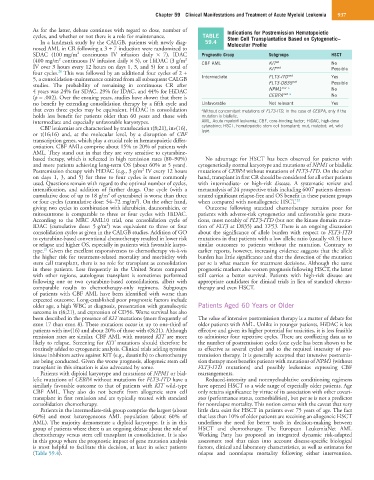
            based therapy, which is reflected in high remission rates (80–90%)   No  advantage  for  HSCT  has  been  observed  for  patients  with
            and more patients achieving long-term OS (about 60% at 5 years).   cytogenetically normal karyotype and mutations of NPM1 or biallelic
                                                2
            Postremission therapy with HiDAC (e.g., 3 g/m  IV every 12 hours   mutations of CEBPA without mutations of FLT3-ITD. On the other
            on  days  1,  3,  and  5)  for  three  to  four  cycles  is  most  commonly   hand, transplant in first CR should be considered for all other patients
            used. Questions remain with regard to the optimal number of cycles,   with  intermediate-  or  high-risk  disease.  A  systematic  review  and
            intensification,  and  addition  of  further  drugs.  One  cycle  (with  a   metaanalysis of 24 prospective trials including 6007 patients demon-
                                    2
            cumulative dose of up to 18 g/m  of cytarabine) is worse than three   strated significant relapse-free and OS benefit in these patient groups
                                              2
            or four cycles (cumulative dose: 54–72 mg/m ). On the other hand,   when compared with nonallogeneic HSCT. 22
            giving two cycles in combination with idarubicin, daunorubicin, or   Outcome  following  standard  chemotherapy  remains  poor  for
            mitoxantrone  is  comparable  to  three  or  four  cycles  with  HiDAC.   patients with adverse-risk cytogenetics and unfavorable gene muta-
            According  to  the  MRC  AML10  trial,  one  consolidation  cycle  of   tions, most notably of FLT3-ITD (but not the kinase domain muta-
                                    2
            IDAC  (cumulative  dose:  5 g/m )  was  equivalent  to  three  or  four   tion of FLT3 at D835) and TP53. There is an ongoing discussion
            consolidation cycles as given in the CALGB studies. Addition of GO   about  the  significance  of  allele  burden  with  respect  to  FLT3-ITD
            to cytarabine-based conventional chemotherapy resulted in lower risk   mutations in that patients with a low allelic ratio (usually <0.5) have
            or relapse and higher OS, especially in patients with favorable karyo-  similar  outcomes  to  patients  without  the  mutation.  Contrary  to
               21
            type.  Given the excellent responsiveness to chemotherapy vis-à-vis   earlier reports, however, increasing evidence suggests that the allele
            the higher risk for treatment-related mortality and morbidity with   burden has little significance and that the detection of the mutation
            stem cell transplant, there is no role for transplant as consolidation   per se is what matters for treatment decisions. Although the same
            in  these  patients.  Less  frequently  in  the  United  States  compared   prognostic markers also worsen prognosis following HSCT, the latter
            with  other  regions,  autologous  transplant  is  sometimes  performed   still  carries  a  better  survival.  Patients  with  high-risk  disease  are
            following  one  or  two  cytarabine-based  consolidations,  albeit  with   appropriate candidates for clinical trials in lieu of standard chemo-
            comparable  results  to  chemotherapy-only  regimens.  Subgroups   therapy and even HSCT.
            of  patients  with  CBF  AML  have  been  identified  with  worse  than
            expected outcome. Long-established poor prognostic factors include
            older age, a high WBC at diagnosis, presentation with granulocytic   Patients Aged 60 Years or Older
            sarcoma in t(8;21), and expression of CD56. Worse survival has also
            been described in the presence of KIT mutations (more frequently of   The value of intensive postremission therapy is a matter of debate for
            exon 17 than exon 8). These mutations occur in up to one-third of   older patients with AML. Unlike in younger patients, HiDAC is less
            patients with inv(16) and about 20% of those with t(8;21). Although   effective and given its higher potential for toxicities, it is less feasible
            remission rates are similar, CBF AML with mutated KIT are more   to administer four repetitive cycles. There are conflicting data as to
            likely to relapse. Screening for KIT mutations should therefore be   the number of postremission cycles (one cycle has been shown to be
            routinely added to cytogenetic analysis. Clinical trials adding tyrosine   as  effective  as  several  cycles)  and  to  the  required  intensity  of  pos-
            kinase inhibitors active against KIT (e.g., dasatinib) to chemotherapy   tremission therapy. It is generally accepted that intensive postremis-
            are being conducted. Given the worse prognosis, allogeneic stem cell   sion therapy most benefits patients with mutations of NPM1 (without
            transplant in this situation is also advocated by some.  FLT3-ITD  mutations)  and  possibly  leukemias  expressing  CBF
              Patients with diploid karyotype and mutations of NPM1 or bial-  rearrangements.
            lelic mutations of CEBPA without mutations for FLT3-ITD have a   Reduced-intensity and nonmyeloablative conditioning regimens
            similarly favorable outcome to that of patients with KIT wild-type   have opened HSCT to a wide range of especially older patients. Age
            CBF  AML.  They  also  do  not  benefit  from  allogeneic  stem  cell   only retains significance by virtue of its association with other covari-
            transplant in first remission and are typically treated with standard   ates (performance status, comorbidities), but per se is not a predictor
            consolidation chemotherapy.                           for nonrelapse mortality. This notion comes with the caveat that very
              Patients in the intermediate-risk group comprise the largest (about   little data exist for HSCT in patients over 75 years of age. The fact
            60%)  and  most  heterogeneous  AML  population  (about  60%  of   that less than 10% of older patients are receiving an allogeneic HSCT
            AML). The majority demonstrate a diploid karyotype. It is in this   underlines  the  need  for  better  tools  in  decision-making  between
            group of patients where there is an ongoing debate about the role of   HSCT  and  chemotherapy.  The  European  LeukemiaNet  AML
            chemotherapy versus stem cell transplant in consolidation. It is also   Working  Party  has  proposed  an  integrated  dynamic  risk-adapted
            in this group where the prognostic impact of gene mutation analysis   assessment  tool  that  takes  into  account  disease-specific  biological
            is most helpful to facilitate this decision, at least in select patients   factors, clinical and laboratory characteristics, as well as estimates for
            (Table 59.4).                                         relapse  and  nonrelapse  mortality  following  either  intervention.

