


Page 1053 - Hematology_ Basic Principles and Practice ( PDFDrive )
P. 1053
936    Part VII  Hematologic Malignancies


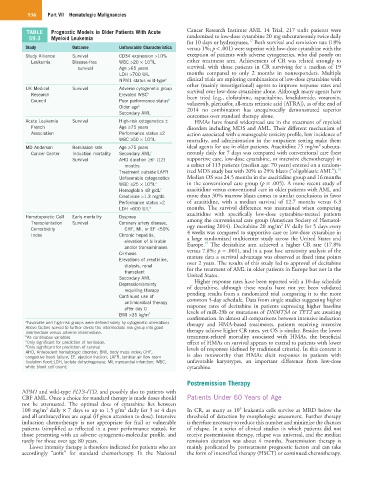
          TABLE   Prognostic Models in Older Patients With Acute   Cancer  Research  Institute  AML  14 Trial,  217  unfit  patients  were
          59.3    Myeloid Leukemia                            randomized to low-dose cytarabine 20 mg subcutaneously twice daily
                                                                                   17
                                                              for 10 days or hydroxyurea.  Both survival and remission rate (18%
         Study           Outcome        Unfavorable Characteristics  versus 1%; p < .001) were superior with low-dose cytarabine with the
         Study Alliance   Survival      CD34 expression >10%  exception of patients with adverse cytogenetics, who did poorly on
                                                  9
           Leukemia      Disease-free   WBC >20 × 10 /L       either  treatment  arm.  Achievement  of  CR  was  related  strongly  to
                           survival     Age >65 years         survival,  with  those  patients  in  CR  surviving  for  a  median  of  19
                                        LDH >700 U/L          months  compared  to  only  2  months  in  nonresponders.  Multiple
                                        NPM1 status wild-type a  clinical trials are exploring combinations of low-dose cytarabine with
                                                              other (mainly investigational) agents to improve response rates and
         UK Medical      Survival       Adverse cytogenetic group  survival over low-dose cytarabine alone. Although many agents have
           Research                     Elevated WBC b        been tried (e.g., clofarabine, sapacitabine, lenalidomide, vosaroxin,
           Council                      Poor performance status b  volasertib, plerixafor, all-trans retinoic acid [ATRA]), as of the end of
                                        Older age b           2014  no  combination  has  unequivocally  demonstrated  superior
                                        Secondary AML         outcomes over standard therapy alone.
         Acute Leukemia   Survival      High-risk cytogenetics ±  HMAs have found widespread use in the treatment of myeloid
           French                       Age ≥75 years         disorders including MDS and AML. Their different mechanism of
           Association                  Performance status ≥2  action associated with a manageable toxicity profile, low incidence of
                                        WBC ≥50 × 10 /L       mortality, and administration in the outpatient setting make them
                                                  9
                                                                                                         2
         MD Anderson     Remission rate  Age ≥75 years        ideal agents for use in older patients. Azacitidine 75 mg/m  subcuta-
           Cancer Center  Induction mortality  Secondary AML c  neously daily for 7 days was compared with conventional care (best
                                                   c
                         Survival       AHD duration ≥6  (12)   supportive care, low-dose cytarabine, or intensive chemotherapy) in
                                          months              a subset of 113 patients (median age: 70 years) entered on a random-
                                                                                                               18
                                        Treatment outside LAFR  ized MDS study but with 20% to 29% blasts (“oligoblastic AML”).
                                        Unfavorable cytogenetics  Median OS was 24.5 months in the azacitidine group and 16 months
                                                  9
                                        WBC ≥25 × 10 /L c     in the conventional care group (p = .005). A more recent study of
                                        Hemoglobin ≤8 g/dL c  azacitidine versus conventional care in older patients with AML and
                                        Creatinine >1.3 mg/dL  more than 30% marrow blasts comes to similar conclusions in favor
                                        Performance status >2  of  azacitidine,  with  a  median  survival  of  12.7  months  versus  6.3
                                        LDH >600 U/L d        months. The  survival  difference  was  maintained  when  comparing
                                                              azacitidine  with  specifically  low-dose  cytarabine-treated  patients
         Hematopoietic Cell   Early mortality  Dyspnea        among the conventional care group (American Society of Hematol-
           Transplantation   Survival   Coronary artery disease,   ogy meeting 2014). Decitabine 20 mg/m  IV daily for 5 days every
                                                                                             2
           Comorbidity                    CHF, MI, or EF <50%  4 weeks was compared to supportive care or low-dose cytarabine in
           Index                        Chronic hepatitis,    a large randomized multicenter study across the United States and
                                          elevation of bilirubin   Europe.   The  decitabine  arm  achieved  a  higher  CR  rate  (17.8%
                                                                    19
                                          and/or transaminases
                                        Cirrhosis             versus 7.8%; p = .001), and in a post hoc sensitivity analysis of the
                                                              mature data a survival advantage was observed at fixed time points
                                        Elevations of creatinine,   over 2 years. The results of this study led to approval of decitabine
                                          dialysis, renal     for the treatment of AML in older patients in Europe but not in the
                                          transplant
                                        Secondary AML         United States.
                                                                 Higher response rates have been reported with a 10-day schedule
                                        Depression/anxiety    of  decitabine,  although  these  results  have  not  yet  been  validated
                                          requiring therapy
                                        Continued use of      pending results from a randomized trial comparing it to the more
                                                              common 5-day schedule. Data from single studies suggesting higher
                                          antimicrobial therapy   response  rates  of  decitabine  in  patients  expressing  higher  baseline
                                          after day 0
                                        BMI >35 kg/m 2        levels of miR-29b or mutations of DNMT3A or TET2 are awaiting
                                                              confirmation. In almost all comparisons between intensive induction
         a Favorable and high-risk groups were defined solely by cytogenetic aberrations.   therapy  and  HMA-based  treatments,  patients  receiving  intensive
         Above factors served to further divide the intermediate risk group into good   therapy achieve higher CR rates, yet OS is similar. Besides the lower
         intermediate versus adverse intermediate.
         b As continuous variables.                           treatment-related  mortality  associated  with  HMAs,  the  beneficial
         c Only significant for prediction of remission.      effect of HMAs on survival appears to extend to patients with lower
         d Only significant for prediction of survival.       levels of responses (defined by traditional criteria). In this context it
         AHD, Antecedent hematologic disorder; BMI, body mass index; CHF,   is  also  noteworthy  that  HMAs  elicit  responses  in  patients  with
         congestive heart failure; EF, ejection fraction; LAFR, laminar air flow room
         (isolation floor);LDH, lactate dehydrogenase; MI, myocardial infarction; WBC,   unfavorable  karyotypes,  an  important  difference  from  low-dose
         white blood cell count;                              cytarabine.
                                                              Postremission Therapy
        NPM1 and wild-type FLT3-ITD, and possibly also to patients with
        CBF AML. Once a choice for standard therapy is made doses should   Patients Under 60 Years of Age
        not  be  attenuated.  The  optimal  dose  of  cytarabine  lies  between
                                                                               9
                2
                                          2
        100 mg/m  daily × 7 days to up to 1.5 g/m  daily for 3 or 4 days   In  CR,  as  many  as  10   leukemia  cells  survive  as  MRD  below  the
        and all anthracyclines are equal (if given attention to dose). Intensive   threshold of detection by morphologic assessment. Further therapy
        induction  chemotherapy  is  not  appropriate  for  frail  or  vulnerable   is therefore necessary to reduce this number and minimize the chances
        patients  (simplified  as  reflected  in  a  poor  performance  status),  for   of relapse. In a series of clinical studies in which patients did not
        those presenting with an adverse cytogenetic-molecular profile, and   receive postremission therapy, relapse was universal, and the median
        rarely for those over age 80 years.                   remission  duration  was  about  4  months.  Postremission  therapy  is
           Lower intensity therapy is therefore indicated for patients who are   mainly predicated by pretreatment prognostic factors and can take
        accordingly  “unfit”  for  standard  chemotherapy.  In  the  National   the form of intensified therapy (HSCT) or continued chemotherapy.

