


Page 1074 - Hematology_ Basic Principles and Practice ( PDFDrive )
P. 1074
Chapter 60  Myelodysplastic Syndromes  957


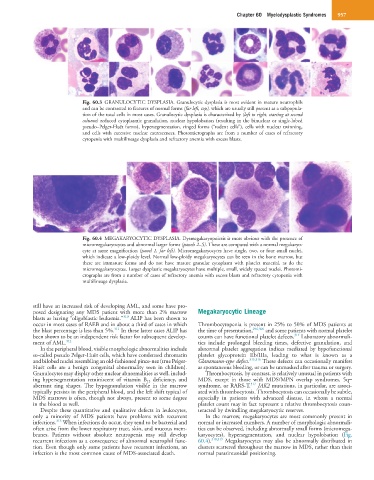
                            Fig. 60.3  GRANULOCYTIC DYSPLASIA. Granulocytic dysplasia is most evident in mature neutrophils
                            and can be contrasted to features of normal forms (far left, top), which are usually still present as a subpopula-
                            tion of the total cells in most cases. Granulocytic dysplasia is characterized by (left to right, starting at second
                            column) reduced cytoplasmic granulation, nuclear hypolobation (resulting in the binuclear or single-lobed
                            pseudo–Pelger-Huët forms), hypersegmentation, ringed forms (“rodent cells”), cells with nuclear twinning,
                            and  cells  with  excessive  nuclear  excrescences.  Photomicrographs  are  from  a  number  of  cases  of  refractory
                            cytopenia with multilineage dysplasia and refractory anemia with excess blasts.


                            Fig. 60.4  MEGAKARYOCYTIC DYSPLASIA. Dysmegakaryopoiesis is most obvious with the presence of
                            micromegakaryocytes and abnormal larger forms (panels 2–5). These are compared with a normal megakaryo-
                            cyte at same magnification (panel 1, far left). Micromegakaryocytes have single, two, or four small nuclei,
                            which indicate a low-ploidy level. Normal low-ploidy megakaryocytes can be seen in the bone marrow, but
                            these  are  immature  forms  and  do  not  have  mature  granular  cytoplasm  with  platelet  material,  as  do  the
                            micromegakaryocytes. Larger dysplastic megakaryocytes have multiple, small, widely spaced nuclei. Photomi-
                            crographs are from a number of cases of refractory anemia with excess blasts and refractory cytopenia with
                            multilineage dysplasia.


            still have an increased risk of developing AML, and some have pro-
            posed  designating  any  MDS  patient  with  more  than  2%  marrow   Megakaryocytic Lineage
                                         310
            blasts as having “oligoblastic leukemia.”  ALIP has been shown to
            occur in most cases of RAEB and in about a third of cases in which   Thrombocytopenia is present in 25% to 50% of MDS patients at
                                      311
            the blast percentage is less than 5%.  In these latter cases ALIP has   the time of presentation, 296,306  and some patients with normal platelet
                                                                                                 314
            been shown to be an independent risk factor for subsequent develop-  counts can have functional platelet defects.  Laboratory abnormali-
            ment of AML. 312                                      ties  include  prolonged  bleeding  times,  defective  granulation,  and
              In the peripheral blood, visible morphologic abnormalities include   abnormal  platelet  aggregation  indices  mediated  by  hypofunctional
            so-called pseudo Pelger-Huët cells, which have condensed chromatin   platelet  glycoprotein  IIb/IIIa,  leading  to  what  is  known  as  a
            and bilobed nuclei resembling an old-fashioned pince-nez (true Pelger-  Glanzmann-type defect. 315,316  These defects can occasionally manifest
            Huët  cells  are  a  benign  congenital  abnormality  seen  in  children).   as spontaneous bleeding, or can be unmasked after trauma or surgery.
            Granulocytes may display other nuclear abnormalities as well, includ-  Thrombocytosis, by contrast, is relatively unusual in patients with
            ing  hypersegmentation  reminiscent  of  vitamin  B 12   deficiency,  and   MDS,  except  in  those  with  MDS/MPN  overlap  syndromes,  5q−
                                                                                   317
            aberrant  ring  shapes.  The  hypogranulation  visible  in  the  marrow   syndrome, or RARS-T.  JAK2 mutations, in particular, are associ-
            typically persists in the peripheral blood, and the left shift typical of   ated with thrombocytosis. Thrombocytosis can occasionally be subtle,
            MDS marrows is often, though not always, present to some degree   especially  in  patients  with  advanced  disease,  in  whom  a  normal
            in the blood as well.                                 platelet count may in fact represent a relative thrombocytosis coun-
              Despite these quantitative and qualitative defects in leukocytes,   teracted by dwindling megakaryocytic reserves.
            only  a  minority  of  MDS  patients  have  problems  with  recurrent   In  the  marrow,  megakaryocytes  are  most  commonly  present  in
                   313
            infections.  When infections do occur, they tend to be bacterial and   normal or increased numbers. A number of morphologic abnormali-
            often arise from the lower respiratory tract, skin, and mucous mem-  ties can be observed, including abnormally small forms (micromega-
            branes.  Patients  without  absolute  neutropenia  may  still  develop   karyocytes),  hypersegmentation,  and  nuclear  hypolobation  (Fig.
            recurrent infections as a consequence of abnormal neutrophil func-  60.4). 318,319  Megakaryocytes may also be abnormally distributed in
            tion. Even though only some patients have recurrent infections, an   clusters scattered throughout the marrow in MDS, rather than their
            infection is the most common cause of MDS-associated death.  normal parasinusoidal positioning.

