


Page 1077 - Hematology_ Basic Principles and Practice ( PDFDrive )
P. 1077
960    Part VII  Hematologic Malignancies


        before the introduction of the IPSS-R, but subsequent studies have   typically  remain  transfusion  dependent,  and  management  of  iron
        suggested that the WPSS and the IPSS-R are about equal in their   overload then becomes increasingly important.
        accuracy of predicting prognosis. 342                    The  designation  of  5q−  syndrome  applies  only  to  patients  in
                                                              whom  loss  of  5q  is  the  only  cytogenetic  abnormality.  Patients  in
                                                              whom 5q− is only one of several cytogenetic aberrations in fact tend
        Specific Clinical Syndromes                           to have a worse prognosis than average, with a more rapid progression
                                                              to AML. As referenced previously, loss of 5q often occurs in tandem
        Although MDS is a heterogeneous disorder, it contains a number of   with  TP53  mutations  (or  loss  of  17p),  another  poor-prognosis
        specific entities, either defined by cytogenetics, pathologic findings,   combination. 149
        or clinical features, which possess distinctive clinical features or bio-
        logic behaviors. Some of these are discussed in more detail later.
                                                              Hypocellular Syndromes
        The 5q− Syndrome                                      Most  patients  with  MDS  have  hypercellular  or  normocellular
                                                              marrows.  Hypocellular  marrows,  in  contrast,  are  found  in  fewer
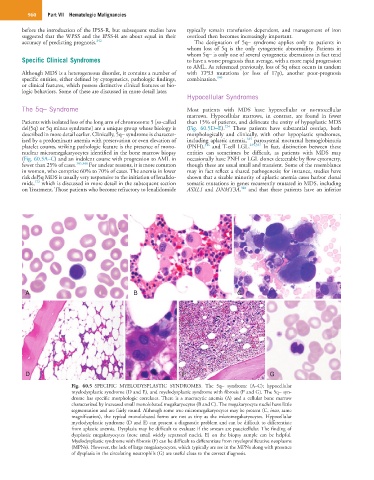
        Patients with isolated loss of the long arm of chromosome 5 [so-called   than 15% of patients, and delineate the entity of hypoplastic MDS
                                                                           224
        del(5q) or 5q minus syndrome] are a unique group whose biology is   (Fig.  60.5D–E).   These  patients  have  substantial  overlap,  both
        described in more detail earlier. Clinically, 5q− syndrome is character-  morphologically  and  clinically,  with  other  hypoplastic  syndromes,
                                                                                  345
        ized by a predominant anemia with preservation or even elevation of   including aplastic anemia,  paroxysmal nocturnal hemoglobinuria
                                                                    346
        platelet counts, striking pathologic feature is the presence of mono-  (PNH),   and T-cell  LGL. 249,347   In  fact,  distinction  between  these
        nuclear micromegakaryocytes identified in the bone marrow biopsy   entities  can  sometimes  be  difficult,  as  patients  with  MDS  may
        (Fig. 60.5A–C) and an indolent course with progression to AML in   occasionally have PNH or LGL clones detectable by flow cytometry,
        fewer than 25% of cases. 343,344  For unclear reasons, it is more common   though these are usual small and transient. Some of the resemblance
        in women, who comprise 60% to 70% of cases. The anemia in lower   may in fact reflect a shared pathogenesis; for instance, studies have
        risk del5q MDS is usually very responsive to the initiation of lenalido-  shown that a sizable minority of aplastic anemia cases harbor clonal
            173
        mide,  which is discussed in more detail in the subsequent section   somatic mutations in genes recurrently mutated in MDS, including
                                                                                348
        on Treatment. Those patients who become refractory to lenalidomide   ASXL1  and  DNMT3A,   and  that  these  patients  have  an  inferior


         A                                   B                                 C


         D                                 E                 F                           G
                        Fig.  60.5  SPECIFIC  MYELODYSPLASTIC  SYNDROMES.  The  5q−  syndrome  (A–C);  hypocellular
                        myelodysplastic syndrome (D and E), and myelodysplastic syndrome with fibrosis (F and G). The 5q− syn-
                        drome  has  specific  morphologic  correlates. There  is a macrocytic anemia (A) and  a  cellular  bone marrow
                        characterized by increased small monolobated megakaryocytes (B and C). The megakaryocyte nuclei have little
                        segmentation and are fairly round. Although some true micromegakaryocytes may be present (C, inset, same
                        magnification),  the  typical  monolobated  forms  are  not  as  tiny  as  the  micromegakaryocytes.  Hypocellular
                        myelodysplastic syndrome (D and E) can present a diagnostic problem and can be difficult to differentiate
                        from aplastic anemia. Dysplasia may be difficult to evaluate if the smears are paucicellular. The finding of
                        dysplastic  megakaryocytes  (note  small  widely  separated  nuclei,  E)  on  the  biopsy  sample  can  be  helpful.
                        Myelodysplastic syndrome with fibrosis (F) can be difficult to differentiate from myeloproliferative neoplasms
                        (MPNs). However, the lack of large megakaryocytes, which typically are see in the MPNs along with presence
                        of dysplasia in the circulating neutrophils (G) are useful clues to the correct diagnosis.

