


Page 1073 - Hematology_ Basic Principles and Practice ( PDFDrive )
P. 1073
956    Part VII  Hematologic Malignancies


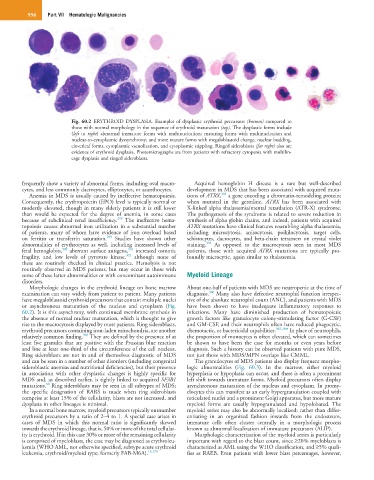
                        Fig. 60.2  ERYTHROID DYSPLASIA. Examples of dysplastic erythroid precursors (bottom) compared to
                        those with normal morphology in the sequence of erythroid maturation (top). The dysplastic forms include
                        (left  to  right)  abnormal  immature  forms  with  multinucleation;  maturing  forms  with  multinucleation  and
                        nuclear-to-cytoplasmic dyssynchrony; and more mature forms with megaloblastoid change, nuclear budding,
                        cloverleaf forms, cytoplasmic vacuolization, and cytoplasmic stippling. Ringed sideroblasts (far right) also are
                        evidence of erythroid dysplasia. Photomicrographs are from patients with refractory cytopenia with multilin-
                        eage dysplasia and ringed sideroblasts.


        frequently show a variety of abnormal forms, including oval macro-  Acquired  hemoglobin  H  disease  is  a  rare  but  well-described
        cytes, and less commonly dacrocytes, elliptocytes, or acanthocytes.  development in MDS that has been associated with acquired muta-
                                                                         304
           Anemia in MDS is usually caused by ineffective hematopoiesis.   tions of ATRX,  a gene encoding a chromatin-remodeling protein;
        Consequently, the erythropoietin (EPO) level is typically normal or   when  mutated  in  the  germline,  ATRX  has  been  associated  with
        modestly elevated, though in many elderly patients it is still lower   X-linked alpha thalassemia/mental retardation (ATR-X) syndrome.
        than  would  be  expected  for  the  degree  of  anemia,  in  some  cases   The pathogenesis of the syndrome is related to severe reduction in
                                       298
        because  of  subclinical  renal  insufficiency.  The  ineffective  hema-  synthesis of alpha globin chains, and indeed, patients with acquired
        topoiesis  causes  abnormal  iron  utilization  in  a  substantial  number   ATRX mutations have clinical features resembling alpha thalassemia,
        of  patients,  many  of  whom  have  evidence  of  iron  overload  based   including  microcytosis,  anisocytosis,  poikilocytosis,  target  cells,
                                    299
        on  ferritin  or  transferrin  saturation.   Studies  have  shown  other   schistocytes,  dacrocytes,  and  beta-chain  tetramers  on  crystal  violet
                                                                    305
        abnormalities  of  erythrocytes  as  well,  including  increased  levels  of   staining.   As  opposed  to  the  macrocytosis  seen  in  most  MDS
                                           301
                     300
        fetal hemoglobin,  aberrant surface antigens,  increased osmotic   patients,  those  with  acquired  ATRX  mutations  are  typically  pro-
                                          302
        fragility,  and  low  levels  of  pyruvate  kinase,   although  none  of   foundly microcytic, again similar to thalassemia.
        these  are  routinely  checked  in  clinical  practice.  Hemolysis  is  not
        routinely observed in MDS patients, but may occur in those with
        some of these latter abnormalities or with concomitant autoimmune   Myeloid Lineage
        disorders.
           Morphologic changes in the erythroid lineage on bone marrow   About one-half of patients with MDS are neutropenic at the time of
                                                                     306
        examination can vary widely from patient to patient. Many patients   diagnosis.  Many also have defective neutrophil function irrespec-
        have megaloblastoid erythroid precursors that contain multiple nuclei   tive of the absolute neutrophil count (ANC), and patients with MDS
        or  asynchronous  maturation  of  the  nucleus  and  cytoplasm  (Fig.   have  been  shown  to  have  inadequate  inflammatory  responses  to
        60.2). It is this asynchrony, with continued membrane synthesis in   infections.  Many  have  diminished  production  of  hematopoietic
        the absence of normal nuclear maturation, which is thought to give   growth  factors  like  granulocyte  colony-stimulating  factor  (G-CSF)
        rise to the macrocytosis displayed by most patients. Ring sideroblasts,   and GM-CSF, and their neutrophils often have reduced phagocytic,
        erythroid precursors containing iron-laden mitochondria, are another   chemotactic, or bactericidal capabilities. 307–309  In place of neutrophils,
                            303
        relatively common finding.  They are defined by the presence of at   the proportion of monocytes is often elevated, which can sometimes
        least five granules that are positive with the Prussian blue reaction   be  shown  to  have  been  the  case  for  months  or  even  years  before
        and line at least one-third of the circumference of the cell nucleus.   diagnosis. Such a history can be observed patients with pure MDS,
        Ring sideroblasts are not in and of themselves diagnostic of MDS   not just those with MDS/MPN overlaps like CMML.
        and can be seen in a number of other disorders (including congenital   The granulocytes of MDS patients also display frequent morpho-
        sideroblastic anemias and nutritional deficiencies), but their presence   logic  abnormalities  (Fig.  60.3).  In  the  marrow,  either  myeloid
        in  association  with  other  dysplastic  changes  is  highly  specific  for   hyperplasia or hypoplasia can occur, and there is often a prominent
        MDS and, as described earlier, is tightly linked to acquired SF3B1   left shift towards immature forms. Myeloid precursors often display
                88
        mutations.  Ring sideroblasts may be seen in all subtypes of MDS;   asynchronous maturation of the nucleus and cytoplasm. In promy-
        the  specific  designation  of  RARS  is  made  when  ring  sideroblasts   elocytes this can manifest as an early hypergranulation coupled with
        comprise at least 15% of the cellularity, blasts are not increased, and   reticulated nuclei and a prominent Golgi apparatus, but more mature
        dysplasia in other lineages is minimal.               myeloid  forms  are  usually  hypogranulated  and  hypolobated.  The
           In a normal bone marrow, myeloid precursors typically outnumber   myeloid series may also be abnormally localized: rather than differ-
        erythroid precursors by a ratio of 2–4 to 1. A special case arises in   entiating  in  an  organized  fashion  inwards  from  the  endosteum,
        cases  of  MDS  in  which  this  normal  ratio  is  significantly  skewed   immature  cells  often  cluster  centrally  in  a  morphologic  process
        towards the erythroid lineage, that is, 50% or more of the total cellular-  known as abnormal localization of immature precursors (ALIP).
        ity is erythroid. If in this case 30% or more of the remaining cellularity   Morphologic characterization of the myeloid series is particularly
        is comprised of myeloblasts, the case may be diagnosed as erythroleu-  important with regard to the blast count, since ≥20% myeloblasts is
        kemia (WHO AML, not otherwise specified, subtype acute erythroid   characterized as AML using the WHO classification, and ≥5% quali-
        leukemia, erythroid/myeloid type; formerly FAB-M6A). 15,170  fies as RAEB. Even patients with lower blast percentages, however,

