


Page 1075 - Hematology_ Basic Principles and Practice ( PDFDrive )
P. 1075
958    Part VII  Hematologic Malignancies

        Lymphoid Lineage                                        TABLE
                                                                60.3    Diagnostic Criteria for Myelodysplastic Syndrome
        A  number  of  abnormalities  in  the  lymphoid  lineage  have  been
        described in subsets of patients with MDS. Some patients have been   A.  Presence of at Least One Unexplained Cytopenia for at Least 6
                                                                    a
                                                               Months
        shown to have global decreases in NK cells, 226,320  some have deficient
                                228
        receptor  localization  on  B  cells,   and  some  have  abnormal T-cell   Hemoglobin <11 g/dL, or
                                                                                        9
                               227
        responses to mitogenic stimuli.  Certain types of immune functions,   Absolute neutrophil count <1.5 × 10 /L, or
        however, appear to be preserved, such as antibody-dependent cellular   Platelet count <100 × 10 /L
                                                                                9
        cytotoxicity. 321                                      plus B.  Presence of One or More MDS-Qualifying Criteria:
           The mechanism by which these abnormalities develop in MDS is   >10% dysplasia in one or more hematopoietic lineage, or
        unclear. One hypothesis proposes that they could be indirectly reflec-
        tive of shared somatic defects in a multipotent progenitor. Although   5%–19% blasts in bone marrow, or
        this has not been directly proven, it is theoretically possible given data   MDS-defining cytogenetic abnormality, such as:
        showing that most driver mutations in MDS patients are present in   t(1;3)(p36.3;q21.1)  t(2;11)(p21;q23)  inv(3)(q21;q26.2)
        the long-term hematopoietic stem cells (LT-HSC) compartment and
                                                         64
        could  therefore  be  passed  both  to  myeloid  and  lymphoid  cells.    t(3;21)(q26.2;q22.1)  −5 or del(5q)  t(6;9)(p23;q34)
        Alternatively, a number of immune functions, including both B-cell   −7 or del(7q)         del(9q)
        and T-cell diversity, diminish as a function of normal aging, 322,323  and   del(11q)  t(11;16)(q23;p13.3)  del(12p) or t(12p)
        in this context, deficiencies of immune function could develop as a   −13 or del(13q)  i(17q) or del(17p)  idic(X)(q13)
        consequence of lymphoid cells arising from and interacting with an
        abnormally aged hematopoietic niche.                   plus C.  Exclusion of Alternative Diagnoses
                                                               AML (i.e., <20% blasts, and no t(8;21), inv(16), t(16;16), t(15;17),
                                                                 or erythroleukemia) or ALL
        Other Objective Findings                               Other hematologic diseases (aplastic anemia, PNH, LGL, lymphoma,
                                                                 myelofibrosis and other MPN)
        Patients with MDS may have a variety of other laboratory abnormali-  Viral infections (HIV, EBV, parvovirus)
        ties as a consequence of their disease. Ineffective erythropoiesis may
        lead to inappropriate iron deposition, resulting in abnormally elevated   Nutritional deficiencies (iron, copper, B 12 , folate)
                                 324
        ferritin and transferrin saturation.  Nonspecific markers of cellular   Medications (methotrexate, azathioprine, isoniazid, cytotoxic
                                                 325
        turnover,  such  as  elevations  in  lactate  dehydrogenase,   uric  acid,   chemotherapy)
        and phosphate, may also be seen. Reflective of underlying immune   Alcohol or other toxins
        dysregulation,  some  patients  may  have  abnormalities  of  immuno-
        globulins  (Igs),  including  hypogammaglobulinemia,  polyclonal   Autoimmune diseases (SLE, Felty syndrome, ITP, autoimmune
        hypergammaglobulinemia, and even monoclonal gammopathies. 326,327    hemolytic anemia)
        Whether this latter phenomenon is directly related to MDS or to an   Congenital disorders (Diamond-Blackfan anemia, Shwachman-
        unrelated, early plasma cell dyscrasia has not been definitively estab-  Diamond syndrome, Fanconi anemia, and others)
        lished, and the answer may indeed be different in different patients.  a Diagnosis can be made earlier than 6 months if no other cause is apparent for
                                                               cytopenias, or there are excess blasts or an MDS-defining cytogenetic
                                                               abnormality
        DIAGNOSTIC SYSTEMS AND CLINICAL SYNDROMES              ALL, Acute lymphoblastic leukemia; AML, acute myeloid leukemia;
                                                               EBV, Epstein-Barr virus; HIV, human immunodeficiency virus; ITP, immune
                                                               thrombocytopenic purpura; LGL, large granular lymphocyte leukemia;
        As discussed throughout this chapter, MDS is heterogeneous in both   MDS, myelodysplastic syndrome; MPN, myeloproliferative neoplasm;
        morphology and clinical course, a characteristic that requires diag-  PNH, paroxysmal nocturnal hemoglobinuria; SLE, systemic lupus
        nostic  criteria  sufficiently  broad  to  capture  the  entire  spectrum  of   erythematosus.
        disease, and diagnostic criteria are typically left purposefully vague to
        allow for inclusion of patients in whom a high suspicion of MDS
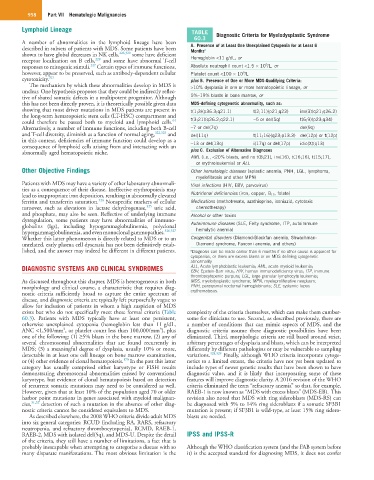
        exists but who do not specifically meet these formal criteria (Table   complexity of the criteria themselves, which can make them cumber-
        60.3).  Patients  with  MDS  typically  have  at  least  one  persistent,   some for clinicians to use. Second, as described previously, there are
        otherwise  unexplained  cytopenia  (hemoglobin  less  than  11 g/dL,   a number of conditions that can mimic aspects of MDS, and the
                                                     3
                      3
        ANC <1,500/mm , or platelet count less than 100,000/mm ), plus   diagnostic  criteria  assume  these  diagnostic  possibilities  have  been
        one of the following: (1) ≥5% blasts in the bone marrow, (2) any of   eliminated. Third, morphologic criteria are still based around strict,
        several  chromosomal  abnormalities  that  are  found  recurrently  in   arbitrary percentages of dysplasia and blasts, which can be interpreted
        MDS; (3) a meaningful degree of dysplasia, usually 10% or more,   differently by different pathologists or may be vulnerable to sampling
        detectable in at least one cell lineage on bone marrow examination,   variations. 328,329  Finally, although WHO criteria incorporate cytoge-
                                         170
        or (4) other evidence of clonal hematopoiesis.  In the past this latter   netics to a limited extent, the criteria have not yet been updated to
        category  has  usually  comprised  either  karyotype  or  FISH  results   include types of newer genetic results that have been shown to have
        demonstrating chromosomal abnormalities missed by conventional   diagnostic  value,  and  it  is  likely  that  incorporating  some  of  these
        karyotype, but evidence of clonal hematopoiesis based on detection   features will improve diagnostic clarity. A 2016 revision of the WHO
        of recurrent somatic mutations may need to be considered as well.   criteria eliminated the term “refractory anemia” so that, for example,
        However, given that at least 10% of the population aged 70 or older   RAEB-1 is now known as “MDS with excess blasts” (MDS-EB).  This
        harbor point mutations in genes associated with myeloid malignan-  revision also noted that MDS with ring sideroblasts (MDS-RS) can
        cies, 31,32  detection of such a mutation in the absence of other diag-  be diagnosed with 5% to 14% ring sideroblasts if a somatic SF3B1
        nostic criteria cannot be considered equivalent to MDS.  mutation is present; if SF3B1 is wild-type, at least 15% ring sidero-
           As described elsewhere, the 2008 WHO criteria divide adult MDS   blasts are needed.
        into six general categories: RCUD (including RA, RARS, refractory
        neutropenia, and refractory  thrombocytopenia), RCMD,  RAEB-1,
        RAEB-2, MDS with isolated del(5q), and MDS-U. Despite the detail   IPSS and IPSS-R
        of the criteria, they still have a number of limitations, a fact that is
        probably inescapable when attempting to categorize a disease with so   Although the WHO classification system (and the FAB system before
        many disparate manifestations. The most obvious limitation is the   it) is the accepted standard for diagnosing MDS, it does not confer

