


Page 1076 - Hematology_ Basic Principles and Practice ( PDFDrive )
P. 1076
Chapter 60  Myelodysplastic Syndromes  959


             TABLE   1997 International Prognostic Scoring System for   TABLE   2012 Revised International Prognostic Scoring
              60.4   Myelodysplastic Syndromes (IPSS)               60.6   System for Myelodysplastic Syndrome (IPSS-R)
                                           Score                   Cytogenetic   Included Karyotypic Abnormalities
                                                                   Risk
             Variable        0       0.5         1      1.5        Very good  del(11q), −Y
             Marrow blasts (%)  <5   5–10        –      11–20      Good       Normal, del(20q), del(5q) alone or +1 other
             Karyotype       Good    Intermediate  Poor  –                      abnormality, del(12p)
             Cytopenias      0–1     2–3         –      –          Intermediate  +8, del(7q), i(17q), +19, +21
                                                                              Any other single or double abnormality
                                                                              Two or more independent clones
                                                                   Poor       der(3q), −7, double with del(7q), complex with
             TABLE   Survival Based on International Prognostic Scoring         exactly 3 abnormalities
              60.5   System for Myelodysplastic Syndromes (Percent)
                                                                   Very poor  Complex with >3 abnormalities
             IPSS Risk Group  # Patients  2 Years  5 Years  10 Years  15 Years  Scoring Table
             Low         267 (33%)  85     55     28     20        Parameter  Category/Score
                                                                   Cytogenetic   Very good  Good  Intermediate  Poor  Very poor
             Intermediate-1  314 (38%  70  35     17     12
                                                                     risk     0       1       2         3    4
             Intermediate-2  179 (22%)  30  8      0      –
                                                                   Marrow blasts   ≤2  3–4    5–10      >10
             High         56 (7%)    5     0      –       –          (%)      0       1       2         3
                                                                   Hemoglobin   ≥10   8–9.9   <8
                                                                     (g/dL)   0       1       1.5
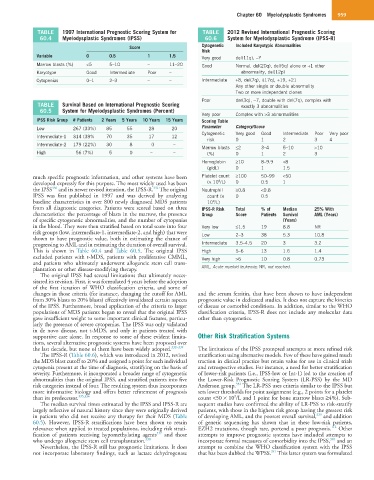
            much specific prognostic information, and other systems have been   Platelet count  ≥100  50–99  <50
                                                                         9
            developed expressly for this purpose. The most widely used has been   (× 10 /L)  0  0.5  1
                                                   331
                  330
            the IPSS  and its newer revised iteration, the IPSS-R.  The original   Neutrophil   ≥0.8  <0.8
            IPSS  was  first  published  in  1997  and  was  derived  by  analyzing   count (×   0  0.5
            baseline characteristics in over 800 newly diagnosed MDS patients   10 /L)
                                                                       9
            from all diagnostic categories. Patients were scored based on three   IPSS-R Risk   Total   % of   Median   25% With
            characteristics: the percentage of blasts in the marrow, the presence   Group  Score  Patients  Survival   AML (Years)
            of specific cytogenetic abnormalities, and the number of cytopenias               (Years)
            in the blood. They were then stratified based on total score into four   Very low  ≤1.5  19  8.8  NR
            risk groups (low, intermediate-1, intermediate-2, and high) that were   Low  2–3  38  5.3   10.8
            shown to have prognostic value, both in estimating the chance of
            progressing to AML and in estimating the duration of overall survival.   Intermediate  3.5–4.5  20  3  3.2
            This  is  shown  in  Table  60.4  and  Table  60.5.  The  original  IPSS   High  5–6  13  1.6  1.4
            excluded patients with t-MDS, patients with proliferative CMML,   Very high  >6  10  0.8    0.73
            and  patients  who  ultimately  underwent  allogeneic  stem  cell  trans-
            plantation or other disease-modifying therapy.         AML, Acute myeloid leukemia; NR, not reached.
              The original IPSS had several limitations that ultimately neces-
            sitated its revision. First, it was formulated 4 years before the adoption
            of  the  first  iteration  of  WHO  classification  criteria,  and  some  of
            changes in those criteria (for instance, changing the cutoff for AML   and the serum ferritin, that have been shown to have independent
            from 30% blasts to 20% blasts) effectively invalidated certain aspects   prognostic value in dedicated studies. It does not capture the kinetics
            of the IPSS. Furthermore, broad application of the criteria to larger   of disease or comorbid conditions. In addition, similar to the WHO
            populations of MDS patients began to reveal that the original IPSS   classification  criteria,  IPSS-R  does  not  include  any  molecular  data
            gave insufficient weight to some important clinical features, particu-  other than cytogenetics.
            larly the presence of severe cytopenias. The IPSS was only validated
            in de novo disease, not t-MDS, and only in patients treated with
            supportive care alone. In response to some of these evident limita-  Other Risk Stratification Systems
            tions, several alternative prognostic systems have been proposed over
            the last decade, but none of them have been widely adopted. 332–334  The limitations of the IPSS prompted attempts at more refined risk
              The IPSS-R (Table 60.6), which was introduced in 2012, revised   stratification using alternative models. Few of these have gained much
            the MDS blast cutoff to 20% and assigned a point for each individual   traction in clinical practice but retain value for use in clinical trials
            cytopenia present at the time of diagnosis, stratifying on the basis of   and retrospective studies. For instance, a need for better stratification
            severity. Furthermore, it incorporated a broader range of cytogenetic   of lower-risk patients (i.e., IPSS-low or Int-1) led to the creation of
            abnormalities than the original IPSS, and stratified patients into five   the  Lower-Risk  Prognostic  Scoring  System  (LR-PSS)  by  the  MD
                                                                              332
            risk categories instead of four. The resulting system thus incorporates   Anderson group.  The LR-PSS uses criteria similar to the IPSS but
            more informative biology and offers better refinement of prognosis   sets lower thresholds for point assignment (e.g., 2 points for a platelet
                                                                              9
            than its predecessor. 335,336                         count <50 × 10 /L and 1 point for bone marrow blasts ≥4%). Sub-
              The median survival times estimated by the IPSS and IPSS-R are   sequent studies have confirmed the ability of LR-PSS to risk-stratify
            largely reflective of natural history since they were originally derived   patients, with those in the highest risk group having the greatest risk
                                                                                                         339
            in patients who did not receive any therapy for their MDS (Table   of developing AML, and the poorest overall survival,  and addition
            60.5).  However,  IPSS-R  stratifications  have  been  shown  to  retain   of  genetic  sequencing  has  shown  that  in  these  low-risk  patients,
                                                                                                             112
            relevance when applied to treated populations, including risk strati-  EZH2 mutations, though rare, portend a poor prognosis.  Other
                                                    337
            fication  of  patients  receiving  hypomethylating  agents   and  those   attempts to improve prognostic systems have included attempts to
                                                                                                             340
            who undergo allogeneic stem cell transplantation. 338  incorporate formal measures of comorbidity into the IPSS,  and an
              Nevertheless, the IPSS-R still has prognostic limitations. It does   attempt to combine the WHO classification system with the IPSS
                                                                                          341
            not  incorporate  laboratory  findings,  such  as  lactate  dehydrogenase   that has been dubbed the WPSS.  This latter system was formulated

