


Page 1101 - Hematology_ Basic Principles and Practice ( PDFDrive )
P. 1101
Chapter 61  Allogeneic Hematopoietic Stem Cell Transplantation for Acute Myeloid Leukemia and Myelodysplastic Syndrome in Adults  971


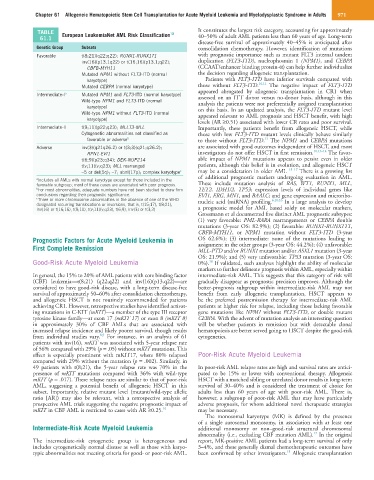
             TABLE   European LeukemiaNet AML Risk Classification 10  It constitutes the largest risk category, accounting for approximately
              61.1                                                40–50% of adult AML patients less than 60 years of age. Long-term
                                                                  disease-free  survival  of  approximately  40–45%  is  anticipated  after
             Genetic Group  Subsets                               consolidation  chemotherapy.  However,  identification  of  mutations
             Favorable      t(8;21)(q22;q22); RUNX1-RUNX1T1       with prognostic importance such as mutant FLT3 internal tandem
                            inv(16)(p13.1q22) or t(16;16)(p13.1;q22);   duplication  (FLT3-ITD),  nucleophosmin  1  (NPM1),  and  CEBPA
                             CBFB-MYH11                           (CCAAT/enhancer binding protein-α) can help further individualize
                            Mutated NPM1 without FLT3-ITD (normal   the decision regarding allogeneic transplantation.
                             karyotype)                             Patients  with  FLT3-ITD  have  inferior  survivals  compared  with
                                                                                      10,11
                            Mutated CEBPA (normal karyotype)      those  without  FLT3-ITD.    The  negative  impact  of  FLT3-ITD
                                                                  appeared  abrogated  by  allogeneic  transplantation  in  CR1  when
             Intermediate-I a  Mutated NPM1 and FLT3-ITD (normal karyotype)  assessed on an ITT donor versus no-donor basis, although in this
                            Wild-type NPM1 and FLT3-ITD (normal   analysis the patients were not preferentially assigned transplantation
                             karyotype)                           on  this  basis.  In  an  updated  analysis,  the  FLT3-ITD  mutant  level
                            Wild-type NPM1 without FLT3-ITD (normal   appeared relevant to AML prognosis and HSCT benefit, with high
                              karyotype)
                                                                  levels (AR ≥0.51) associated with lower CR rates and poor survival.
             Intermediate-II  t(9;11)(p22;q23); MLLT3-MLL         Importantly,  these  patients  benefit  from  allogeneic  HSCT,  while
                            Cytogenetic abnormalities not classified as   those with low FLT3-ITD mutant levels clinically behave similarly
                              favorable or adverse b              to  those  without  FLT3-ITD.  The  NPM1  and  CEBPA  mutations
                                                                                        12
             Adverse        inv(3)(q21q26.2) or t(3;3)(q21;q26.2);   are associated with good outcomes independent of HSCT, and most
                                                                                                        10,12–14
                             RPN1-EVI1                            investigators do not offer HSCT in first remission.   The favor-
                            t(6;9)(p23;q34); DEK-NUP214           able  impact  of  NPM1  mutations  appears  to  persist  even  in  older
                            t(v;11)(v;q23); MLL rearranged        patients, although this belief is in evolution, and allogeneic HSCT
                                                                                                15–17
                            −5 or del(5q); −7; abnl(17p); complex karyotype c  may be a consideration in older AML    There is a growing list
                                                                  of  additional  prognostic  markers  undergoing  evaluation  in  AML.
             a Includes all AMLs with normal karyotype except for those included in the
             favorable subgroup; most of these cases are associated with poor prognosis.  These  include  mutation  analysis  of  RAS,  WT1,  RUNX1,  MLL,
             b For most abnormalities, adequate numbers have not been studied to draw firm   TET2,  IDH1/2,  TP53;  expression  levels  of  individual  genes  like
             conclusions regarding their prognostic significance.  EVI1, ERG, MN1, and BAALC; and gene expression and microribo-
             c Three or more chromosome abnormalities in the absence of one of the WHO   nucleic acid (miRNA) profiling. 6,10,16  In a large analysis to develop
             designated recurring translocations or inversions, that is, t(15;17), t(8;21),
             inv(16) or t(16;16), t(9;11), t(v;11)(v;q23), t(6;9), inv(3) or t(3;3)  a  prognostic  model  for  AML  based  solely  on  molecular  markers,
                                                                  Grossmann et al documented five distinct AML prognostic subtypes:
                                                                  (1)  very  favorable:  PML-RARA  rearrangements  or  CEBPA  double
                                                                  mutations (3-year OS: 82.9%); (2) favorable: RUNX1-RUNX1T1,
                                                                  CBFB-MYH11,  or  NPM1  mutation  without  FLT3-ITD  (3-year
            Prognostic Factors for Acute Myeloid Leukemia in      OS  62.6%);  (3)  intermediate:  none  of  the  mutations  leading  to
            First Complete Remission                              assignment in the other groups (3-year OS: 44.2%); (4) unfavorable:
                                                                  MLL-PTD and/or RUNX1 mutation and/or ASXL1 mutation (3-year
                                                                  OS: 21.9%); and (5) very unfavorable: TP53 mutation (3-year OS:
            Good-Risk Acute Myeloid Leukemia                      0%).  If validated, such analyses highlight the ability of molecular
                                                                     18
                                                                  markers to further delineate prognosis within AML, especially within
            In general, the 15% to 20% of AML patients with core binding factor   intermediate-risk AML. This suggests that this category of risk will
            (CBF)  leukemia—t(8;21)  (q22;q22)  and  inv(16)(p13.q22)—are   gradually disappear as prognostic precision improves. Although the
            considered to have good-risk disease, with a long-term disease-free   better-prognosis  subgroup  within  intermediate-risk  AML  may  not
            survival of approximately 50–60% after consolidation chemotherapy,   benefit  from  early  allogeneic  transplantation,  HSCT  appears  to
            and  allogeneic  HSCT  is  not  routinely  recommended  for  patients   be  the  preferred  postremission  therapy  for  intermediate-risk  AML
            achieving CR1. However, retrospective studies have identified activat-  patients at higher risk for relapse, including those lacking favorable
            ing mutations in C-KIT (mKIT)—a member of the type III receptor   gene mutations like NPM1 without FLT3-ITD, or double mutant
            tyrosine kinase family—at exon 17 (mKIT 17) or exon 8 (mKIT 8)   CEBPA. With the advent of mutation analysis an interesting question
            in  approximately  30%  of  CBF  AMLs  that  are  associated  with   will  be  whether  patients  in  remission  but  with  detectable  clonal
            increased relapse incidence and likely poorer survival, though results   hematopoiesis are better served going to HSCT despite the good-risk
                                  8,9
            from  individual  studies  vary.   For  instance,  in  an  analysis  of  61   cytogenetics.
            patients with inv(16), mKIT was associated with 5-year relapse rate
            of 56% compared with 29% (p = .05) without mKIT mutations. This
            effect  is  especially  prominent  with  mKIT17,  where  80%  relapsed   Poor-Risk Acute Myeloid Leukemia
            compared with 29% without the mutation (p = .002). Similarly, in
            49  patients  with  t(8;21),  the  5-year  relapse  rate  was  70%  in  the   In poor-risk AML relapse rates are high and survival rates are antici-
            presence  of  mKIT  mutations  compared  with  36%  with  wild-type   pated  to  be  15%  or  lower  with  conventional  therapy.  Allogeneic
            mKIT (p = .017). These relapse rates are similar to that of poor-risk   HSCT with a matched sibling or unrelated donor results in long-term
            AML,  suggesting  a  potential  benefit  of  allogeneic  HSCT  in  this   survival  of  30–40%  and  is  considered  the  treatment  of  choice  for
            subset.  Importantly,  relative  mutant  level  (mutant/wild-type  allelic   adults  less  than  60  years  of  age  with  poor-risk  AML.  There  is,
            ratio  [AR])  may  also  be  relevant,  with  a  retrospective  analysis  of   however, a subgroup of poor-risk AML that may have particularly
            prospective AML trials suggesting the negative prognostic impact of   adverse prognosis, for whom additional novel therapeutic strategies
            mKIT in CBF AML is restricted to cases with AR ≥0.25. 10  may be necessary.
                                                                    The  monosomal  karyotype  (MK)  is  defined  by  the  presence
                                                                  of  a  single  autosomal  monosomy,  in  association  with  at  least  one
            Intermediate-Risk Acute Myeloid Leukemia              additional  monosomy  or  non–good-risk  structural  chromosomal
                                                                                                        17
                                                                  abnormality (i.e., excluding CBF mutation AML).  In the original
            The  intermediate-risk  cytogenetic  group  is  heterogeneous  and   report, MK-positive AML patients had a long-term survival of only
            includes cytogenetically normal disease as well as those with karyo-  3–4%, and these generally dismal chemotherapeutic outcomes have
                                                                                               18
            typic abnormalities not meeting criteria for good- or poor-risk AML.   been confirmed by other investigators.  Allogeneic transplantation

