


Page 1105 - Hematology_ Basic Principles and Practice ( PDFDrive )
P. 1105
Chapter 61  Allogeneic Hematopoietic Stem Cell Transplantation for Acute Myeloid Leukemia and Myelodysplastic Syndrome in Adults  975


                  100                                                100
                                          1970-79   1995-99           75                      1970-79   1995-99
                 Survival still alive (%)  50  53  43  1990-95  29  Survival still alive (%)  50  1990-95
                                                                                                        2000-04
                                                    2000-04
                                          1980-84
                                                                                              1980-84
                   75
                                                                                              1985-89
                                                    2005-09
                                                                                                        2005-09
                                          1985-89
                                            35
                   25
                                                                      25
                                                             5
                    0                                  23    15        0        23     10      7     4  2       2 1
                      0      5       10     15      20     25            0       5      10     15      20      25
                A                Time from entry (years)           B                Time from entry (years)
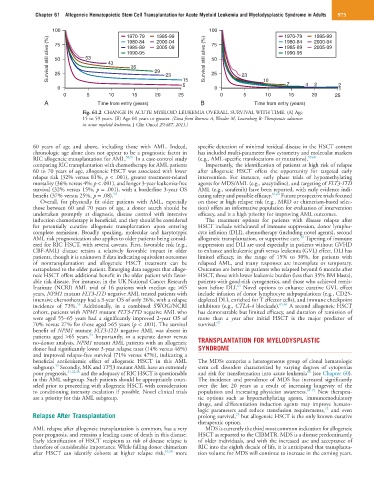
                            Fig. 61.2  CHANGE IN ACUTE MYELOID LEUKEMIA OVERALL SURVIVAL WITH TIME. (A) Age
                            15 to 59 years. (B) Age 60 years or greater. (Data from Burnett A, Wetzler M, Lowenberg B: Therapeutic advances
                            in acute myeloid leukemia, J Clin Oncol 29:487, 2011.)
            60  years  of  age  and  above,  including  those  with  AML.  Indeed,   specific detection of minimal residual disease in the HSCT context
            chronologic age alone does not appear to be a prognostic factor in   has included multi-parameter flow cytometry and molecular markers
            RIC allogeneic transplantation for AML. 50,51  In a case-control study   (e.g., AML-specific translocations or mutations). 59,60
            comparing RIC transplantation with chemotherapy for AML patients   Importantly, the identification of patients at high risk of relapse
            60 to 70 years of age, allogeneic HSCT was associated with lower   after  allogeneic  HSCT  offers  the  opportunity  for  targeted  early
            relapse risk (32% versus 81%, p < .001), greater treatment-related   intervention.  For  instance,  early  phase  trials  of  hypomethylating
            mortality (36% versus 4%; p < .001), and longer 3-year leukemia-free   agents for MDS/AML (e.g., azacytidine), and targeting of FLT3-ITD
            survival (32% versus 15%, p = .001), with a borderline 3-year OS   AML (e.g., sorafenib) have been reported, with early evidence indi-
            benefit (37% versus 25%, p = .08). 52                 cating safety and possible efficacy. 61,62  Future prospective trials focused
              Overall,  for  physically  fit  older  patients  with  AML,  especially   on those at high relapse risk (e.g., MRD or chimerism-based selec-
            those  between  60  and  70  years  of  age,  a  donor  search  should  be   tion) offers an informative population for evaluation of intervention
            undertaken  promptly  at  diagnosis,  disease  control  with  intensive   efficacy, and is a high priority for improving AML outcomes.
            induction chemotherapy is beneficial, and they should be considered   The  treatment  options  for  patients  with  disease  relapse  after
            for  potentially  curative  allogeneic  transplantation  upon  entering   HSCT include withdrawal of immune suppression, donor lympho-
            complete  remission.  Broadly  speaking,  molecular  and  karytotypic   cyte infusion (DLI), chemotherapy (including novel agents), second
                                                                                                   63
            AML risk prognostication also applies to older patients being consid-  allogeneic transplantation, or supportive care.  Tapering of immune
            ered for RIC HSCT, with several caveats. First, favorable risk (e.g.,   suppression and DLI are used especially in patients without GVHD
            CBF-AML)  disease  retains  a  relatively  favorable  impact  in  older   to enhance antileukemic graft versus leukemia (GVL) effect. DLI has
            patients, though it is unknown if data indicating equivalent outcomes   limited  efficacy,  in  the  range  of  15%  to  30%,  for  patients  with
            of  nontransplantation  and  allogeneic  HSCT  treatment  can  be   relapsed  AML,  and  many  responses  are  incomplete  or  temporary.
            extrapolated to the older patient. Emerging data suggests that alloge-  Outcomes are better in patients who relapsed beyond 6 months after
            neic HSCT offers additional benefit in the older patient with favor-  HSCT, those with lower leukemic burden (less than 35% BM blasts),
            able risk disease. For instance, in the UK National Cancer Research   patients with good-risk cytogenetics, and those who achieved remis-
                                                                               64
            Institute  (NCRI)  AML  trial  of  16  patients  with  median  age  >65   sion  before  DLI.   Novel  options  to  enhance  curative  GVL  effect
            years, NPM1 mutant FLT3-ITD negative AML treated patients with   include infusion of donor lymphocyte subpopulations (e.g., CD25-
            intensive chemotherapy had a 3-year OS of only 26%, with a relapse   depleted DLI, enriched for T effector cells), and immune checkpoint
                          53
            incidence  of  73%.   Additionally,  in  a  combined  SWOG/NCRI   inhibitors (e.g., CTLA-4 blockade). 65,66  A second allogeneic HSCT
            cohort, patients with NPM1 mutant FLT3-ITD negative AML who   has demonstrable but limited efficacy, and duration of remission of
            were aged 55−65 years had a significantly improved 2-year OS of   more  than  a  year  after  initial  HSCT  is  the  major  predictor  of
            70% versus 27% for those aged >65 years (p < .001). The survival   survival. 67
            benefit of NPM1 mutant FLT3-ITD negative AML was absent in
                              54
            patients  aged  >65  years.   Importantly,  in  a  separate  donor  versus
            no-donor analysis, NPM1 mutant AML patients with an allogeneic   TRANSPLANTATION FOR MYELODYSPLASTIC
            donor had significantly lower 3-year relapse rates (14% versus 46%)   SYNDROME
            and improved relapse-free survival (71% versus 47%), indicating a
            beneficial  antileukemic  effect  of  allogeneic  HSCT  in  this  AML   The MDSs comprise a heterogeneous group of clonal hematologic
                   55
            subgroup.  Secondly, MK and TP53 mutant AML have an extremely   stem  cell  disorders  characterized  by  varying  degrees  of  cytopenias
                                                                                                     68
            poor prognosis, 21,22,56  and the adequacy of RIC HSCT is questionable   and risk for transformation into acute leukemia  (see Chapter 60).
            in this AML subgroup. Such patients should be appropriately coun-  The  incidence  and  prevalence  of  MDS  has  increased  significantly
            seled prior to proceeding with allogeneic HSCT, with consideration   over  the  last  20  years  as  a  result  of  increasing  longevity  of  the
            to conditioning intensity escalation if possible. Novel clinical trials   population and increasing physician awareness. 69–71  New therapeu-
            are a priority for this AML subgroup.                 tic  options  such  as  hypomethylating  agents,  immunomodulatory
                                                                  drugs,  and  differentiation  induction  agents  may  improve  hemato-
                                                                                                           72
                                                                  logic  parameters  and  reduce  transfusion  requirements,   and  even
            Relapse After Transplantation                         prolong survival,  but allogeneic HSCT is the only known curative
                                                                              73
                                                                  therapeutic option.
            AML relapse after allogeneic transplantation is common, has a very   MDS is currently the third most common indication for allogeneic
            poor prognosis, and remains a leading cause of death in this disease.   HSCT as reported to the CIBMTR. MDS is a disease predominantly
            Early identification of HSCT recipients at risk of disease relapse is   of older individuals, and with the increased use and acceptance of
            therefore of considerable importance. While falling donor chimerism   RIC into the eighth decade of life, it is anticipated that transplanta-
            after  HSCT  can  identify  cohorts  at  higher  relapse  risk, 57,58   more   tion volume for MDS will continue to increase in the coming years.

