


Page 1102 - Hematology_ Basic Principles and Practice ( PDFDrive )
P. 1102
972    Part VII  Hematologic Malignancies


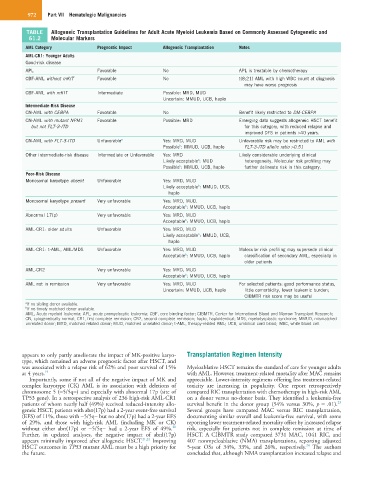
          TABLE   Allogeneic Transplantation Guidelines for Adult Acute Myeloid Leukemia Based on Commonly Assessed Cytogenetic and
          61.2    Molecular Markers
         AML Category            Prognostic Impact    Allogeneic Transplantation  Notes
         AML-CR1: Younger Adults
         Good-risk disease
         APL                     Favorable            No                       APL is treatable by chemotherapy
         CBF-AML without mKIT    Favorable            No                       t(8;21) AML with high WBC count at diagnosis
                                                                                 may have worse prognosis
         CBF-AML with mKIT       Intermediate         Possible: MRD, MUD
                                                      Uncertain: MMUD, UCB, haplo
         Intermediate-Risk Disease
         CN-AML with CEBPA       Favorable            No                       Benefit likely restricted to DM-CEBPA
         CN-AML with mutant NPM1   Favorable          Possible: MRD            Emerging data suggests allogeneic HSCT benefit
           but not FLT-3-ITD                                                     for this category, with reduced relapse and
                                                                                 improved DFS in patients >40 years.
         CN-AML with FLT-3-ITD   Unfavorable a        Yes: MRD, MUD            Unfavorable risk may be restricted to AML with
                                                      Possible : MMUD, UCB, haplo  FLT-3-ITD allelic ratio >0.51
                                                            b
         Other intermediate-risk disease  Intermediate or Unfavorable  Yes: MRD  Likely considerable underlying clinical
                                                                  a
                                                      Likely acceptable : MUD    heterogeneity. Molecular risk profiling may
                                                      Possible : MMUD, UCB, haplo  further delineate risk in this category.
                                                            b
         Poor-Risk Disease
         Monosomal karyotype absent  Unfavorable      Yes: MRD, MUD
                                                      Likely acceptable : MMUD, UCB,
                                                                  b
                                                        haplo
         Monosomal karyotype present  Very unfavorable  Yes: MRD, MUD.
                                                      Acceptable : MMUD, UCB, haplo
                                                              b
         Abnormal 17(p)          Very unfavorable     Yes: MRD, MUD
                                                      Acceptable : MMUD, UCB, haplo
                                                              b
         AML-CR1: older adults   Unfavorable          Yes: MRD, MUD
                                                      Likely acceptable : MMUD, UCB,
                                                                  b
                                                        haplo
         AML-CR1: t-AML, AML/MDS  Unfavorable         Yes: MRD, MUD            Molecular risk profiling may supersede clinical
                                                      Acceptable : MMUD, UCB, haplo  classification of secondary AML, especially in
                                                              b
                                                                                 older patients
         AML-CR2                 Very unfavorable     Yes: MRD, MUD
                                                              b
                                                      Acceptable : MMUD, UCB, haplo
         AML not in remission    Very unfavorable     Yes: MRD, MUD            For selected patients: good performance status,
                                                      Uncertain: MMUD, UCB, haplo  little comorbidity, lower leukemic burden;
                                                                                 CIBMTR risk score may be useful
         a If no sibling donor available.
         b If no timely matched donor available.
         AML, Acute myeloid leukemia; APL, acute promyelocytic leukemia; CBF, core binding factor; CIBMTR, Center for International Blood and Marrow Transplant Research;
         CN, cytogenetically normal; CR1, first complete remission; CR2, second complete remission; haplo, haploidentical; MDS, myelodysplastic syndrome; MMUD, mismatched
         unrelated donor; MRD, matched related donor; MUD, matched unrelated donor; t-AML, therapy-related AML; UCB, umbilical cord blood; WBC, white blood cell.


        appears to only partly ameliorate the impact of MK-positive karyo-  Transplantation Regimen Intensity
        type, which remained an adverse prognostic factor after HSCT, and
        was associated with a relapse risk of 62% and poor survival of 15%   Myeloablative HSCT remains the standard of care for younger adults
        at 4 years. 19                                        with AML. However, treatment-related mortality after MAC remains
           Importantly, some if not all of the negative impact of MK and   appreciable. Lower-intensity regimens offering less treatment-related
        complex  karyotype  (CK)  AML  is  its  association  with  deletions  of   toxicity  are  increasing  in  popularity.  One  report  retrospectively
        chromosome 5 (−5/5q−) and especially with abnormal 17p (site of   compared RIC transplantation with chemotherapy in high-risk AML
        TP53 gene). In a retrospective analysis of 236 high-risk AML-CR1   on a donor versus no-donor basis. They identified a leukemia-free
                                                                                                               23
        patients of whom nearly half (49%) received reduced-intensity allo-  survival benefit in the donor group (54% versus 30%, p = .01).
        geneic HSCT, patients with abn(17p) had a 2-year event-free survival   Several  groups  have  compared  MAC  versus  RIC  transplantation,
        (EFS) of 11%, those with −5/5q− but no abn(17p) had a 2-year EFS   documenting similar overall and leukemia-free survival, with some
        of  29%,  and  those  with  high-risk  AML  (including  MK  or  CK)   reporting lower treatment-related mortality offset by increased relapse
                                                         20
        without  either  abn(17p)  or  −5/5q−  had  a  2-year  EFS  of  49%.    risk,  especially  for  patients  not  in  complete  remission  at  time  of
        Further,  in  updated  analyses,  the  negative  impact  of  abnl(17p)   HSCT. A CIBMTR study compared 3731 MAC, 1041 RIC, and
        appears minimally improved after allogeneic HSCT. 21,22  Improving   407  nonmyeloablative  (NMA)  transplantations,  reporting  adjusted
                                                                                                     24
        HSCT outcomes in TP53 mutant AML must be a high priority for   5-year  OSs  of  34%,  33%,  and  26%,  respectively.   The  authors
        the future.                                           concluded that, although NMA transplantation increased relapse and

