


Page 1103 - Hematology_ Basic Principles and Practice ( PDFDrive )
P. 1103
Chapter 61  Allogeneic Hematopoietic Stem Cell Transplantation for Acute Myeloid Leukemia and Myelodysplastic Syndrome in Adults  973


                                                 No. of patients
                                               Donor   No-donor                              Favors     Favors
            Source                             group     group   No. of trials  HR (95% Cl)  donor group no-donor group
                      1
              Shiller et al,  1992              28        54              1.91 (0.95-3.84)
                          2
              Archimbaud et al,  1994           27        31              1.04 (0.52-2.11)
              Hewlett et al,  1995              53        110             0.98 (0.65-1.49)
                       3
              Sierra et al,  1996               47        68              1.60 (0.96-2.65)
                      4
                       5
              Keating et al,  1998              295       377             0.88 (0.72-1.09)
                       6
              Slovak et al,  2000               89        174             0.82 (0.57-1.18)
                      7
              Suciu et al,  2003                293       441             0.85 (0.67-1.08)
                        8
              Jourdan et al,  2005              182       290             0.81 (0.63-1.05)
              Burnett et al,  2006              428       877             0.87 (0.74-1.03)
                       9
                          10
              Cornelissan et al,  2007          326       599             0.89 (0.74-1.08)
              Overall survival benefit (fixed effects)  1768  3021  15    0.90 (0.82-0.97)
            Sensitivity analyses for overall survival
            benefit for AML in first remission
              Random effects meta-analysis     1768      3021       15    0.90 (0.82-1.00)
              Adjusted HR                      1768      3021       15    0.89 (0.81-0.97)
              Including cytogenetic risk-stratified trials  2057  3549  21  0.87 (0.80-0.94)
              (fixed effects)
              Including cytogenetic risk-stratified trials  2057  3549  21  0.87 (0.78-0.98)
              (random effects)
              Including cytogenetic risk-stratified trials  2057  3549  21  0.86 (0.79-0.93)
              (adjusted HR)
            Overall survival benefit by cytogenetic risk
              Good-risk AML                     188       359       10    1.07 (0.83-1.38)
              Intermediate-risk AML             864      1635       14    0.83 (0.74-0.93)
              Poor-risk AML                     226       366       14    0.73 (0.59-0.90)
                               2
              Test for heterogeneity: χ  = 5.29; P = .07;
                                2
               2
              J  = 62.2%
                                                                                     0.1           1.0            10
                                                                                             Death, HR (95% Cl)
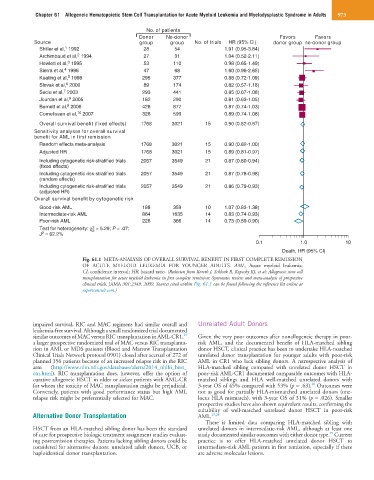
                            Fig. 61.1  META-ANALYSIS OF OVERALL SURVIVAL BENEFIT IN FIRST COMPLETE REMISSION
                            OF  ACUTE  MYELOID  LEUKEMIA  FOR  YOUNGER  ADULTS.  AML,  Acute  myeloid  leukemia;
                            CI, confidence interval; HR, hazard ratio. (Redrawn from Koreth J, Schlenk R, Kopecky KJ, et al: Allogeneic stem cell
                            transplantation for acute myeloid leukemia in first complete remission: Systematic review and meta-analysis of prospective
                            clinical trials, JAMA 301:2349, 2009. Sources cited within Fig. 61.1 can be found following the reference list online at
                            expertconsult.com.)


            impaired survival, RIC and MAC regimens had similar overall and   Unrelated Adult Donors
            leukemia-free survival. Although a small randomized trial documented
                                                             25
            similar outcomes of MAC versus RIC transplantation in AML-CR1,    Given the very poor outcomes after nonallogeneic therapy in poor-
            a larger prospective randomized trial of MAC versus RIC transplanta-  risk  AML,  and  the  documented  benefit  of  HLA-matched  sibling
            tion in AML or MDS patients (Blood and Marrow Transplantation   donor HSCT, clinical practice has been to undertake HLA-matched
            Clinical Trials Network protocol 0901) closed after accrual of 272 of   unrelated  donor  transplantation  for  younger  adults  with  poor-risk
            planned 356 patients because of an increased relapse risk in the RIC   AML in CR1 who lack sibling donors. A retrospective analysis of
            arm   (http://www.nlm.nih.gov/databases/alerts/2014_nhlbi_bmt_  HLA-matched  sibling  compared  with  unrelated  donor  HSCT  in
            ctn.html).  RIC  transplantation  does,  however,  offer  the  option  of   poor-risk AML-CR1 documented comparable outcomes with HLA-
            curative allogeneic HSCT in older or sicker patients with AML-CR   matched  siblings  and  HLA  well-matched  unrelated  donors  with
                                                                                                       26
            for whom the toxicity of MAC transplantation might be prejudicial.   3-year OS of 45% compared with 53% (p = .63).  Outcomes were
            Conversely,  patients  with  good  performance  status  but  high  AML   not as good for partially HLA-mismatched unrelated donors (one-
            relapse risk might be preferentially selected for MAC.  locus HLA mismatch), with 3-year OS of 31% (p = .026). Smaller
                                                                  prospective studies have also shown equivalent results, confirming the
                                                                  suitability  of  well-matched  unrelated  donor  HSCT  in  poor-risk
            Alternative Donor Transplantation                     AML. 27,28
                                                                    There  is  limited  data  comparing  HLA-matched  sibling  with
            HSCT from an HLA-matched sibling donor has been the standard   unrelated  donors  in  intermediate-risk  AML,  although  at  least  one
                                                                                                             29
            of care for prospective biologic treatment assignment studies evaluat-  study documented similar outcomes with either donor type.  Current
            ing postremission therapies. Patients lacking sibling donors could be   practice  is  to  offer  HLA-matched  unrelated  donor  HSCT  to
            considered for alternative donors: unrelated adult donors, UCB, or   intermediate-risk AML patients in first remission, especially if there
            haploidentical donor transplantation.                 are adverse molecular lesions.

