


Page 1107 - Hematology_ Basic Principles and Practice ( PDFDrive )
P. 1107
Chapter 61  Allogeneic Hematopoietic Stem Cell Transplantation for Acute Myeloid Leukemia and Myelodysplastic Syndrome in Adults  977


                                             Age 50-60                                       Age >60
                            1.0                                            1.0
                            0.8                                            0.8

                          Probability  0.4                               Probability  0.4
              Myeloablative  0.6                                           0.6


                            0.2                                            0.2

                             0                                              0
                                  0     10    20     30    40     50            0      10    20     30    40     50
                                      Time since transplant (months)                 Time since transplant (months)

                                            Alive after relapse                            Alive after relapse
                                            Dead after relapse                             Dead after relapse
                                            Nonrelapse death                               Nonrelapse death

                            1.0                                            1.0

                            0.8                                            0.8

                          Probability  0.4                               Probability  0.4
                     RIC    0.6                                            0.6


                            0.2                                            0.2

                             0                                              0
                                  0     10    20     30    40     50            0      10    20     30    40     50
                                      Time since transplant (months)                 Time since transplant (months)
                                            Alive after relapse                            Alive after relapse
                                            Dead after relapse                             Dead after relapse
                                            Nonrelapse death                               Nonrelapse death
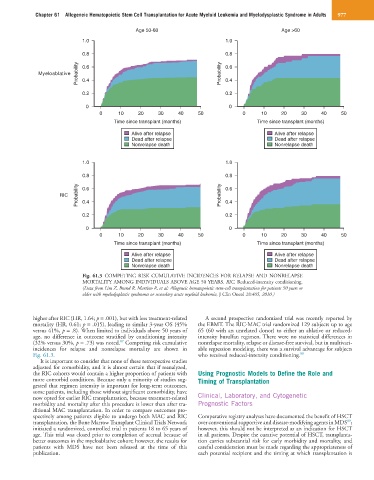
                            Fig. 61.3  COMPETING RISK CUMULATIVE INCIDENCES FOR RELAPSE AND NONRELAPSE
                            MORTALITY AMONG INDIVIDUALS ABOVE AGE 50 YEARS. RIC, Reduced-intensity conditioning.
                            (Data from Lim Z, Brand R, Martino R, et al: Allogeneic hematopoietic stem-cell transplantation for patients 50 years or
                            older with myelodysplastic syndromes or secondary acute myeloid leukemia, J Clin Oncol 28:405, 2010.)


            higher after RIC (HR, 1.64; p = .001), but with less treatment-related   A second prospective randomized trial was recently reported by
            mortality (HR, 0.61; p = .015), leading to similar 3-year OS (45%   the EBMT. The RIC-MAC trial randomized 129 subjects up to age
            versus 41%, p = .8). When limited to individuals above 50 years of   65 (60 with an unrelated donor) to either an ablative or reduced-
            age,  no  difference  in  outcome  stratified  by  conditioning  intensity   intensity busulfan regimen. There were no statistical differences in
                                        87
            (32% versus 30%, p = .73) was noted.  Competing risk cumulative   nonrelapse mortality, relapse or disease-free survival, but in multivari-
            incidences  for  relapse  and  nonrelapse  mortality  are  shown  in     able regression modeling, there was a survival advantage for subjects
            Fig. 61.3.                                            who received reduced-intensity conditioning. 88
              It is important to consider that none of these retrospective studies
            adjusted for comorbidity, and it is almost certain that if reanalyzed,
            the RIC cohorts would contain a higher proportion of patients with   Using Prognostic Models to Define the Role and
            more comorbid conditions. Because only a minority of studies sug-  Timing of Transplantation
            gested that regimen intensity is important for long-term outcomes,
            some patients, including those without significant comorbidity, have
            now opted for earlier RIC transplantation, because treatment-related   Clinical, Laboratory, and Cytogenetic
            morbidity and mortality after this procedure is lower than after tra-  Prognostic Factors
            ditional MAC transplantation. In order to compare outcomes pro-
            spectively among patients eligible to undergo both MAC and RIC   Comparative registry analyses have documented the benefit of HSCT
                                                                                                                   89
            transplantation, the Bone Marrow Transplant Clinical Trials Network   over conventional supportive and disease-modifying agents in MDS ;
            initiated a randomized, controlled trial in patients 18 to 65 years of   however, this should not be interpreted as an indication for HSCT
            age. This trial was closed prior to completion of accrual because of   in all patients. Despite the curative potential of HSCT, transplanta-
            better outcomes in the myeloablative cohort; however, the results for   tion carries substantial risk for early morbidity and mortality, and
            patients  with  MDS  have  not  been  released  at  the  time  of  this   careful consideration must be made regarding the appropriateness of
            publication.                                          each potential recipient and the timing at which transplantation is

