


Page 1123 - Hematology_ Basic Principles and Practice ( PDFDrive )
P. 1123
Chapter 62  Acute Myeloid Leukemia in Children  989


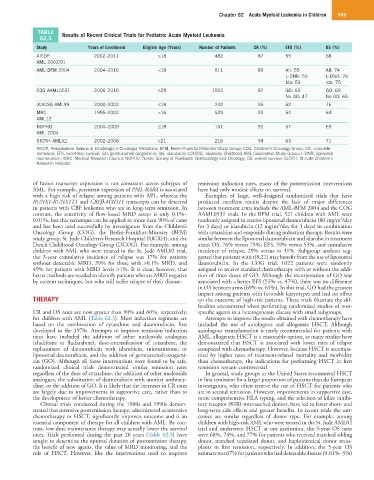
             TABLE   Results of Recent Clinical Trials for Pediatric Acute Myeloid Leukemia
              62.3
             Study            Years of Enrollment  Eligible Age (Years)  Number of Patients  CR (%)  EFS (%)  OS (%)
             AIEOP              2002–2011            ≤18               482           87       55            68
             AML 2002/01
             AML-BFM 2004       2004–2010            <18               611           89       All: 55       All: 74
                                                                                              L-DNR: 59     L-DNR: 76
                                                                                              Ida: 53       Ida: 75
             COG AAML0531       2006–2010            ≤29              1022           87       GO: 53        GO: 69
                                                                                              No GO: 47     No GO: 65
             JCACSG AML99       2000–2002            ≤18               240           95       62            76
             MRC                1995–2002            <16               529           92       54            64
             AML12
             NOPHO              2004–2009            ≤18               151           92       57            69
             AML 2004
             SJCRH AML02        2002–2008            ≤21               216           94       63            71
             AIEOP, Associazione Italiana di Ematologia e Oncologia Pediatrica; BFM, Berlin-Frankfurt-Münster Study Group; COG, Children’s Oncology Group; CR, complete
             remission; EFS, event-free survival; GO, gemtuzumab ozogamicin; Ida, idarubicin; JCACSG, Japanese Childhood AML Cooperative Study Group; L-DNR, liposomal
             daunorubicin; MRC, Medical Research Council; NOPHO, Nordic Society of Paediatric Haematology and Oncology; OS, overall survival; SJCRH, St Jude Children’s
             Research Hospital.


            of  fusion  transcript  expression  is  not  consistent  across  subtypes  of   remission induction rates, many of the postremission interventions
            AML. For example, persistent expression of PML-RARA is associated   have had only modest effects on survival.
            with a high risk of relapse among patients with APL, whereas the   Examples  of  large,  well-designed  randomized  trials  that  have
            RUNX1-RUNX1T1 and CBFβ-MYH11 transcripts can be detected   produced  excellent  results  despite  the  lack  of  major  differences
            in patients with CBF leukemia who are in long-term remission. In   between treatment arms include the AML-BFM 2004 and the COG
            contrast,  the  sensitivity  of  flow-based  MRD  assays  is  only  0.1%–  AAML0531 trials. In the BFM trial, 521 children with AML were
                                                                                                                2
            0.01%, but this technique can be applied to more than 90% of cases   randomly assigned to receive liposomal daunorubicin (80 mg/m /day
                                                                                            2
            and has been used successfully by investigators from the Children’s   for 3 days) or idarubicin (12 mg/m /day for 3 days) in combination
            Oncology  Group  (COG),  the  Berlin-Frankfurt-Münster  (BFM)   with cytarabine and etoposide during induction therapy. Results were
            study group, St. Jude Children’s Research Hospital (SJCRH), and the   similar between the liposomal daunorubicin and idarubicin treatment
            Dutch Childhood Oncology Group (DCOG). For example, among   arms: OS, 76% versus 75%; EFS, 59% versus 53%, and cumulative
            children with AML who were treated in the St. Jude AML02 trial,   incidence  of  relapse,  29%  versus  vs  31%.  Subgroup  analyses  sug-
            the  3-year  cumulative  incidence  of  relapse  was  17%  for  patients   gested that patients with t(8;21) may benefit from the use of liposomal
            without  detectable  MRD,  39%  for  those  with  >0.1%  MRD,  and   daunorubicin.  In  the  COG  trial,  1022  patients  were  randomly
            49% for patients with MRD levels >1%. It is clear, however, that   assigned to receive standard chemotherapy with or without the addi-
            better methods are needed to identify patients who are MRD negative   tion of three doses of GO. Although the incorporation of GO was
            by current techniques, but who still suffer relapse of their disease.  associated with a better EFS (53% vs. 47%), there was no difference
                                                                  in OS between arms (69% vs. 65%). In this trial, GO had the greatest
                                                                  impact among patients with favorable karyotypes and had no effect
            THERAPY                                               on the outcome of high-risk patients. These trials illustrate the dif-
                                                                  ficulties encountered when performing randomized studies of non-
            CR and OS rates are now greater than 90% and 60%, respectively,   specific agents in a heterogeneous disease with small subgroups.
            for children with AML (Table 62.3). Most induction regimens are   Attempts to improve the results obtained with chemotherapy have
            based  on  the  combination  of  cytarabine  and  daunorubicin,  first   included  the  use  of  autologous  and  allogeneic  HSCT.  Although
            developed in the 1970s. Attempts to improve remission induction   autologous transplantation is rarely recommended for patients with
            rates  have  included  the  addition  of  other  nucleoside  analogues   AML, allogeneic HSCT is a reasonable option, as many studies have
            (cladribine  or  fludarabine),  dose-intensification  of  cytarabine,  the   demonstrated  that  HSCT  is  associated  with  lower  rates  of  relapse
            replacement  of  daunorubicin  with  idarubicin,  mitoxantrone,  or   compared with chemotherapy. However, because HSCT is accompa-
            liposomal daunorubicin, and the addition of gemtuzumab ozogami-  nied  by  higher  rates  of  treatment-related  mortality  and  morbidity
            cin (GO). Although all these interventions were found to be safe,   than  chemotherapy,  the  indications  for  performing  HSCT  in  first
            randomized  clinical  trials  demonstrated  similar  remission  rates   remission remain controversial
            regardless of the dose of cytarabine, the addition of other nucleoside   In general, study groups in the United States recommend HSCT
            analogues, the substitution of daunorubicin with another anthracy-  in first remission for a larger proportion of patients than do European
            cline, or the addition of GO. It is likely that the increases in CR rates   investigators, who often reserve the use of HSCT for patients who
            are largely due to improvements in supportive care, rather than to   are in second remission. However, improvements in supportive care,
            the development of better chemotherapy.               more comprehensive HLA typing, and the selection of killer inhibi-
              Clinical  trials  conducted  during  the  1980s  and  1990s  demon-  tory receptor (KIR)-mismatched donors, have led to fewer short- and
            strated that intensive postremission therapy, administered as intensive   long-term side effects and greater benefits. In recent trials the out-
            chemotherapy or HSCT, significantly improves outcome and is an   comes  are  similar  regardless  of  donor  type.  For  example,  among
            essential component of therapy for all children with AML. By con-  children with high-risk AML who were treated in the St. Jude AML02
            trast, low-dose maintenance therapy may actually lower the survival   trial and underwent HSCT at our institution, the 5-year OS rates
            rates. Trials performed during the past 20 years (Table 62.3) have   were 68%, 74%, and 77% for patients who received matched sibling
            sought to determine the optimal duration of postremission therapy,   donor,  matched  unrelated  donor,  and  haploidentical  donor  trans-
            the benefit of new agents, the value of MRD monitoring, and the   plants  in  first  remission,  respectively.  In  addition,  the  5-year  OS
            role  of  HSCT.  However,  like  the  interventions  used  to  improve   estimate was 67% for patients who had detectable disease (0.01%–5%)

