


Page 1124 - Hematology_ Basic Principles and Practice ( PDFDrive )
P. 1124
990    Part VII  Hematologic Malignancies


                                 1
                                0.9
                                0.8
                                0.7     62.8% ± 3.8%   (2002−2008, n=203)
                                0.6
                              Probability  0.5  45.9% ± 4.1%   (1991−2002, n=146)


                                0.4
                                0.3     22.4% ± 2.6%   (1976−1991, n=255)

                                0.2
                                0.1
                           A     0
                                   0      5      10     15      20     25     30     35     40
                                                          Years on study
                                 1
                                0.9
                                0.8     72.3% ± 3.5%   (2002−2008, n=203)
                                0.7     54.1% ± 4.1%   (1991−2002, n=146)

                                0.6
                              Probability  0.5

                                0.4
                                0.3     29.4% ± 2.8%   (1976−1991, n=255)

                                0.2
                                0.1
                           B     0
                                   0      5      10     15      20     25     30     35     40
                                                           Years on study
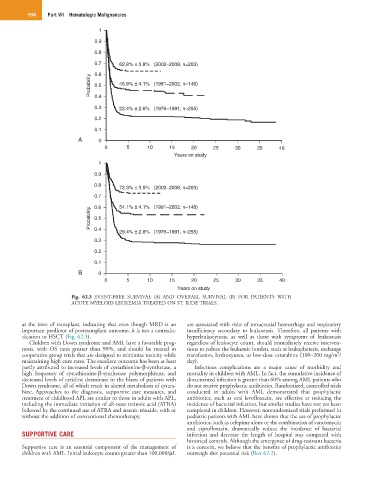
                        Fig.  62.3  EVENT-FREE  SURVIVAL  (A)  AND  OVERALL  SURVIVAL  (B)  FOR  PATIENTS  WITH
                        ACUTE MYELOID LEUKEMIA TREATED ON ST. JUDE TRIALS.


        at the time of transplant, indicating that even though MRD is an   are associated with risks of intracranial hemorrhage and respiratory
        important predictor of posttransplant outcome, it is not a contrain-  insufficiency  secondary  to  leukostasis. Therefore,  all  patients  with
        dication to HSCT (Fig. 62.3).                         hyperleukocytosis,  as  well  as  those  with  symptoms  of  leukostasis
           Children with Down syndrome and AML have a favorable prog-  regardless of leukocyte count, should immediately receive interven-
        nosis,  with  OS  rates  greater  than  90%,  and  should  be  treated  in   tions to reduce the leukemic burden, such as leukapheresis, exchange
                                                                                                               2
        cooperative group trials that are designed to minimize toxicity while   transfusion, hydroxyurea, or low-dose cytarabine (100–200 mg/m /
        maintaining high cure rates. The excellent outcome has been at least   day).
        partly attributed to increased levels of cystathionine-β-synthetase, a   Infectious  complications  are  a  major  cause  of  morbidity  and
        high  frequency  of  cystathionine-β-synthetase  polymorphisms,  and   mortality in children with AML. In fact, the cumulative incidence of
        decreased levels of cytidine deaminase in the blasts of patients with   documented infection is greater than 60% among AML patients who
        Down syndrome, all of which result in altered metabolism of cytara-  do not receive prophylactic antibiotics. Randomized, controlled trials
        bine.  Approaches  to  the  diagnosis,  supportive  care  measures,  and   conducted  in  adults  with  AML  demonstrated  that  prophylactic
        treatment of childhood APL are similar to those in adults with APL,   antibiotics,  such  as  oral  levofloxacin,  are  effective  at  reducing  the
        including the immediate initiation of all-trans retinoic acid (ATRA)   incidence of bacterial infection, but similar studies have not yet been
        followed by the continued use of ATRA and arsenic trioxide, with or   completed in children. However, nonrandomized trials performed in
        without the addition of conventional chemotherapy.    pediatric patients with AML have shown that the use of prophylactic
                                                              antibiotics, such as cefepime alone or the combination of vancomycin
                                                              and  ciprofloxacin,  dramatically  reduce  the  incidence  of  bacterial
        SUPPORTIVE CARE                                       infection  and  decrease  the  length  of  hospital  stay  compared  with
                                                              historical controls. Although the emergence of drug-resistant bacteria
        Supportive  care  is  an  essential  component  of  the  management  of   is a concern, we believe that the benefits of prophylactic antibiotics
        children with AML. Initial leukocyte counts greater than 100,000/µL   outweigh this potential risk (Box 62.2).

