


Page 1118 - Hematology_ Basic Principles and Practice ( PDFDrive )
P. 1118
984    Part VII  Hematologic Malignancies


                                       Mature blood cells     in MLL-MLLT3 transgenic mice. Although HOXA9 was not specifi-
        Progenitor cell                                       cally required for MLL-MLLT3-mediated leukemogenesis, multiple
                                                              other HOX genes are upregulated in this model and it was proposed
                                                              that due to functional redundancy within members of a given Hox
                                                              cluster, a “Hox code,” as defined by upregulation of multiple HOX
                          Differentiation                     genes, is sufficient for the development of leukemia as opposed to
                                                              one specific gene.
                                                                 In contrast to CBF leukemias, where cooperating genetic lesions
                                                              providing a proliferative signal have been described, analysis of MLL-
                                                              rearranged leukemia suggests that very few additional mutations are
                                     Differentiation block    present  in  this  subset  of  patients.  CNAs  in  MLL-rearranged  cases
                                 RUNX1-RUN1XT1   GATA1        average only 1.33 for pediatric AML and 1 for pediatric ALL in two
                                 CBFβ-MYH11      CEBPA        studies.  Next-generation  sequencing  of  MLL-rearranged  leukemias
                                 MLLrIMLL-PTD    IDH1/2       has confirmed a paucity of cooperating mutations, although approxi-
                                 PML-RARA        TET2         mately  50%  carry  an  activating  tyrosine  kinase  mutation  in  this
                                 RBM15-MKL1      EZH2         pathway,  providing  the  so-called  second  hit  for  leukemogenesis.
                                 CBFA2T3-GLIS2   SUZ12        However, cases exist that lack additional genetic alterations, and the
                                 NUP98-KDM5A     NPM1         kinase mutations for those samples that contain them are typically
                                                              subclonal and often absent at relapse. These data confirm the strength
          Kinase signaling                                    of the MLL fusion genes and suggest targeting of cooperating muta-
           FLT3-ITD/TKD                                       tions will not result in a therapeutic benefit.
           cKIT
           RAS
           JAK                                                Partial Tandem Duplications of MLL (MLL-PTD)

                                                              Tandem  duplication  of  the  5′  end  of  the  MLL  gene  was  initially
                                                              observed  in  AML  with  a  normal  karyotype  or  trisomy  11.  The
                                                              duplications are in-frame repetitions of exons and lead to a potentially
                                         Enhanced self-renewal  translatable sequence. In patients with a normal karyotype, the PTD
                                         Differentiation block  is only present on one allele; similarly, in trisomy 11 patients only
                    AML BLAST            Decrease apoptosis
                                         Proliferation        one allele is mutated while the other two are unchanged. In contrast
                                         Growth advantage     to MLL fusion genes, the C-terminal portion of MLL is retained.
                                                                 Interestingly, pediatric MLL-PTD cases failed to cluster with other
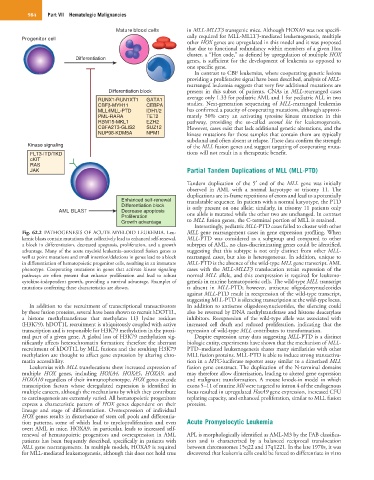
        Fig. 62.2  PATHOGENESIS OF ACUTE MYELOID LEUKEMIA. Leu-  MLL gene rearrangement cases in gene expression profiling. When
        kemic blasts contain mutations that collectively lead to enhanced self-renewal,   MLL-PTD  was  considered  as  a  subgroup  and  compared  to  other
        a block in differentiation, decreased apoptosis, proliferation, and a growth   subtypes of AML, no class-discriminating genes could be identified,
        advantage. Many of the acute myeloid leukemia–associated fusion genes as   suggesting that this subtype is not only distinct from other MLL-
        well as point mutations and small insertion/deletions in genes lead to a block   rearranged cases, but also is heterogeneous. In addition, unique to
        in differentiation of hematopoietic progenitor cells, resulting in an immature   MLL-PTD is the absence of the wild-type MLL gene transcript. AML
        phenotype.  Cooperating  mutations  in  genes  that  activate  kinase  signaling   cases  with  the  MLL-MLLT3  translocation  retain  expression  of  the
        pathways  are  often  present  that  enhance  proliferation  and  lead  to  robust   normal MLL allele, and this coexpression is required for leukemo-
        cytokine-independent growth, providing a survival advantage. Examples of   genesis in murine hematopoietic cells. The wild-type MLL transcript
        mutations conferring these characteristics are shown.   is  absent  in  MLL-PTD;  however,  antisense  oligodeoxynucleotides
                                                              against MLL-PTD result in reexpression of the wild-type transcript,
                                                              suggesting MLL-PTD is silencing transcription at the wild-type locus.
           In addition to the recruitment of transcriptional transactivators   In addition to antisense oligodeoxynucleotides, the silencing could
        by these fusion proteins, several have been shown to recruit hDOT1L,   also be reversed by DNA methyltransferase and histone deacetylase
        a  histone  methyltransferase  that  methylates  H3  lysine  residues   inhibitors. Reexpression of the wild-type allele was associated with
        (H3K79). hDOT1L recruitment is ubiquitously coupled with active   increased  cell  death  and  reduced  proliferation,  indicating  that  the
        transcription and is responsible for H3K79 methylation in the proxi-  repression of wild-type MLL contributes to transformation.
        mal part of a given gene. A global loss of H3K79 methylation sig-  Despite expression array data suggesting MLL-PTD is a distinct
        nificantly affects heterochromatin formation; therefore the aberrant   biologic entity, experiments have shown that the mechanism of MLL-
        recruitment of hDOT1L by MLL fusions and the resulting H3K79   PTD–mediated leukemogenesis shares many similarities with other
        methylation are thought to affect gene expression by altering chro-  MLL fusion proteins. MLL-PTD is able to induce strong transactiva-
        matin accessibility.                                  tion in a MYC-luciferase reporter assay similar to a dimerized MLL
           Leukemias with MLL translocations show increased expression of   fusion gene construct. The duplication of the N-terminal domains
        multiple  HOX  genes,  including  HOXA4,  HOXA5,  HOXA9,  and   may therefore allow dimerization, leading to altered gene expression
        HOXA10 regardless of their immunophenotype. HOX genes encode   and malignant transformation. A mouse knock-in model in which
        transcription  factors  whose  deregulated  expression  is  identified  in   exons 5–11 of murine Mll were targeted to intron 4 of the endogenous
        multiple cancers, although the mechanisms by which they contribute   locus resulted in upregulated HoxA9 gene expression, increased CFU
        to carcinogenesis are extremely varied. All hematopoietic progenitors   replating capacity, and enhanced proliferation, similar to MLL fusion
        express  a  characteristic  pattern  of  HOX  genes  dependent  on  their   proteins.
        lineage  and  stage  of  differentiation.  Overexpression  of  individual
        HOX genes results in disturbance of stem cell pools and differentia-
        tion  patterns,  some  of  which  lead  to  myeloproliferation  and  even   Acute Promyelocytic Leukemia
        overt AML in mice. HOXA9, in particular, leads to increased self-
        renewal  of  hematopoietic  progenitors  and  overexpression  in  AML   APL is morphologically identified as AML-M3 by the FAB classifica-
        patients has been frequently described, specifically in patients with   tion  and  is  characterized  by  a  balanced  reciprocal  translocation
        MLL gene rearrangements. In multiple models, HOXA9 is required   between chromosomes 15q22 and 17q1221. In the late 1970s, it was
        for MLL-mediated leukemogenesis, although this does not hold true   discovered that leukemia cells could be forced to differentiate in vitro

