


Page 1122 - Hematology_ Basic Principles and Practice ( PDFDrive )
P. 1122
988    Part VII  Hematologic Malignancies


        blueberry muffin lesions that are associated with congenital infection.   TABLE   Prognostically Important Genetic Abnormalities in
        Skin nodules sometimes develop before bone marrow involvement   62.2  Pediatric Acute Myeloid Leukemia
        and  may  regress  spontaneously.  Patients  with  elevated  leukocyte
        counts  (hyperleukocytosis)  may  also  present  with  central  nervous   Favorable
        system (CNS) symptoms (seizure or stroke) or pulmonary symptoms   t(8;21)(q22;q22)/RUNX1-RUNX1T1
        related to hyperviscosity.                             inv(16)(p13.1;q22)/CBFβ-MYH11
           Among  children  with  AML,  the  median  leukocyte  count  at   t(16;16)(p13.1;q22)/CBFβ-MYH11
                                   9
        diagnosis is approximately 20 × 10 /L, with a median hemoglobin   t(1;11)(q21;q23)/MLL-MLLT11
        concentration of approximately 9 g/dL and a median platelet count   NPM1/wt-FLT3
                9
        of 60 × 10 /L. Although about 10% of children with AML do not   CEBPA
        have morphologically detectable circulating blasts, careful examina-  t(15;17)(q22;q12)/PML-RARα
        tion of the peripheral blood smear will reveal leukemic cells in most   Unfavorable
        cases. Prolonged prothrombin, thrombin, and partial thromboplastin   t(6;11)(q27;q23)/MLL-MLLT4
        times, as well as decreased fibrinogen levels, are seen in the majority   t(10;11)(p12;q23)/MLL-MLLT10
        of patients with APL and about 5% of other AML cases. Abnormali-  t(10;11)(p11.2;q23)/MLL-ABI1
        ties of serum chemistries may include hyperuricemia, although this   t(6;9)(p23;q34)/DEK-NUP214
        is less common and less severe than hyperuricemia associated with   t(8;16)(p11;p13)/MYST3-CREBBP
        ALL. The presence of hypokalemia, a rare finding in patients with   t(16;21)(q24;q22)/RUNX1-CBFA2T3
        ALL, suggests a diagnosis of monoblastic leukemia.     t(5;11)(q35;p15.5)/NUP98-NSD1
           Among patients who present with circulating blasts, the differen-  inv(16)(p13.3q24.3)/CBFA2T3-GLIS2
        tial  diagnosis  is  generally  limited  to  various  types  of  leukemia,   FLT3-ITD
        including  AML,  ALL,  and  juvenile  myelomonocytic  leukemia   Monosomy 7
        (JMML). For patients who do not have blasts in their blood at the   Likely Unfavorable
        time of presentation, the differential diagnosis is determined by signs   IDH1, IDH2
        and  symptoms  and  may  include  aplastic  anemia,  autoimmune  or   RUNX1
        inflammatory  disease,  infection,  and  solid  malignancies.  In  most   TET2
        cases, the diagnosis of AML is made by bone marrow examination.   DNMT3A
        A  bone  marrow  aspiration  should  be  performed  for  morphologic   Intermediate or Unknown
        examination, immunophenotyping, genetic, and molecular studies,
        whereas a bone marrow biopsy is used to assess cellularity. A diagnosis   t(9;11)(p12;q23)/MLL-MLLT3
        of AML is confirmed when 20% or more of nucleated bone marrow   Other MLL
        cells are blasts of myeloid origin or when the blasts contain AML-  t(1;22)(p13;q13)/RBM15-MKL1
        specific genetic lesions, regardless of blast percentage. When a diag-
        nosis  of  AML  is  confirmed,  most  investigators  classify  each  case
        according to the World Health Organization criteria (Table 62.1).
        Since AML may involve the CNS, examination of the cerebrospinal   associated with normal karyotypes and a favorable outcome in adults
        fluid (CSF) should also be performed as part of the workup of all   with  AML,  but  occur  in  less  than  5%  of  childhood  AML  cases.
        patients.  Although  CNS  leukemia  is  traditionally  defined  as  the   Nevertheless, they are likely to be associated with a favorable outcome
        presence of at least five leukocytes/µL of CSF with leukemic blast   and are included as a low-risk feature in many treatment protocols.
        cells present, the significance of lower levels of CNS involvement is   Genetic abnormalities, for which there is strong evidence of an
        not known. The diagnosis of CNS involvement may also be based   association  with  a  high  risk  of  relapse,  include  monosomy  7  and
        on  the  presence  of  cranial  nerve  palsies  or  radiologic  evidence  of   FLT3-ITD. The  outcome  of  patients  with  FLT3-ITD  is  especially
        leukemic infiltration.                                poor  in  cases  with  high  ratios  of  FLT3-ITD  to  wild-type  FLT3.
                                                              Translocations that create chimeric fusion genes and likely confer a
                                                              poor prognosis include the t(6;11)(q27;q23)/MLL-MLLT4, t(10;11)
        Prognostic Factors                                    (p12;q23)/MLL-MLLT10,  t(10;11)(p11.2;q23)/MLL-ABI1,  t(5;11)
                                                              (q35;p15.5)/NUP98-NSD1, t(6;9)(p23;q34)/DEK-NUP214, t(8;16)
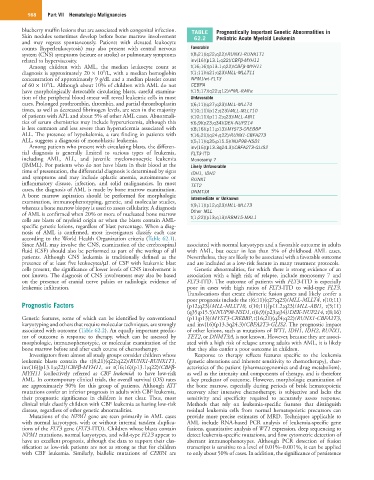
        Genetic features, some of which can be identified by conventional   (p11;p13)/MYST3-CREBBP, t(16;21)(q24;q22)/RUNX1-CBFA2T3,
        karyotyping and others that require molecular techniques, are strongly   and inv(16)(p13.3q24.3)/CBFA2T3-GLIS2. The prognostic impact
        associated with outcome (Table 62.2). An equally important predic-  of other lesions, such as mutations of WT1, IDH1, IDH2, RUNX1,
        tor  of  outcome  is  response  to  therapy,  which  can  be  assessed  by   TET2, or DNMT3A, is not known. However, because they are associ-
        morphologic, immunophenotypic, or molecular examination of the   ated with a high risk of relapse among adults with AML, it is likely
        bone marrow before and after each course of chemotherapy.  that they also confer a poor outcome in children.
           Investigators from almost all study groups consider children whose   Response  to  therapy  reflects  features  specific  to  the  leukemia
        leukemic  blasts  contain  the  t(8;21)(q22;q22)/RUNX1-RUNX1T1,   (genetic alterations and inherent sensitivity to chemotherapy), char-
        inv(16)(p13.1;q22)/CBFβ-MYH11,  or  t(16;16)(p13.1;q22)/CBFβ-  acteristics of the patient (pharmacogenomics and drug metabolism),
        MYH11  (collectively  referred  as  CBF  leukemia)  to  have  low-risk   as well as the intensity and components of therapy, and is therefore
        AML. In contemporary clinical trials, the overall survival (OS) rates   a key predictor of outcome. However, morphologic examination of
        are  approximately  90%  for  this  group  of  patients.  Although  KIT   the bone marrow, especially during periods of brisk hematopoietic
        mutations confer an inferior prognosis in adults with CBF leukemia,   recovery  after  intensive  chemotherapy,  is  subjective  and  lacks  the
        their  prognostic  significance  in  children  is  not  clear.  Thus,  most   sensitivity  and  specificity  required  to  accurately  assess  response.
        clinical trials classify children with CBF leukemia as having low-risk   Methods  that  rely  on  leukemia-specific  features  that  distinguish
        disease, regardless of other genetic abnormalities.   residual  leukemia  cells  from  normal  hematopoietic  precursors  can
           Mutations of the NPM1 gene are seen primarily in AML cases   provide  more  precise estimates of MRD. Techniques  applicable to
        with normal karyotypes, with or without internal tandem duplica-  AML  include  RNA-based  PCR  analysis  of  leukemia-specific  gene
        tions of the FLT3 gene (FLT3-ITD). Children whose blasts contain   fusions, quantitative analysis of WT1 expression, deep sequencing to
        NPM1 mutations, normal karyotypes, and wild-type FLT3 appear to   detect leukemia-specific mutations, and flow cytometric detection of
        have an excellent prognosis, although the data to support their clas-  aberrant  immunophenotypes.  Although  PCR  detection  of  fusion
        sification as low-risk patients are not as strong as that for children   transcripts is sensitive to a level of 0.01%–0.001%, it can be applied
        with  CBF  leukemia.  Similarly,  biallelic  mutations  of  CEBPA  are   to only about 50% of cases. In addition, the significance of persistence

