


Page 1220 - Hematology_ Basic Principles and Practice ( PDFDrive )
P. 1220
1066   Part VII  Hematologic Malignancies


        According to STIM (A-STIM) study evaluated whether the loss of   A
        MMR, defined as <0.1% BCR-ABL (IS), was a safe and clinically   1.0
        relevant measure for defining molecular relapse after imatinib discon-   Chronic phase (n = 303)
        tinuation. Eighty patients with CP-CML in prolonged CMR were
        studied.  Cumulative  MMR  loss  was  36%  at  24  months,  whereas   0.8
        probability  of  losing  CMR  was  higher.  Fluctuation  of  BCR-ABL
        transcript levels below the MMR threshold was observed in 31% of
        patients.  Treatment-free  remission  was  estimated  as  61%  at  36   0.6  Accelerated phase/blast
                                                                             crises remission (n = 359)
        months. These results suggest that loss of MMR is a practical and
        safe criterion for restarting therapy after treatment discontinuation   Probability of survival
        in CML patients with prolonged CMR.                      0.4

        Management of Pregnancy in CML Patients                  0.2                Blast crisis (n = 20)

        Imatinib  therapy  has  been  associated  with  a  constellation  of  rare
        congenital  malformations  and  spontaneous  abortions.  All  couples   0.0
        should be counselled on the risks associated with pregnancy whilst   0  2    4        6        8       10
        receiving TKI therapy. At the time of diagnosis, fertility preservation    Years after transplant
        should be discussed with both male and female patients of childbear-
        ing potential. Patients should be counselled regarding fertility options   B
        such  as  semen  cryopreservation,  oocyte  retrieval  and  storage,  and   1.0
        embryo cryopreservation because of potential deleterious effects of
        TKIs on gonadal function and fertility. Pregnancy in CML presents
        specific  management  challenges,  and  requires  a  multidisciplinary   0.8  Chronic phase (n = 168)
        approach  with  close  collaboration  with  the  obstetricians.  Manage-
        ment of patients who become pregnant whilst receiving TKI therapy
        requires balancing risks to the fetus of continuing therapy versus risks   0.6
        to the patient from treatment interruption and loss of disease control.   Accelerated phase/blast
        Patients  presenting  with  CP  CML  during  pregnancy  could  safely   Probability of survival  crises remission (n = 49)
        continue their pregnancy to term and be successfully managed with   0.4
        leukapheresis during the first and subsequent trimesters, and intro-
        duction of IFN in the second trimester onwards if needed. Patients             Blast crisis (n = 10)
        presenting in advanced phase disease should consider elective termi-  0.2
        nation of pregnancy in order to commence induction chemotherapy
        and/or a TKI. 25
                                                                 0.0
                                                                   0         2       4        6        8       10
        Allogeneic Hematopoietic Cell Transplantation                              Years after transplant

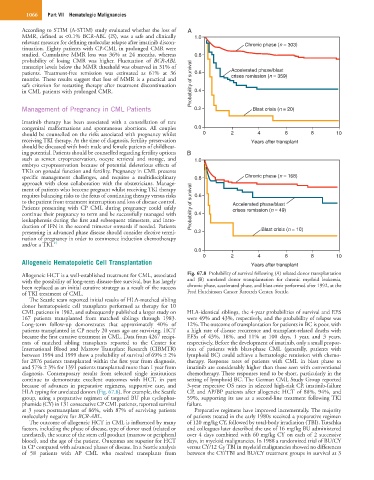
        Allogeneic HCT is a well-established treatment for CML, associated   Fig. 67.8  Probability of survival following (A) related donor transplantation
        with the possibility of long-term disease-free survival, but has largely   and  (B)  unrelated  donor  transplantation  for  chronic  myeloid  leukemia,
        been replaced as an initial curative strategy as a result of the success   chronic phase, accelerated phase, and blast crisis performed after 1992, at the
        of TKI treatment of CML.                              Fred Hutchinson Cancer Research Center, Seattle.
           The Seattle team reported initial results of HLA-matched sibling
        donor  hematopoietic  cell  transplants  performed  as  therapy  for  10
        CML patients in 1982, and subsequently published a larger study on   HLA-identical siblings, the 4-year probabilities of survival and EFS
        167  patients  transplanted  from  matched  siblings  through  1983.   were 49% and 43%, respectively, and the probability of relapse was
        Long-term  follow-up  demonstrates  that  approximately  40%  of   12%. The outcome of transplantation for patients in BC is poor, with
        patients transplanted in CP nearly 20 years ago are surviving. HCT   a high rate of disease recurrence and transplant-related deaths with
        became the first curative treatment in CML. Data from 4267 recipi-  EFSs  of  43%,  18%,  and  11%  at  100  days,  1  year,  and  3  years,
        ents  of  matched  sibling  transplants  reported  to  the  Center  for   respectively. Before the development of imatinib, only a small propor-
        International  Blood  and  Marrow  Transplant  Research  (CIBMTR)   tion  of  patients  with  blast-phase  CML  (generally,  patients  with
        between 1994 and 1999 show a probability of survival of 69% ± 2%   lymphoid BC) could achieve a hematologic remission with chemo-
        for 2876 patients transplanted within the first year from diagnosis,   therapy.  Response  rates  of  patients  with  CML  in  blast  phase  to
        and 57% ± 3% for 1391 patients transplanted more than 1 year from   imatinib are considerably higher than those seen with conventional
        diagnosis.  Contemporary  results  from  selected  single  institutions   chemotherapy. These responses tend to be short, particularly in the
        continue  to  demonstrate  excellent  outcomes  with  HCT,  in  part   setting of lymphoid BC. The German CML Study Group reported
        because  of  advances  in  preparative  regimens,  supportive  care,  and   3-year respective OS rates in selected high-risk CP, imatinib-failure
        HLA typing for unrelated donors (Fig. 67.8). For example, the Seattle   CP,  and AP/BP  patients after  allogeneic HCT of  88%,  94%,  and
        group, using a preparative regimen of targeted BU plus cyclophos-  59%, supporting its use as a second-line treatment following TKI
        phamide (CY) in 131 consecutive CP CML patients, reported survival   failure.
        at  3  years  posttransplant  of  86%,  with  87%  of  surviving  patients   Preparative regimens have improved incrementally. The majority
        molecularly negative for BCR-ABL.                     of patients treated in the early 1980s received a preparative regimen
           The outcome of allogeneic HCT in CML is influenced by many   of 120 mg/kg CY, followed by total-body irradiation (TBI). Tutschka
        factors, including the phase of disease, type of donor used (related or   and colleagues later described the use of 16 mg/kg BU administered
        unrelated), the source of the stem cell product (marrow or peripheral   over 4 days combined with 60 mg/kg CY on each of 2 successive
        blood), and the age of the patient. Outcomes are superior for HCT   days, in myeloid malignancies. In 1988 a randomized trial of BU/CY
        in CP compared with advanced phases of disease. In a Seattle analysis   versus CY/12 Gy TBI in myeloid malignancies showed no differences
        of  58  patients  with  AP  CML  who  received  transplants  from   between the CY/TBI and BU/CY treatment groups in survival at 3

