


Page 1217 - Hematology_ Basic Principles and Practice ( PDFDrive )
P. 1217
Chapter 67  Chronic Myeloid Leukemia  1063


            A                                                     A
              100                                                   100
               90                                                    90
               80                   Complete hematologic response    80
             Rates of response (%)  60  Complete cytogenetic response  Patients without progression (%)  60  Response at 12 months
                                                                     70
               70
                            Major cytogenetic response
                                                                     50
               50
                                                                     40
               40
               30
                                                                     20
                                                                                            Partial cytogenetic response
               20                                                    30                     Complete cytogenetic response
                                                                     10                     No major cytogenetic response
               10
                                                                      0
                0                                                      0      12      24     36     48      60    72
                  0  6   12  18  24  30  36  42  48  54  60  66
                                     Months                                                 Months
            B
              100                                                 B
                                                                    100
               90        Progression         All events              90
               80
             Patients without event (%)  70                        Patients without progression (%)  70  Complete cytogenetic response
                                                                     80
               60
                                                                     60
               50
                                                                     50
                                                                                             Response at 18 months
               40
                                                                     40
               30
               20
                                                                                          Complete cytogenetic response
                                                                     20
                                                                                          with <3 log reduction
               10                                                    30                   with ≥3 log reduction
                                                                     10                   No complete cytogenetic response
                0
                  0     12      24     36     48     60      72       0
                                                                       0      12      24     36     48      60    72
                                      Months
            No. of events                                                                   Months
            Progression  8      22     29     33      35
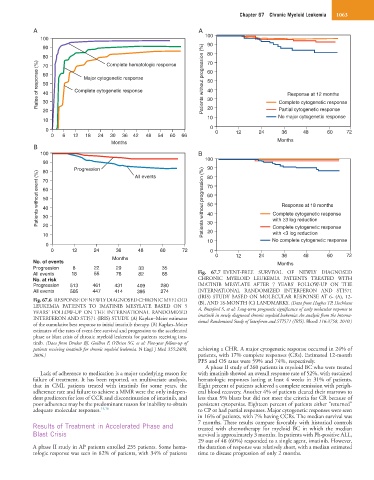
            All events  18      55     76     82      85          Fig.  67.7  EVENT-FREE  SURVIVAL  OF  NEWLY  DIAGNOSED
            No. at risk                                           CHRONIC  MYELOID  LEUKEMIA  PATIENTS  TREATED  WITH
            Progression  513   461     431    409     280         IMATINIB  MESYLATE  AFTER  7  YEARS’  FOLLOW-UP  ON  THE
            All events  505    447     414    395     274         INTERNATIONAL  RANDOMIZED  INTERFERON  AND  STI571
                                                                  (IRIS) STUDY BASED ON MOLECULAR RESPONSE AT 6- (A), 12-
            Fig. 67.6  RESPONSE OF NEWLY DIAGNOSED CHRONIC MYELOID   (B), AND 18-MONTH (C) LANDMARKS. (Data from Hughes TP, Hochhaus
            LEUKEMIA  PATIENTS  TO  IMATINIB  MESYLATE  BASED  ON  5   A, Branford S, et al: Long-term prognostic significance of early molecular response to
            YEARS’  FOLLOW-UP  ON  THE  INTERNATIONAL  RANDOMIZED   imatinib in newly diagnosed chronic myeloid leukemia: An analysis from the Interna-
            INTERFERON AND STI571 (IRIS) STUDY. (A) Kaplan–Meier estimates   tional Randomized Study of Interferon and STI571 (IRIS). Blood 116:3758, 2010.)
            of the cumulative best response to initial imatinib therapy. (B) Kaplan–Meier
            estimates of the rates of event-free survival and progression to the accelerated
            phase or blast crisis of chronic myeloid leukemia for patients receiving ima-
            tinib. (Data from Druker BJ, Guilhot F, O’Brien SG, et al: Five-year follow-up of
            patients receiving imatinib for chronic myeloid leukemia. N Engl J Med 355:2408,   achieving a CHR. A major cytogenetic response occurred in 24% of
            2006.)                                                patients, with 17% complete responses (CRs). Estimated 12-month
                                                                  PFS and OS rates were 59% and 74%, respectively.
                                                                    A phase II study of 260 patients in myeloid BC who were treated
              Lack of adherence to medication is a major underlying reason for   with imatinib showed an overall response rate of 52%, with sustained
            failure of treatment. It has been reported, on multivariate analysis,   hematologic responses lasting at least 4 weeks in 31% of patients.
            that  in  CML  patients  treated  with  imatinib  for  some  years,  the   Eight percent of patients achieved a complete remission with periph-
            adherence rate and failure to achieve a MMR were the only indepen-  eral blood recovery. Another 4% of patients cleared their marrows to
            dent predictors for loss of CCR and discontinuation of imatinib, and   less than 5% blasts but did not meet the criteria for CR because of
            poor adherence may be the predominant reason for inability to obtain   persistent cytopenias. Eighteen percent of patients either “returned”
            adequate molecular responses. 15,16                   to CP or had partial responses. Major cytogenetic responses were seen
                                                                  in 16% of patients, with 7% having CCRs. The median survival was
            Results of Treatment in Accelerated Phase and         7 months. These results compare favorably with historical controls
                                                                  treated  with  chemotherapy  for  myeloid  BC  in  which  the  median
            Blast Crisis                                          survival is approximately 3 months. In patients with Ph-positive ALL,
                                                                  29 out of 48 (60%) responded to a single agent, imatinib. However,
            A phase II study in AP patients enrolled 235 patients. Some hema-  the duration of response was relatively short, with a median estimated
            tologic response was seen in 82% of patients, with 34% of patients   time to disease progression of only 2 months.

