


Page 1221 - Hematology_ Basic Principles and Practice ( PDFDrive )
P. 1221
Chapter 67  Chronic Myeloid Leukemia  1067


            years (80%), relapse (13%), or EFS (68% for CY/TBI and 71% for   increased with delay; rather there is a modest effect of delay on relapse
            BU/CY). Updated results showed OS of 78% at 10 years with BU/  rate  and  nonrelapse  mortality.  A  CIBMTR  report  suggested  that
            CY versus 64% with CY/TBI. The absorption and metabolism of   exposure to low-dose BU led to a worse outcome with subsequent
            BU varies considerably from patient to patient, and BU assays were   transplantation. Reports have suggested that exposure to IFN might
            incorporated into transplant trials. Patients with a steady-state BU   worsen the outcome of unrelated donor transplant, but data on the
            concentration less than the median value (<917 ng/mL) of the cohort   effect of IFN on matched sibling transplantation were less clear. In
            had a significantly higher risk for disease recurrence and worse OS   a recent German report, the 5-year survival rate from transplant was
            than those with levels greater than 917 ng/mL. A subsequent report   46% for the 50 patients who received IFN within the last 90 days
            of 131 consecutive CML CP patients who received transplants from   before transplant and 71% for the 36 patients who did not. These
            HLA-identical relatives showed a 3-year survival of 86%, a relapse   observations suggest that IFN should be avoided, if possible, in the
            rate of only 8%, and a nonrelapse mortality rate of 14%. Surprisingly,   months immediately preceding allogeneic HCT.
            there were no significant differences in outcome related to patient age   The form of GVHD prophylaxis used in treatment regimens also
            up to 65 years of age.                                influences  the  outcome  of  transplantation  for  CML,  especially  in
              Only  approximately  one-third  of  patients  have  HLA-matched   CP. Although successful in reducing the incidence of GVHD, T-cell
            family  members  to  serve  as  donors.  Although  early  results  with   depletion  in  CML  was  associated  with  high  rates  of  graft  failure
            matched  unrelated  donor  transplantation  in  CML  showed  results   and relapse, leading to poorer disease-free and OS. These findings
            somewhat poorer than those seen with matched siblings, advances in   illustrated the critical role of the graft-versus-leukemia (GVL) effect
            donor selection, graft-versus-host disease (GVHD) prophylaxis, and   in  eradicating  CML  following  allogeneic  transplantation.  Because
            supportive care have resulted in continued improvements in outcome.   of  these  observations, T-cell  depletion  was  largely  abandoned  as  a
            Thus,  in  many  institutions  results  following  unrelated  transplants   method  to  control  GVHD  in  CML  transplants.  However,  there
            are  almost  equivalent  to  those  seen  with  matched  siblings  (with  a   has  been  renewed  interest  in  the  possibility  of  preventing  GVHD
            caveat  that  unrelated  donor  transplants  have  a  lower  age  patient   without loss of a GVL effect by combining T-cell depletion with an
            exclusion), and registry data of multiple centers report 65% survival   intensified  conditioning  regimen  and  delayed  reinfusion  of  viable
            at  5  years  among  younger  patients  transplanted  within  a  year  of    donor lymphocytes.
            diagnosis.                                              Several studies have investigated the effect of prior imatinib and
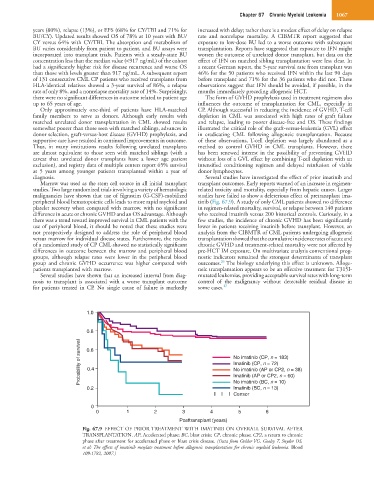
              Marrow was used as the stem cell source in all initial transplant   transplant outcomes. Early reports warned of an increase in regimen-
            studies. Two large randomized trials involving a variety of hematologic   related toxicity and mortality, especially from hepatic causes. Larger
            malignancies have shown that use of filgrastim (G-CSF)-mobilized   studies have failed to show a deleterious effect of pretransplant ima-
            peripheral blood hematopoietic cells leads to more rapid myeloid and   tinib (Fig. 67.9). A study of only CML patients showed no difference
            platelet recovery when compared with marrow, with no significant   in regimen-related mortality, survival, or relapse between 140 patients
            difference in acute or chronic GVHD and an OS advantage. Although   who received imatinib versus 200 historical controls. Curiously, in a
            there was a trend toward improved survival in CML patients with the   few studies, the incidence of chronic GVHD has been significantly
            use of peripheral blood, it should be noted that these studies were   lower in patients receiving imatinib before transplant. However, an
            not  prospectively  designed  to  address  the  role  of  peripheral  blood   analysis from the CIBMTR of CML patients undergoing allogeneic
            versus marrow for individual disease states. Furthermore, the results   transplantation showed that the cumulative incidence rates of acute and
            of a randomized study of CP CML showed no statistically significant   chronic GVHD and treatment-related mortality were not affected by
            differences  in  outcome  between  the  marrow  and  peripheral  blood   pre-HCT IM exposure. On multivariate analysis conventional prog-
            groups,  although  relapse  rates  were  lower  in  the  peripheral  blood   nostic indicators remained the strongest determinants of transplant
                                                                         26
            group  and  chronic  GVHD  occurrence  was  higher  compared  with   outcomes.  The biology underlying this effect is unknown. Alloge-
            patients transplanted with marrow.                    neic transplantation appears to be an effective treatment for T315I-
              Several studies have shown that an increased interval from diag-  mutated leukemias, providing acceptable survival rates with long-term
            nosis  to  transplant  is  associated  with  a  worse  transplant  outcome   control  of  the  malignancy  without  detectable  residual  disease  in
            for  patients  treated  in  CP.  No  single  cause  of  failure  is  markedly   some cases. 27


                             1.0


                             0.8
                           Probability of survival  0.6                      No imatinib (CP, n = 183)


                                                                             Imatinib (CP, n = 72)
                              0.4
                                                                             No imatinib (AP or CP2, n = 38)
                                                                             No imatinib (BC, n = 10)
                                                                             Imatinib (BC, n = 13)
                             0.2                                             Imatinib (AP or CP2, n = 60)
                                                                             Censor
                               0
                                0         1        2         3        4        5        6
                                                            Posttransplant (years)
                            Fig. 67.9  EFFECT OF PRIOR TREATMENT WITH IMATINIB ON OVERALL SURVIVAL AFTER
                            TRANSPLANTATION. AP, Accelerated phase; BC, blast crisis; CP, chronic phase; CP2, a return to chronic
                            phase after treatment for accelerated phase or blast crisis disease. (Data from Oehler VG, Gooley T, Snyder DS,
                            et al: The effects of imatinib mesylate treatment before allogeneic transplantation for chronic myeloid leukemia. Blood
                            109:1782, 2007.)

