


Page 1255 - Hematology_ Basic Principles and Practice ( PDFDrive )
P. 1255
Chapter 68  The Polycythemias  1101


                                                                  activities, including direct effects on malignant cells, enhancement of
                                                                  antitumor  immune  responses,  induction  of  proapoptotic  genes,
                                                                  inhibition of angiogenesis, and promotion of the cycling of dormant
                                                                  malignant stem cells. Because of the recent development of “targeted”
                                                                  therapies, the use of IFN has been dramatically reduced over the past
                                                                  decade. The increasing awareness of the numerous mutations beyond
                                                                  those involving JAK2 suggest, however, that such an approach using
                                                                  target-specific  agents  is  not  universally  effective.  This  awareness
                                                                  provided the rationale for the use of an agent such as IFN-α that
                                                                  might  be  especially  useful  for  the  treatment  of  a  disease  in  which
                                                                  multiple genetic, epigenetic, and environmental factors contribute to
                                                                  its origin and progression. IFN-α promotes apoptosis of a variety of
                                                                  tumor cell types. The induction of apoptosis by IFN-α involves the
                                                                  activation  of  a  number  of  IFN-stimulated  genes  that  mediate  this
                                                                  response. Gene expression studies have identified more than 15 IFN-
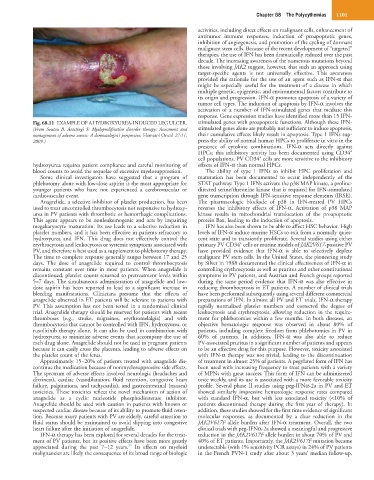
            Fig. 68.11  EXAMPLE OF A HYDROXYUREA-INDUCED LEG ULCER.   stimulated genes with proapoptotic functions. Although these IFN-
            (From  Soutou  B,  Aractingi  S:  Myeloproliferative  disorder  therapy:  Assessment  and   stimulated genes alone are probably not sufficient to induce apoptosis,
            management of adverse events: A dermatologist’s perspective. Hematol Oncol 27:11,   their cumulative effects likely result in apoptosis. Type 1 IFNs sup-
            2009.)                                                press the ability of normal human HPCs to proliferate in vitro in the
                                                                  presence  of  cytokine  combinations.  IFN-α  acts  directly  against
                                                                                                                    +
                                                                  HPCs; this inhibitory activity has been documented using CD34
                                                                                      +
                                                                  cell populations. PV CD34  cells are more sensitive to the inhibitory
            hydroxyurea requires patient compliance and careful monitoring of   effects of IFN-α than normal HPCs.
            blood counts to avoid the sequelae of excessive myelosuppression.  The  ability  of  type  1  IFNs  to  inhibit  HPC  proliferation  and
              Some  clinical  investigators  have  suggested  that  a  program  of   maturation  has  been  documented  to  occur  independently  of  the
            phlebotomy alone with low-dose aspirin is the most appropriate for   STAT pathway. Type 1 IFNs activate the p38 MAP kinase, a proline-
            younger  patients  who  have  not  experienced  a  cerebrovascular  or   directed serine/threonine kinase that is required for IFN-stimulated
            cardiovascular event.                                 gene transcription through IFN-sensitive response elements (IRSE).
              Anagrelide, a selective inhibitor of platelet production, has been   The  pharmacologic  blockade  of  p38  in  IFN-treated  PV  HPCs
            used to treat uncontrolled thrombocytosis not responsive to hydroxy-  reverses  the  inhibitory  effects  of  IFN-α.  Activation  of  p38  MAP
            urea in PV patients with thrombotic or hemorrhagic complications.   kinase  results  in  mitochondrial  translocation  of  the  proapoptotic
            This  agent  appears  to  be  nonleukemogenic  and  acts  by  impairing   protein Bax, leading to the induction of apoptosis.
            megakaryocyte maturation. Its use leads to a selective reduction in   IFN has also been shown to be able to affect HSC behavior. High
            platelet numbers, and it has been effective in patients refractory to   levels of IFN-α induce murine HSCs to exit from a normally quies-
            hydroxyurea  and  IFN.  This  drug  does  not  effectively  control  the   cent state and to transiently proliferate. Several studies using either
                                                                                +
            erythrocytosis and leukocytosis or systemic symptoms associated with   primary PV CD34  cells or murine models of JAK2V617-positive PV
            PV, and therefore is best used as a supplement to phlebotomy therapy.   have  provided  evidence  that  IFN-α  is  able  to  selectively  deplete
            The time to complete response generally ranges between 17 and 25   malignant PV stem cells. In the United States, the pioneering study
            days.  The  dose  of  anagrelide  required  to  control  thrombocytosis   by Silver in 1988 documented the clinical effectiveness of IFN-α in
            remains  constant  over  time  in  most  patients.  When  anagrelide  is   controlling erythrocytosis as well as pruritus and other constitutional
            discontinued, platelet counts returned to pretreatment levels within   symptoms in PV patients, and Austrian and French groups reported
            5–7 days. The simultaneous administration of anagrelide and low-  during  the  same  period  evidence  that  IFN-α  was  also  effective  in
            dose  aspirin  has  been  reported  to  lead  to  a  significant  increase  in   reducing thrombocytosis in ET patients. A number of clinical trials
            bleeding  manifestations.  Clinicians  presume  that  the  effects  of   have been performed subsequently using several different commercial
            anagrelide observed in ET patients will be relevant to patients with   preparations of IFN. In almost all PV and ET trials, IFN-α therapy
            PV. This assumption has not been tested in a randomized clinical   rapidly  normalized  platelet  numbers  and  corrected  the  degree  of
            trial. Anagrelide therapy should be reserved for patients with recent   leukocytosis  and  erythrocytosis,  allowing  reduction  in  the  require-
            thromboses  (e.g.,  stroke,  migraines,  erythromelalgia)  and  with   ment for phlebotomies within a few months. In both diseases, an
            thrombocytosis that cannot be controlled with IFN, hydroxyurea, or   objective  hematologic  response  was  observed  in  about  80%  of
            ruxolitinib therapy alone. It can also be used in combination with   patients, including complete freedom from phlebotomies in PV in
            hydroxyurea to minimize adverse events that accompany the use of   60%  of  patients.  In  addition,  IFN-α  was  also  able  to  reduce
            each drug alone. Anagrelide should not be used in pregnant patients   PV-associated pruritus in a significant number of patients and appears
            because it can easily cross the placenta, leading to adverse effects on   to be an effective drug for this purpose. However, toxicity associated
            the platelet count of the fetus.                      with IFN-α therapy was not trivial, leading to the discontinuation
              Approximately 15–20% of patients treated with anagrelide dis-  of treatment in almost 25% of patients. A pegylated form of IFN has
            continue the medication because of nonmyelosuppressive side effects.   been used with increasing frequency to treat patients with a variety
            The spectrum of adverse effects involved neurologic (headaches and   of MPNs with great success. This form of IFN can be administered
            dizziness),  cardiac  (vasodilatation,  fluid  retention,  congestive  heart   once weekly, and its use is associated with a more favorable toxicity
            failure, palpitations, and tachycardia), and gastrointestinal (nausea)   profile. Several phase II studies using peg-IFNα-2a in PV and ET
            toxicities. These toxicities reflect the novel mechanism of action of   showed  similarly  impressive  hematologic  response  rates  compared
            anagrelide  as  a  cyclic  nucleotide  phosphodiesterase  inhibitor.   with  standard  IFN-α,  but  with  less  associated  toxicity  (<10%  of
            Anagrelide should be used with caution in patients with known or   patients  discontinued  therapy  during  the  first  year  of  therapy).  In
            suspected cardiac disease because of its ability to promote fluid reten-  addition, these studies showed for the first time evidence of significant
            tion. Because many patients with PV are elderly, careful attention to   molecular  responses,  as  documented  by  a  clear  reduction  in  the
            fluid status should be maintained to avoid slipping into congestive   JAK2V617F allele burden after IFN-α treatment. Overall, the two
            heart failure after the initiation of anagrelide.     clinical trials with peg-IFNα-2a showed a meaningful and progressive
              IFN-α therapy has been explored for several decades for the treat-  reduction in the JAK2V617F allele burden in about 70% of PV and
            ment of PV patients, but its positive effects have been more greatly   40% of ET patients. Importantly, the JAK2V617F mutation became
                                           29
            appreciated  during  the  past  7–12  years.   Its  effects  on  myeloid   undetectable (with 1% sensitivity PCR assays) in 24% of PV patients
            malignancies are likely the consequence of its broad range of biologic   in the French PVN-1 study after about 3 years’ median follow-up,

