


Page 1252 - Hematology_ Basic Principles and Practice ( PDFDrive )
P. 1252
1098   Part VII  Hematologic Malignancies


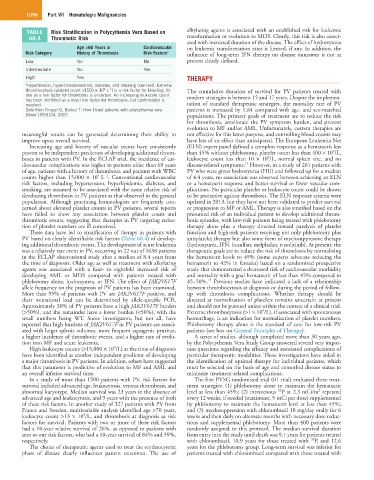
          TABLE   Risk Stratification in Polycythemia Vera Based on   alkylating agents is associated with an established risk for leukemic
          68.4    Thrombotic Risk                             transformation or evolution to MDS. Clearly, this risk is also associ-
                                                              ated with increased duration of the disease. The effect of hydroxyurea
                          Age >60 Years or      Cardiovascular   on leukemic transformation rates is limited, if any. In addition, the
         Risk Category    History of Thrombosis  Risk Factors a  influence of long-term IFN therapy on disease outcomes is not at
         Low              No                    No            present clearly defined.
         Intermediate     No                    Yes
         High             Yes                                 THERAPY
         a Hypertension, hypercholesterolemia, diabetes, and smoking (see text). Extreme
                                   9
         thrombocytosis (platelet count >1500 × 10  L ) is a risk factor for bleeding. Its   The  cumulative  duration  of  survival  for  PV  patients  treated  with
                                     −1
         role as a risk factor for thrombosis is uncertain. An increasing leukocyte count   modern strategies is between 15 and 17 years. Despite the implemen-
         has been identified as a novel risk factor for thrombosis, but confirmation is
         required.                                            tation  of  standard  therapeutic  strategies,  the  mortality  rate  of  PV
         Data from Finazzi G, Barbui T: How I treat patients with polycythemia vera.   patients is increased by 1.84 compared with age- and sex-matched
         Blood 109:5104, 2007.                                populations. The primary goals of treatment are to reduce the risk
                                                              for  thrombosis,  ameliorate  the  PV  symptom  burden,  and  prevent
                                                              evolution to MF and/or AML. Unfortunately, current therapies are
        meaningful  results  can  be  generated  determining  their  ability  to   not effective for this latter purpose, and controlling blood counts may
        improve upon overall survival.                        have less of an effect than anticipated. The European Leukemia Net
           Increasing  age  and  history  of  vascular  events  have  consistently   (ELN) expert panel defined a complete response as a hematocrit less
                                                                                                              9
        proven to be independent predictors of developing additional throm-  than 45% without phlebotomy, platelet count less than 400 × 10 /L,
                                                                                         9
        boses in patients with PV. In the ECLAP trial, the incidence of car-  leukocyte count less than 10  × 10 /L, normal spleen size, and no
                                                                                 25
        diovascular complications was higher in patients older than 69 years   disease-related symptoms.  However, in a study of 261 patients with
        of age, patients with a history of thrombosis, and patients with WBC   PV who were given hydroxyurea (HU) and followed up for a median
                                 9
                                   −1
        counts higher than 15,000 × 10  L . Conventional cardiovascular   of 4.4 years, no association was observed between achieving an ELN
        risk  factors,  including  hypertension,  hyperlipidemia,  diabetes,  and   or a hematocrit response and better survival or fewer vascular com-
        smoking, are assumed to be associated with the same relative risk of   plications. No particular platelet or leukocyte count could be shown
        developing thrombosis in PV patients as that observed in the general   to be protective against thrombosis. The ELN response criteria were
        population.  Although  practicing  hematologists  are  frequently  con-  updated in 2013, but they have not been validated to predict survival
        cerned about elevated platelet counts in PV patients, several reports   or progression to MF or AML. Therapy is also stratified based on the
        have  failed  to  show  any  association  between  platelet  count  and   presumed risk of an individual patient to develop additional throm-
        thrombotic events, suggesting that therapies in PV targeting reduc-  botic episodes, with low-risk patients being treated with phlebotomy
        tion of platelet numbers are ill conceived.           therapy  alone  plus  a  therapy  directed  toward  paralysis  of  platelet
           These data have led to stratification of therapy in patients with   function and high-risk patients receiving not only phlebotomy plus
        PV based on clearly identifiable risk factors (Table 68.4) of develop-  antiplatelet therapy but also some form of myelosuppressive therapy
        ing additional thrombotic events. The development of acute leukemia   (hydroxyurea, IFN, busulfan, melphalan, ruxolitinib). At present, the
        was a relatively rare event in PV, occurring in 22 out of 1638 patients   therapeutic goals are to reduce the risk of thrombosis by normalizing
        in the ECLAP observational study after a median of 8.4 years from   the hematocrit levels to 45% (some experts advocate reducing the
        the time of diagnosis. Older age as well as treatment with alkylating   hematocrit to 42% in females) based on a randomized prospective
        agents  was  associated  with  a  four-  to  eightfold  increased  risk  of   study that demonstrated a decreased risk of cardiovascular morbidity
        developing  AML  or  MDS  compared  with  patients  treated  with   and mortality with a goal hematocrit of less than 45% compared to
                                                                     21
        phlebotomy alone, hydroxyurea, or IFN. The effect of JAK2V617F   45–50%.  Previous studies have indicated a lack of a relationship
        allele frequency on the prognosis of PV patients has been examined.   between thrombocytosis at diagnosis or during the period of follow-
        More than 95% of patients with PV are JAK2V617F positive, and   up  with  thrombotic  complications.  Whether  therapy  should  be
        their  mutational  load  can  be  determined  by  allele-specific  PCR.   directed  at  normalization  of  platelets  remains  uncertain  at  present
        Approximately 30% of PV patients have a high JAK2V617F burden   and should not be pursued unless within the context of a clinical trial.
                                                                                       9
        (>50%), and the remainder have a lower burden (<50%), with the   Extreme thrombocytosis (>1 × 10 /L), if associated with spontaneous
        small  numbers  being  WT.  Some  investigators,  but  not  all,  have   hemorrhage, is an indication for normalization of platelet numbers.
        reported that high burdens of JAK2V617F in PV patients are associ-  Phlebotomy  therapy  alone  is  the  standard  of  care  for  low-risk  PV
        ated with larger splenic volumes, more frequent aquagenic pruritus,   patients (see box on General Principles of Therapy).
        a higher incidence of thrombotic events, and a higher rate of evolu-  A series of studies, although completed more than 30 years ago,
        tion into MF and acute leukemia.                      by the Polycythemia Vera Study Group answered several very impor-
                                      9
           High leukocyte counts (>15,000 × 10 /L) at the time of diagnosis   tant questions regarding the efficacy and associated complications of
        have been identified as another independent predictor of developing   particular therapeutic modalities. These investigations have aided in
        a major thrombosis in PV patients. In addition, others have suggested   the identification of optimal therapy for individual patients, which
        that this parameter is predictive of evolution to MF and AML and   must be selected on the basis of age and comorbid disease status to
        an overall inferior survival time.                    minimize treatment-related complications.
           In a study of more than 1500 patients with PV, risk factors for   The first PVSG randomized trial (01 trial) evaluated three treat-
        survival included advanced age, leukocytosis, venous thrombosis, and   ment  strategies:  (1)  phlebotomy  alone  to  maintain  the  hematocrit
                                                                                            32
                                                                                                         2
        abnormal karyotype. Median survival was 23 years in the absence of   level at less than 45%; (2) intravenous  P at 2.3 mCi/m  repeated
        advanced age and leukocytosis, and 9 years with the presence of both   every 12 weeks, if needed (maximum, 5 mCi per dose) supplemented
        of these risk factors. In another study of 327 patients with PV from   by phlebotomy to maintain the hematocrit level at less than 45%;
        France and Sweden, multivariable analysis identified age >70 years,   and (3) myelosuppression with chlorambucil 10 mg/day orally for 6
                            9
        leukocyte count >13 × 10 /L, and thrombosis at diagnosis as risk   weeks and then daily on alternate months with necessary dose reduc-
        factors for survival. Patients with two or more of these risk factors   tions and supplemental phlebotomy. More than 400 patients were
        had a 10-year relative survival of 26%, as opposed to patients with   randomly  assigned  to  this  protocol. The  median  survival  duration
        zero or one risk factors, who had a 10-year survival of 84% and 59%,   from entry into the study until death was 9.1 years for patients treated
                                                                                                       32
        respectively.                                         with chlorambucil, 10.9 years for those treated with  P, and 12.6
           The choice of therapeutic agents used to treat the erythrocytotic   years for the phlebotomy group. Long-term survival was inferior for
        phase  of  disease  clearly  influences  patient  outcomes.  The  use  of   patients treated with chlorambucil compared with those treated with

