


Page 1251 - Hematology_ Basic Principles and Practice ( PDFDrive )
P. 1251
Chapter 68  The Polycythemias  1097


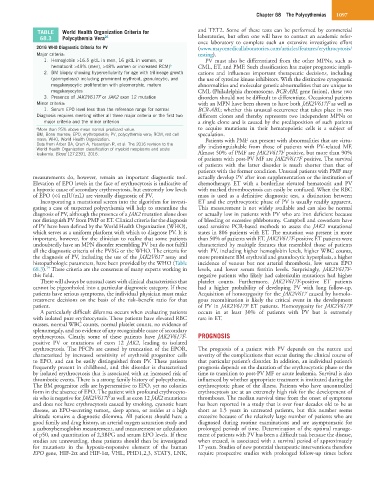
             TABLE   World Health Organization Criteria for       and TET2.  Some  of  these  tests  can  be  performed  by  commercial
              68.3   Polycythemia Vera 24                         laboratories, but often one will have to contact an academic refer-
                                                                  ence  laboratory  to  complete  such  an  extensive  investigative  effort
             2016 WHO Diagnostic Criteria for PV                  (www.mayomedicallaboratories.com/articles/features/erythrocytosis/
             Major criteria:                                      testing).
               1.  Hemoglobin >16.5 g/dL in men, 16 g/dL in women, or   PV  must  also  be  differentiated  from  the  other  MPNs,  such  as
                  hematocrit >49% (men), >48% women or increased RCM) a  CML, ET, and PMF. Such classification has major prognostic impli-
               2.  BM biopsy showing hypercellularity for age with trilineage growth   cations  and  influences  important  therapeutic  decisions,  including
                  (panmyelosis) including prominent erythroid, granulocytic, and   the use of tyrosine kinase inhibitors. With the distinctive cytogenetic
                  megakaryocytic proliferation with pleomorphic, mature   abnormalities and molecular genetic abnormalities that are unique to
                  megakaryocytes                                  CML (Philadelphia chromosome, BCR-ABL gene fusion), these two
               3.  Presence of JAK2V617F or JAK2 exon 12 mutation  disorders should not be difficult to differentiate. Occasional patients
             Minor criteria:                                      with an MPN have been shown to have both JAK2V617F as well as
               1.  Serum EPO level less than the reference range for normal  BCR-ABL; whether this unusual occurrence that takes place in two
             Diagnosis requires meeting either all three major criteria or the first two   different clones and thereby represents two independent MPNs or
               major criteria and the minor criterion             a single clone and is caused by the predisposition of such patients
             a More than 25% above mean normal predicted value.   to  acquire  mutations  in  their  hematopoietic  cells  is  a  subject  of
             BM, Bone marrow; EPO, erythropoietin; PV, polycythemia vera; RCM, red cell   speculation.
             mass; WHO, World Health Organization.                  Patients with PMF can present with abnormalities that are virtu-
             Data from Arber DA, Orazi A, Hasserjian R, et al: The 2016 revision to the   ally  indistinguishable  from  those  of  patients  with  PV-related  MF.
             World Health Organization classification of myeloid neoplasms and acute
             leukemia. Blood 127:2391, 2016.                      Almost 50% of PMF are JAK2V617F positive, but more than 90%
                                                                  of patients with post-PV MF are JAK2V617F positive. The survival
                                                                  of  patients  with  the  latter  disorder  is  much  shorter  than  that  of
                                                                  patients with the former condition. Unusual patients with PMF may
            measurements  do,  however,  remain  an  important  diagnostic  tool.   actually develop PV after iron supplementation or the institution of
            Elevation of EPO levels in the face of erythrocytosis is indicative of   chemotherapy.  ET  with  a  borderline  elevated  hematocrit  and  PV
            a hypoxic cause of secondary erythrocytosis, but extremely low levels   with marked thrombocytosis can easily be confused. When the RBC
            of EPO (<4 mIU/mL) are virtually diagnostic of PV.    mass  is  used  as  a  definitive  diagnostic  test,  a  distinction  between
              Incorporating a mutational screen into the algorithm for investi-  ET and the erythrocytotic phase of PV is usually readily apparent.
            gating a case of suspected polycythemia will help to streamline the   This  measurement  is  not  widely  available  and  can  also  be  normal
            diagnosis of PV, although the presence of a JAK2 mutation alone does   or actually low in patients with PV who are iron deficient because
            not distinguish PV from PMF or ET. Clinical criteria for the diagnosis   of bleeding or excessive phlebotomy. Campbell and coworkers have
            of PV have been defined by the World Health Organization (WHO),   used  sensitive  PCR-based  methods  to  assess  the  JAK2  mutational
            which serves as a uniform platform with which to diagnose PV. It is   states in 806 patients with ET. The mutation was present in more
            important,  however,  for  the  clinician  to  realize  that  some  patients   than 50% of patients with ET. JAK2V617F-positive ET patients were
            undoubtedly have an MPN disorder resembling PV but do not fulfill   characterized by multiple features that resembled those of patients
            all the diagnostic criteria of the PVSG or the WHO. The criteria for   with PV, including higher hemoglobin levels, higher WBC counts,
            the diagnosis of PV, including the use of the JAK2V617 assay and   more prominent BM erythroid and granulocytic hyperplasia, a higher
            histopathologic parameters, have been provided by the WHO (Table   incidence  of  venous  but  not  arterial  thrombosis,  low  serum  EPO
                24
            68.3).  These criteria are the consensus of many experts working in   levels,  and  lower  serum  ferritin  levels.  Surprisingly,  JAK2V617F-
            this field.                                           negative patients who likely had calreticulin mutations had higher
              There will always be unusual cases with clinical characteristics that   platelet  counts.  Furthermore,  JAK2V617F-positive  ET  patients
            cannot be pigeonholed into a particular diagnostic category. If these   had  a  higher  probability  of  developing  PV  with  long  follow-up.
            patients have serious symptoms, the individual physician must make   Acquisition of homozygosity for the JAK2V617 caused by homolo-
            treatment  decisions  on  the  basis  of  the  risk–benefit  ratio  for  that   gous  recombination  is  likely  the  critical  event  in  the  development
            patient.                                              of PV in JAK2V617F ET patients. Homozygosity for JAK2V617F
              A particularly difficult dilemma occurs when evaluating patients   occurs  in  at  least  30%  of  patients  with  PV  but  is  extremely
            with isolated pure erythrocytosis. These patients have elevated RBC   rare in ET.
            masses, normal WBC counts, normal platelet counts, no evidence of
            splenomegaly, and no evidence of any recognizable cause of secondary
            erythrocytosis.  Clearly,  some  of  these  patients  have  JAK2V617F-  PROGNOSIS
            positive  PV  or  mutations  of  exon  12  JAK2,  leading  to  isolated
            erythrocytosis. The PFCPs are caused by truncation of the EPOR,   The  prognosis  of  a  patient  with  PV  depends  on  the  nature  and
            characterized  by  increased  sensitivity  of  erythroid  progenitor  cells   severity of the complications that occur during the clinical course of
            to  EPO,  and  can  be  easily  distinguished  from  PV. These  patients   that particular patient’s disorder. In addition, an individual patient’s
            frequently  present  in  childhood,  and  this  disorder  is  characterized   prognosis depends on the duration of the erythrocytotic phase or the
            by isolated erythrocytosis that is associated with an increased risk of   time to transition to post-PV MF or acute leukemia. Survival is also
            thrombotic events. There is a strong family history of polycythemia.   influenced by whether appropriate treatment is instituted during the
            The BM progenitor cells are hypersensitive to EPO, yet no colonies   erythrocytotic phase of the illness. Patients who have uncontrolled
            form in the absence of EPO. The patient with profound erythrocyto-  erythrocytosis are at an extremely high risk for the development of
            sis who is negative for JAK2V617F as well as exon 12 JAK2 mutations   thromboses. The median survival time from the onset of symptoms
            and does not have erythrocytosis caused by smoking, cyanotic heart   has been reported in a study that is over four decades old to be as
            disease, an EPO-secreting tumor,, sleep apnea, or resides at a high   short  as  1.5  years  in  untreated  patients,  but  this  number  seems
            altitude  remains  a  diagnostic  dilemma.  All  patients  should  have  a   excessive because of the relatively large number of patients who are
            good family and drug history, an arterial oxygen saturation study and   diagnosed  during  routine  examinations  and  are  asymptomatic  for
            a carboxyhemoglobin measurement, and measurement or calculation   prolonged periods of time. Determination of the optimal manage-
            of p50, and quantitation of 2,3BPG and serum EPO levels. If these   ment of patients with PV has been a difficult task because the disease,
            studies are unrewarding, these patients should then be investigated   when treated, is associated with a survival period of approximately
            for  mutations  in  the  hypoxia-responsive  element  of  the  human   17 years. Studies of new potential therapeutic interventions therefore
            EPO gene, HIF-2α and HIF-1α, VHL, PHD1,2,3, STAT5, LNK,   require  prospective  studies  with  prolonged  follow-up  times  before

