


Page 1254 - Hematology_ Basic Principles and Practice ( PDFDrive )
P. 1254
1100   Part VII  Hematologic Malignancies


                                                              However, it should be avoided in patients with extremely high platelet
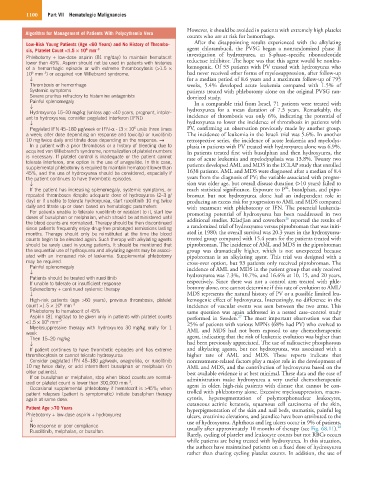
         Algorithm for Management of Patients With Polycythemia Vera
                                                              counts who are at risk for hemorrhage.
          Low-Risk Young Patients (Age <60 Years) and No History of Thrombo-  After  the  disappointing  results  experienced  with  the  alkylating
          sis, Platelet Count <1.5 × 10  mm −3                agent  chlorambucil,  the  PVSG  began  a  nonrandomized  phase  II
                             6
          Phlebotomy  +  low-dose  aspirin  (81 mg/day)  to  maintain  hematocrit   investigation  of  hydroxyurea,  an  S-phase–specific  ribonucleotide
          lower than 45%. Aspirin should not be used in patients with histories   reductase inhibitor. The hope was that this agent would be nonleu-
          of  a  hemorrhagic  episode  or  with  extreme  thrombocytosis  (>1.5  ×   kemogenic. Of 53 patients with PV treated with hydroxyurea who
           6
               −3
          10  mm ) or acquired von Willebrand syndrome.       had never received other forms of myelosuppression, after follow-up
           ↓                                                  for a median period of 8.6 years and a maximum follow-up of 795
           Thrombosis or hemorrhage                           weeks,  5.4%  developed  acute  leukemia  compared  with  1.5%  of
           Systemic symptoms                                  patients treated with phlebotomy alone on the original PVSG ran-
           Severe pruritus refractory to histamine antagonists  domized study.
           Painful splenomegaly                                  In a comparable trial from Israel, 71 patients were treated with
           ↓                                                  hydroxyurea  for  a  mean  duration  of  7.3  years.  Remarkably,  the
           Hydroxyurea 15–20 mg/kg (unless age <40 years, pregnant, intoler-
          ant to hydroxyurea; consider pegylated interferon [IFN])  incidence  of  thrombosis  was  only  6%,  indicating  the  potential  of
           ↓                                                  hydroxyurea to lower the incidence of thrombosis in patients with
                                             6
           Pegylated IFN 45–180 µg/week or IFN-α - (3 × 10  units three times   PV, confirming an observation previously made by another group.
          a week; alter dose depending on response and toxicity) or ruxolitinib   The incidence of leukemia in the Israeli trial was 5.6%. In another
          10 mg twice daily and titrate dose depending on the response. →  retrospective series, the incidence of acute leukemia and myelodys-
           In a patient with a prior thrombosis or a history of bleeding due to   plasia in patients with PV treated with hydroxyurea alone was 6.9%.
          acquired von Willebrand’s syndrome, normalization of platelet numbers   In patients treated first with busulphan and then hydroxyurea, the
          is  necessary.  If  platelet  control  is  inadequate  or  the  patient  cannot   rate of acute leukemia and myelodysplasia was 13.8%. Twenty two
          tolerate interferon, one option is the use of anagrelide. In this case,   patients developed AML and MDS in the ECLAP study that enrolled
          supplemental phlebotomy is required to maintain hematocrit lower than
          45%, and the use of hydroxyurea should be considered, especially if   1638 patients. AML and MDS were diagnosed after a median of 8.4
          the patient continues to have thrombotic episodes.  years from the diagnosis of PV; the variable associated with progres-
           ↓                                                  sion was older age, but overall disease duration (>10 years) failed to
                                                                                              32
           If the patient has increasing splenomegaly, systemic symptoms, or   reach statistical significance. Exposure to P , busulphan, and pipo-
          repeated  thromboses  despite  adequate  dose  of  hydroxyurea  (2–3 g/  broman  but  not  hydroxyurea  alone  had  an  independent  role  in
          day) or if unable to tolerate hydroxyurea, start ruxolitinib 10 mg twice   producing an excess risk for progression to AML and MDS compared
          daily and titrate up or down based on hematologic parameters  with treatment with phlebotomy or IFN. The potential leukemia-
           For patients unable to tolerate ruxolitinib or resistant to it, start low   promoting  potential  of  hydroxyurea  has  been  readdressed  in  two
          doses of busulphan or melphalan, which should be administered until   additional studies. Kiladjian and coworkers  reported the results of
                                                                                              26
          the blood counts are normalized. Therapy should be then discontinued
          since patients frequently enjoy drug-free prolonged remissions lasting   a randomized trial of hydroxyurea versus piprobroman that was initi-
          months.  Therapy  should  only  be  reinstituted  at  the  time  the  blood   ated in 1980; the overall survival was 20.3 years in the hydroxyurea-
          counts begin to be elevated again. Such therapy with alkylating agents   treated group compared with 15.4 years for the patients treated with
          should be rarely used in young patients. It should be mentioned that   piprobroman. The incidence of AML and MDS in the piprobroman
          the sequential use of hydroxyurea and alkylating agents may be associ-  group  was  dramatically  higher,  which  is  not  unexpected  because
          ated  with  an  increased  risk  of  leukemia.  Supplemental  phlebotomy   pipobroman  is  an  alkylating  agent. This trial  was  designed with a
          may be required.                                    cross-over option, but 93 patients only received piprobroman. The
           Painful splenomegaly                               incidence of AML and MDS in the patient group that only received
           ↓                                                  hydroxyurea was 7.3%, 10.7%, and 16.6% at 10, 15, and 20 years,
           Patients should be treated with ruxolitinib
           If unable to tolerate or insufficient response     respectively.  Since  there  was  not  a  control  arm  treated  with  phle-
           Splenectomy + continued systemic therapy           botomy alone, one cannot determine if this rate of evolution to AML/
           ↓                                                  MDS represents the natural history of PV or a possible limited leu-
           High-risk  patients  (age  >60  years),  previous  thrombosis,  platelet   kemogenic effect of hydroxyurea. Interestingly, no difference in the
                     6
          count >1.5 × 10  mm −3                              incidence of vascular events was seen between the two arms. This
           Phlebotomy to hematocrit of 45%                    same  question  was  again  addressed  in  a  nested  case–control  study
           Aspirin (81 mg/day) to be given only in patients with platelet counts   performed in Sweden.  The most important observation was that
                                                                               27
                6
          <1.5 × 10  mm −2                                    25% of patients with various MPNs (68% had PV) who evolved to
           Myelosuppressive  therapy  with  hydroxyurea  30 mg/kg  orally  for  1   AML  and  MDS  had  not  been  exposed  to  any  chemotherapeutic
          week
           Then 15–20 mg/kg                                   agent, indicating that the risk of leukemic evolution was higher than
           ↓                                                  had been previously appreciated. The use of radioactive phosphorous
           If  patient  continues  to  have  thrombotic  episodes  and  has  extreme   and  alkylating  agents,  but  not  hydroxyurea,  was  associated  with  a
          thrombocytosis or cannot tolerate hydroxyurea       higher  rate  of  AML  and  MDS.  These  reports  indicate  that
           Consider  pegylated  IFN  45–180 µg/week,  anagrelide,  or  ruxolitinib   nontreatment-related factors play a major role in the development of
          10 mg  twice  daily,  or  add  intermittent  busulphan  or  melphalan  (in   AML and MDS, and the contribution of hydroxyurea based on the
          older patients).                                    best available evidence is at best minimal. These data and the ease of
           If on busulphan or melphalan, stop when blood counts are normal-  administration  make  hydroxyurea  a  very  useful  chemotherapeutic
                                           −3
          ized or platelet count is lower than 300,000 mm .   agent in older, high-risk patients with disease that cannot be con-
           Occasional supplemental phlebotomy if hematocrit is >45%; when
          patient  relapses  (patient  is  symptomatic)  initiate  busulphan  therapy   trolled with phlebotomy alone. Excessive myelosuppression, macro-
          again at same dose.                                 cytosis,  hypersegmentation  of  polymorphonuclear  leukocytes,
                                                              cutaneous  actinic  keratosis,  squamous  cell  carcinoma  of  the  skin,
          Patient Age >70 Years                               hyperpigmentation of the skin and nail beds, stomatitis, painful leg
          Phlebotomy + low-dose aspirin + hydroxyurea         ulcers, creatinine elevations, and jaundice have been attributed to the
           ↓                                                  use of hydroxyurea. Aphthous and leg ulcers occur in 9% of patients,
           No response or poor compliance                     usually after approximately 10 months of therapy (see Fig. 68.11).
                                                                                                               28
           Ruxolitinib, melphalan, or busulfan.
                                                              Rarely, cycling of platelet and leukocyte counts but not RBCs occurs
                                                              while patients are being treated with hydroxyurea. In this situation,
                                                              the authors have maintained patients on a fixed dose of hydroxyurea
                                                              rather than chasing cycling platelet counts. In addition, the use of

