


Page 1275 - Hematology_ Basic Principles and Practice ( PDFDrive )
P. 1275
Chapter 69  Essential Thrombocythemia  1121


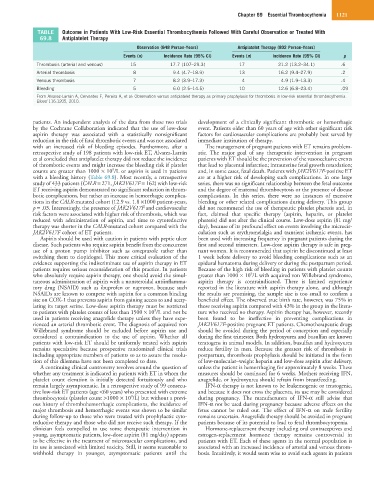
             TABLE   Outcome in Patients With Low-Risk Essential Thrombocythemia Followed With Careful Observation or Treated With
              69.8   Antiplatelet Therapy
                                              Observation (848 Person-Years)   Antiplatelet Therapy (802 Person-Years)
                                         Events (n)    Incidence Rate (95% CI)  Events (n)  Incidence Rate (95% CI)  p
             Thrombosis (arterial and venous)  15        17.7 (107–29.3)       17           21.2 (13.2–34.1)     .6
             Arterial thrombosis             8            9.4 (4.7–18.9)       13           16.2 (9.4–27.9)      .2
             Venous thrombosis               7            8.2 (3.9–17.3)        4            4.9 (1.9–13.3)      .4
             Bleeding                        5            6.0 (2.5–14.5)       10           12.6 (6.8–23.4)      .09
             From Alvarez-Larrán A, Cervantes F, Pereira A, et al: Observation versus antiplatelet therapy as primary prophylaxis for thrombosis in low-risk essential thrombocythemia.
             Blood 116:1205, 2010.


            patients. An independent analysis of the data from these two trials   development  of  a  clinically  significant  thrombotic  or  hemorrhagic
            by the Cochrane Collaboration indicated that the use of low-dose   event. Patients older than 60 years of age with other significant risk
            aspirin  therapy  was  associated  with  a  statistically  nonsignificant   factors for cardiovascular complications are probably best served by
            reduction in the risk of fatal thrombotic events and was not associated   immediate institution of therapy.
            with  an  increased  risk  of  bleeding  episodes.  Furthermore,  after  a   The management of pregnant patients with ET remains problem-
            retrospective study of 198 patients with low-risk ET, Alvarez-Larrán   atic.  The  major  goal  of  any  therapeutic  intervention  in  pregnant
            et al concluded that antiplatelet therapy did not reduce the incidence   patients with ET should be the prevention of the vasoocclusive events
            of thrombotic events and might increase the bleeding risk if platelet   that lead to placental infarction; intrauterine fetal growth retardation;
                                      9
            counts are greater than 1000 × 10 /L or aspirin is used in patients   and, in some cases, fetal death. Patients with JAK2V617F-positive ET
            with a bleeding history (Table 69.8). Most recently, a retrospective   are at a higher risk of developing such complications. In one large
            study of 433 patients (CALR = 271, JAK2V617F = 162) with low-risk   series, there was no significant relationship between the fetal outcome
            ET receiving aspirin demonstrated no significant reduction in throm-  and the degree of maternal thrombocytosis or the presence of disease
            botic complications, but rather an increase in hemorrhagic complica-  complications.  In  this  series,  there  were  no  instances  of  excessive
            tions in the CALR-mutated cohort (12.9 vs. 1.8 ×1000 patient-years,   bleeding or other related complications during delivery. This group
            p = .03. Interestingly, the presence of JAK2V617F and cardiovascular   did not recommend the use of therapeutic platelet pheresis and, in
            risk factors were associated with higher risk of thrombosis, which was   fact,  claimed  that  specific  therapy  (aspirin,  heparin,  or  platelet
            reduced  with  administration  of  aspirin,  and  time  to  cytoreductive   pheresis) did not alter the clinical course. Low-dose aspirin (81 mg/
            therapy was shorter in the CALR-mutated cohort compared with the   day), because of its profound effect on events involving the microcir-
            JAK2V617F cohort of ET patients.                      culation such as erythromelalgia and transient ischemic events, has
              Aspirin should be used with caution in patients with peptic ulcer   been used with increasing frequency in pregnant patients during the
            disease. Such patients who require aspirin benefit from the concurrent   first and second trimesters. Low-dose aspirin therapy is safe in preg-
            use  of  a  proton  pump  inhibitor  such  as  omeprazole  rather  than   nant women. It is recommended that aspirin be discontinued at least
            switching them to clopidogrel. This more critical evaluation of the   1 week before delivery to avoid bleeding complications such as an
            evidence supporting the indiscriminate use of aspirin therapy in ET   epidural hematoma during delivery or during the postpartum period.
            patients requires serious reconsideration of this practice. In patients   Because of the high risk of bleeding in patients with platelet counts
                                                                                   9
            who absolutely require aspirin therapy, one should avoid the simul-  greater than 1000 × 10 /L with acquired von Willebrand syndrome,
            taneous administration of aspirin with a nonsteroidal antiinflamma-  aspirin  therapy  is  contraindicated.  There  is  limited  experience
            tory  drug  (NSAID)  such  as  ibuprofen  or  naproxen,  because  such   reported in the literature with aspirin therapy alone, and although
            NSAIDs are known to compete with aspirin for a common binding   the results are promising, the sample size is too small to confirm a
            site on COX-1 that prevents aspirin from gaining access to and acety-  beneficial effect. The observed true birth rate, however, was 75% in
            lating its target serine. Low-dose aspirin therapy must be restricted   those receiving aspirin compared with 43% in the group in the litera-
                                                    9
            to patients with platelet counts of less than 1500 × 10 /L and not be   ture who received no therapy. Aspirin therapy has, however, recently
            used in patients receiving anagrelide therapy unless they have expe-  been  found  to  be  ineffective  in  preventing  complications  in
            rienced an arterial thrombotic event. The diagnosis of acquired von   JAK2V617F-positive pregnant ET patients. Chemotherapeutic drugs
            Willebrand  syndrome  should  be  excluded  before  aspirin  use  and   should  be  avoided  during  the  period  of  conception  and  especially
            considered  a  contraindication  to  the  use  of  aspirin.  Whether  all   during the first trimester. Both hydroxyurea and busulfan are known
            patients with low-risk ET should be uniformly treated with aspirin   teratogens in animal models. In addition, busulfan and hydroxyurea
            remains  speculative  because  prospective  randomized  clinical  trials   reduce  fertility  in  men.  Because  the  greatest  risk  of  thrombosis  is
            including appropriate numbers of patients so as to assure the resolu-  postpartum, thrombosis prophylaxis should be initiated in the form
            tion of this dilemma have not been completed to date.  of low-molecular–weight heparin and low-dose aspirin after delivery,
              A continuing clinical controversy revolves around the question of   unless the patient is hemorrhaging for approximately 8 weeks. These
            whether any treatment is indicated in patients with ET in whom the   measures should be continued for 6 weeks. Mothers receiving IFN,
            platelet  count  elevation  is  initially  detected  fortuitously  and  who   anagrelide, or hydroxyurea should refrain from breastfeeding.
            remain largely asymptomatic. In a retrospective study of 99 consecu-  IFN-α therapy is not known to be leukemogenic or teratogenic,
            tive low-risk ET patients (age <60 years) who presented with extreme   and because it does not cross the placenta, its use may be considered
                                            9
            thrombocytosis (platelet count >1000 × 10 /L) but without a previ-  during  pregnancy.  The  manufacturers  of  IFN-α  still  advise  that
            ous history of thrombohemorrhagic complications, the incidence of   IFN-α not be used during pregnancy because adverse effects on the
            major thrombosis and hemorrhagic events was shown to be similar   fetus  cannot  be  ruled  out.  The  effect  of  IFN-α  on  male  fertility
            during follow-up to those who were treated with prophylactic cyto-  remains uncertain. Anagrelide therapy should be avoided in pregnant
            reductive therapy and those who did not receive such therapy. If the   patients because of its potential to lead to fetal thrombocytopenia.
            clinician  feels  compelled  to  use  some  therapeutic  intervention  in   Hormone-replacement therapy including oral contraceptives and
            young, asymptomatic patients, low-dose aspirin (81 mg/day) appears   estrogen-replacement  hormone  therapy  remains  controversial  in
            to be effective in the treatment of microvascular complications, and   patients with ET. Each of these agents in the normal population is
            its use is associated with limited toxicity. Still, it seems reasonable to   associated with an increased incidence of arterial and venous throm-
            withhold  therapy  in  younger,  asymptomatic  patients  until  the   bosis. Intuitively, it would seem wise to avoid such agents in patients

