


Page 1271 - Hematology_ Basic Principles and Practice ( PDFDrive )
P. 1271
Chapter 69  Essential Thrombocythemia  1117


                               1.00                                     1.00
                             Overall survival (proportion)  0.50  ET  Leukemia-free survival  (proportion)  0.50  ET
                               0.75
                                                                        0.75


                                                                                  Early or prefibrotic PMF
                                         Early or prefibrotic PMF
                               0.25
                                                                        0.25
                                 0
                                   0  P < .001  10   15     20            0  0  P < .001  10   15    20
                                         5
                                                                                  5
                                        Time since diagnosis (yr)                Time since diagnosis (yr)
                            Events      32     47    31     13       Events       3      5     6     2
                         A  No. at risk  628  326   157     57   B   No. at risk  627  325    156    57
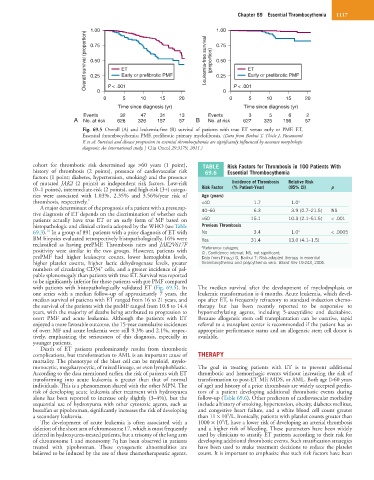
                            Fig.  69.5  Overall  (A)  and  leukemia-free  (B)  survival  of  patients  with  true  ET  versus  early  or  PMF.  ET,
                            Essential thrombocythemia; PMF, prefibrotic primary myelofibrosis. (Data from Barbui T, Thiele J, Passamonti
                            F, et al: Survival and disease progression in essential thrombocythemia are significantly influenced by accurate morphologic
                            diagnosis: An international study. J Clin Oncol 29:3179, 2011.)

            cohort  for  thrombotic  risk  determined  age  >60  years  (1  point),   TABLE   Risk Factors for Thrombosis in 100 Patients With
            history  of  thrombosis  (2  points),  presence  of  cardiovascular  risk   69.6  Essential Thrombocythemia
            factors (1 point; diabetes, hypertension, smoking) and the presence
            of  mutated  JAK2  (2  points)  as  independent  risk  factors.  Low-risk   Incidence of Thrombosis   Relative Risk
            (0–1 points), intermediate-risk (2 points), and high-risk (3+) catego-  Risk Factor  (% Patient-Year)  (95% CI)  p
            ries  were  associated  with  1.03%,  2.35%  and  3.56%/year  risk  of   Age (years)
            thrombosis, respectively. 9                            <40              1.7         1.0 a
              A major determinant of the prognosis of a patient with a presump-
            tive diagnosis of ET depends on the discrimination of whether such   40–60  6.3     3.9 (0.7–21.5)  NS
            patients  actually  have  true  ET  or  an  early  form  of  MF  based  on   >60  15.1  10.3 (2.1–51.5)  < .001
            histopathologic and clinical criteria adopted by the WHO (see Table   Previous Thrombosis
                14
            69.3).  In a group of 891 patients with a prior diagnosis of ET with   No  3.4      1.0 a        < .0005
            BM biopsies evaluated retrospectively histopathologically, 16% were   Yes  31.4    13.0 (4.1–1.5)
            reclassified  as  having  prePMF.  Thrombosis  rates  and  JAK2V617F   a
                                                                   Reference category.
            positivity  were  similar  in  the  two  groups.  However,  patients  with   CI, Confidence interval; NS, not significant.
            prePMF  had  higher  leukocyte  counts,  lower  hemoglobin  levels,   Data from Finazzi G, Barbui T: Risk-adapted therapy in essential
            higher  platelet  counts,  higher  lactic  dehydrogenase  levels,  greater   thrombocythemia and polycythemia vera. Blood Rev 19:243, 2005.
                                  +
            numbers of circulating CD34  cells, and a greater incidence of pal-
            pable splenomegaly than patients with true ET. Survival was reported
            to be significantly inferior for those patients with pre PMF compared
            with patients with histopathologically validated ET (Fig. 69.5). In   The  median  survival  after  the  development  of  myelodysplasia  or
            one  series  with  a  median  follow-up  of  approximately  7  years,  the   leukemic transformation is 4 months. Acute leukemia, which devel-
            median survival of patients with ET ranged from 16 to 21 years, and   ops after ET, is frequently refractory to standard induction chemo-
            the survival of the patients with the preMF ranged from 10.8 to 14.4   therapy  but  has  been  recently  reported  to  be  responsive  to
            years, with the majority of deaths being attributed to progression to   hypomethylating  agents,  including  5-azacytidine  and  decitabine.
            overt  PMF  and  acute  leukemia.  Although  the  patients  with  ET   Because  allogeneic  stem  cell  transplantation  can  be  curative,  rapid
            enjoyed a more favorable outcome, the 15-year cumulative incidences   referral to a transplant center is recommended if the patient has an
            of overt MF and acute leukemia were still 9.3% and 2.1%, respec-  appropriate performance status and an allogeneic stem cell donor is
            tively,  emphasizing  the  seriousness  of  this  diagnosis,  especially  in   available.
            younger patients.
              Death  of  ET  patients  predominantly  results  from  thrombotic
            complications, but transformation to AML is an important cause of   THERAPY
            mortality. The phenotype of the blast cell can be myeloid, myelo-
            monocytic, megakaryocytic, of mixed lineage, or even lymphoblastic.   The  goal  in  treating  patients  with  ET  is  to  prevent  additional
            According to the data mentioned earlier, the risk of patients with ET   thrombotic and hemorrhagic events without increasing the risk of
            transforming  into  acute  leukemia  is  greater  than  that  of  normal   transformation to post-ET MF, MDS, or AML. Both age (>60 years
            individuals. This is a phenomenon shared with the other MPN. The   of age) and history of a prior thrombosis are widely accepted predic-
            risk of developing acute leukemia after treatment with hydroxyurea   tors  of  a  patient  developing  additional  thrombotic  events  during
            alone  has  been  reported  to  increase  only  slightly  (3–4%),  but  the   follow-up (Table 69.6). Other predictors of cardiovascular morbidity
            sequential use of hydroxyurea with other cytotoxic agents, such as   include a history of smoking, hypertension, obesity, diabetes mellitus,
            busulfan or pipobroman, significantly increases the risk of developing   and  congestive  heart  failure,  and  a  white  blood  cell  count  greater
                                                                           9
            a secondary leukemia.                                 than 11 × 10 /L. Ironically, patients with platelet counts greater than
                                                                          9
              The  development  of  acute  leukemia  is  often  associated  with  a   1000 × 10 /L have a lower risk of developing an arterial thrombosis
            deletion of the short arm of chromosome 17, which is most frequently   and  a  higher  risk  of  bleeding. These  parameters  have  been  widely
            deleted in hydroxyurea-treated patients, but a trisomy of the long arm   used by clinicians to stratify ET patients according to their risk for
            of chromosome 1 and monosomy 7q has been observed in patients   developing additional thrombotic events. Such stratification strategies
            treated  with  pipobroman.  These  cytogenetic  abnormalities  are   have been used to make treatment decisions to reduce the platelet
            believed to be induced by the use of these chemotherapeutic agents.   count. It is important to emphasize that such risk factors have been

