


Page 1276 - Hematology_ Basic Principles and Practice ( PDFDrive )
P. 1276
1122   Part VII  Hematologic Malignancies


        with ET who are already at an increased risk of developing throm-  TABLE
        bosis. Gangat et al retrospectively reviewed the consequences of such   69.9  Response Criteria for Essential Thrombocythemia
        hormonal interventions in 305 women. Oral contraceptive therapy
        was associated with a high incidence of venous thrombosis occurring    Criteria
        within  the  abdominal  cavity,  but  estrogen-replacement  hormone   Complete Remission
        therapy in menopausal women did not appear to be associated with   A   Durable  resolution of disease-related signs
                                                                                    a
        an increased incidence of thrombosis. This observation is surprising     including palpable hepatosplenomegaly, large
        and  might  be  a  consequence  of  the  limited  numbers  of  patients   symptoms improvement,  AND
                                                                                                 b
        included within this study.                                                 a
           If a patient with ET develops a thrombotic episode, anticoagula-  B  Durable  peripheral blood count remission,
                                                                                                         9
        tion with low-molecular–weight heparin and then transition to an         defined as: platelet count ≤400 ×10 /L, WBC
                                                                                           9
        oral anticoagulant is recommended. The thrombotic episode places         count <10 × 10 /L, absence of
        a patient into a high-risk group in which myelosuppressive therapy is    leukoerythroblastosis, AND
        clearly indicated. Whether patients should have life-long anticoagula-  C  Without signs of progressive disease, and
        tion or should receive only 6–12 months of anticoagulation after they    absence of any hemorrhagic or thrombotic
        are in a complete hematologic remission has not been investigated in     events, AND
        a systematic fashion. Because the data necessary to make this decision   D  Bone marrow histological remission defined as
        are not available, this decision can only be made at the discretion of   disappearance of megakaryocyte hyperplasia
        the treating physician. Antiplatelet therapy has been shown to reduce    and absence of >grade 1 reticulin fibrosis.
        the risks of deep venous thrombosis and pulmonary embolism in a   Partial Remission
        variety of high-risk groups. In patients who have a new thrombosis   A  Durable  resolution of disease-related signs
                                                                                    a
        while they are in complete hematologic remission and are optimally       including palpable hepatosplenomegaly, and
        anticoagulated, some consideration should be given to adding low-        large symptoms improvement, AND
        dose aspirin if the risk of hemorrhage is not excessive.
                                                                                    a
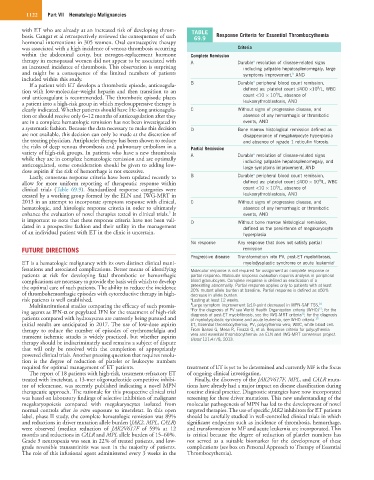
           Lastly, consensus response criteria have been updated recently to   B  Durable  peripheral blood count remission,
                                                                                                         9
        allow  for  more  uniform  reporting  of  therapeutic  response  within   defined as: platelet count ≤400 × 10 /L, WBC
                                                                                           9
        clinical  trials  (Table  69.9).  Standardized  response  categories  were   count <10 × 10 /L, absence of
        created by a working group formed by the ELN and IWG-MRT in              leukoerythroblastosis, AND
        2013 in an attempt to incorporate symptom response with clinical,   C  Without signs of progressive disease, and
        hematologic, and histologic response criteria in order to ultimately     absence of any hemorrhagic or thrombotic
                                                        3
        enhance the evaluation of novel therapies tested in clinical trials.  It   events, AND
        is important to note that these response criteria have not been vali-  D  Without bone marrow histological remission,
        dated in a prospective fashion and their utility in the management       defined as the persistence of megakaryocyte
        of an individual patient with ET in the clinic is uncertain.             hyperplasia
                                                               No response     Any response that does not satisfy partial
        FUTURE DIRECTIONS                                                        remission
                                                               Progressive disease  Transformation into PV, post-ET myelofibrosis,
        ET is a hematologic malignancy with its own distinct clinical mani-      myelodysplastic syndrome or acute leukemia c
        festations and associated complications. Better means of identifying   Molecular response is not required for assignment as complete response or
        patients  at  risk  for  developing  fatal  thrombotic  or  hemorrhagic   partial response. Molecular response evaluation requires analysis in peripheral
        complications are necessary to provide the basis with which to develop   blood granulocytes. Complete response is defined as eradication of a
        the optimal care of such patients. The ability to reduce the incidence   preexisting abnormality. Partial response applies only to patients with at least
                                                               20% mutant allele burden at baseline. Partial response is defined as ≥50%
        of thrombohemorrhagic episodes with cytoreductive therapy in high-  decrease in allele burden.
        risk patients is well established.                     a Lasting at least 12 weeks.
           Multiinstitutional studies comparing the efficacy of such promis-  b Large symptom improvement (≥10-point decrease) in MPN-SAF TSS. 10
                                                                For the diagnosis of PV see World Health Organization criteria (WHO) ; for the
                                                                                                         13
        ing agents as IFN-α or pegylated IFN for the treatment of high-risk   c diagnosis of post-ET myelofibrosis, see the IWG-MRT criteria ; for the diagnosis
                                                                                                    12
        patients compared with hydroxyurea are currently being pursued and   of myelodysplastic syndrome and acute leukemia, see WHO criteria. 13
        initial results are anticipated in 2017. The use of low-dose aspirin   ET, Essential thrombocythemia; PV, polycythemia vera; WBC, white blood cell.
        therapy  to  reduce  the  number  of  episodes  of  erythromelalgia  and   From Barosi G, Mesa R, Finazzi G, et al: Response criteria for polycythemia
        transient  ischemic  attacks  is  widely  practiced,  but  whether  aspirin   vera and essential thrombocythemia: an ELN and IWG-MRT consensus project.
                                                               Blood 121:4778, 2013.
        therapy should be indiscriminately used remains a subject of dispute
        that  will  only  be  resolved  with  the  completion  of  appropriately
        powered clinical trials. Another pressing question that requires resolu-
        tion  is  the  degree  of  reduction  of  platelet  or  leukocyte  numbers
        required for optimal management of ET patients.       treatment of ET is yet to be determined and currently MF is the focus
           The report of 18 patients with high-risk, treatment-refractory ET   of ongoing clinical investigation.
        treated with imetelstat, a 13-mer oligonucleotide competitive inhibi-  Finally, the discovery of the JAK2V617F, MPL, and CALR muta-
        tor of telomerase, was recently published indicating a novel MPN   tions have already had a major impact on disease classification during
        therapeutic approach. The rationale for this prospective clinical trial   routine clinical practice. Diagnostic strategies have now incorporated
        was based on laboratory findings of selective inhibition of malignant   screening for these driver mutations. This new understanding of the
        megakaryopoiesis  compared  with  megakaryocytes  isolated  from   molecular pathogenesis of MPN has led to the development of novel
        normal  controls  after  in  vitro  exposure  to  imetelstat.  In  this  open   targeted therapies. The use of specific JAK2 inhibitors for ET patients
        label, phase II study, the complete hematologic remission was 89%   should be carefully studied in well-controlled clinical trials in which
        and reductions in driver mutation allele burden (JAK2, MPL, CALR)   significant endpoints such as incidence of thrombosis, hemorrhage,
        were  observed  (median  reduction  of  JAK2V617F  of  59%  at  12   and transformation to MF and acute leukemia are incorporated. This
        months and reductions in CALR and MPL allele burden of 15–60%.   is  critical  because  the  degree  of  reduction  of  platelet  numbers  has
        Grade 3 neutropenia was seen in 22% of treated patients, and low-  not  served  as  a  suitable  biomarker  for  the  development  of  these
        grade reversible transaminitis was seen in the majority of patients.   complications (see box on Personal Approach to Therapy of Essential
        The role of this infusional agent administered every 3 weeks in the   Thrombocythemia).

