


Page 1273 - Hematology_ Basic Principles and Practice ( PDFDrive )
P. 1273
Chapter 69  Essential Thrombocythemia  1119


              An alternative to hydroxyurea is therapy with anagrelide. Data on   100
            the use of anagrelide in ET suggest that it is nonleukemogenic. When                Hydroxyurea + aspirin
            considering the risk-to-benefit ratio, one can conclude that hydroxy-
            urea therapy is a first-line therapy for ET patients at a high risk of   90                         89%
            developing an additional thrombosis, including those older than 60
            years of age or with a history of a thrombotic episode or with signifi-  Anagrelide + aspirin
            cant other cardiovascular risk factors. Such nonleukemogenic drugs   Event-free survival (%)  80    84%
            as IFN-α, anagrelide, or pegylated IFN appear to be good choices in
            symptomatic patients younger than 40 years of age.
              Anagrelide is a member of the imidazo(2,1-b)quinazolin-2-1 series
            of compounds. When studied in humans, it was noted that anagrelide   70
            in small doses produced thrombocytopenia. The drug acts primarily    P = .03
            by  reducing  megakaryocyte  size  and  ploidy,  and  decreasing  mega-  0
            karyocyte proliferation. Anagrelide therefore appears to lower platelet   0  1   2      3      4       5
            counts, primarily by interfering with the development of megakaryo-
            cytes.  Anagrelide  suppresses  megakaryocytopoiesis  by  selectively       Time after trial entry (yr)
            reducing the expression levels of GATA-1, FLI-1, NFE-2, and FOG-1   No. at risk
            in  cells  belonging  to  the  megakaryocytic  lineage.  The  effects  of   Hydroxyurea  404  388  298  204  129  57
            anagrelide do not involve thrombopoietin-mediated signal transduc-  plus aspirin
            tion events. GATA-1 and FOG-1 play critical roles in megakaryocytic   Anagrelide  405  379  272  190  119  52
            differentiation. Anagrelide in low doses is effective in lowering the   plus aspirin
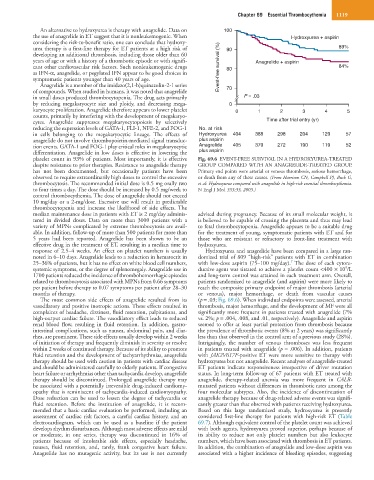
            platelet count in 93% of patients. Most importantly, it is effective   Fig. 69.6  EVENT-FREE SURVIVAL IN A HYDROXYUREA-TREATED
            despite resistance to prior therapies. Resistance to anagrelide therapy   GROUP COMPARED WITH AN ANAGRELIDE-TREATED GROUP.
            has  not  been  documented,  but  occasionally  patients  have  been   Primary end points were arterial or venous thrombosis, serious hemorrhage,
            observed to require extraordinarily high doses to control the excessive   or death from any of these causes. (From Harrison CN, Campbell PJ, Buck G,
            thrombocytosis. The recommended initial dose is 0.5 mg orally two   et al: Hydroxyurea compared with anagrelide in high-risk essential thrombocythemia.
            to four times a day. The dose should be increased by 0.5 mg/week to   N Engl J Med 353:33, 2005.)
            control thrombocythemia. The dose of anagrelide should not exceed
            10 mg/day or a 2-mg/dose. Excessive use will result in predictable
            thrombocytopenia  and  increase  the  likelihood  of  side  effects. The
            median maintenance dose in patients with ET is 2 mg/day adminis-  advised during pregnancy. Because of its small molecular weight, it
            tered  in  divided  doses.  Data  on  more  than  3000  patients  with  a   is believed to be capable of crossing the placenta and thus may lead
            variety of MPNs complicated by extreme thrombocytosis are avail-  to fetal thrombocytopenia. Anagrelide appears to be a suitable drug
            able. In addition, follow-up of more than 500 patients for more than   for the treatment of young, symptomatic patients with ET and for
            5  years  had  been  reported.  Anagrelide  has  been  shown  to  be  an   those  who  are  resistant  or  refractory  to  front-line  treatment  with
            effective drug in the treatment of ET, resulting in a median time to   hydroxyurea.
            response  of  2.5–4  weeks.  An  effect  on  platelet  numbers  is  usually   Hydroxyurea and anagrelide have been compared in a large ran-
            noted in 6–10 days. Anagrelide leads to a reduction in hematocrit in   domized trial of 809 “high-risk” patients with ET in combination
                                                                                                7
            25–36% of patients, but it has no effect on white blood cell numbers,   with low-dose aspirin (75–100 mg/day).  The dose of each cytore-
                                                                                                                  9
            systemic symptoms, or the degree of splenomegaly. Anagrelide use in   ductive agent was titrated to achieve a platelet count <400 × 10 /L
            1700 patients reduced the incidence of thrombohemorrhagic episodes   and long-term control was attained in each treatment arm. Overall,
            related to thrombocytosis associated with MPNs from 0.66 symptoms   patients randomized to anagrelide (and aspirin) were more likely to
            per patient before therapy to 0.07 symptoms per patient after 28–30   reach the composite primary endpoint of major thrombosis (arterial
            months of therapy.                                    or  venous),  major  hemorrhage,  or  death  from  vascular  causes
              The  most  common  side  effects  of  anagrelide  resulted  from  its   (p = .03; Fig. 69.6). When individual endpoints were assessed, arterial
            vasodilatory and positive inotropic actions. These effects resulted in   thrombosis, major hemorrhage, and the development of MF were all
            complaints of headache, dizziness, fluid retention, palpitations, and   significantly more frequent in patients treated with anagrelide (7%
            high-output cardiac failure. The vasodilatory effect leads to reduced   vs. 2%; p = .004, .008, and .01, respectively). Anagrelide and aspirin
            renal  blood  flow,  resulting  in  fluid  retention.  In  addition,  gastro-  seemed to offer at least partial protection from thrombosis because
            intestinal complications, such as nausea, abdominal pain, and diar-  the prevalence of thrombotic events (8% at 2 years) was significantly
            rhea, are prominent. These side effects usually develop within 2 weeks   less than that observed in the control arm of a previous study (28%).
            of initiation of therapy and frequently diminish in severity or resolve   Intriguingly,  the  number  of  venous  thromboses  was  less  frequent
            within 2 weeks of continued therapy. Because of its ability to promote   in patients treated with anagrelide (p = .006). In addition, patients
            fluid retention and the development of tachyarrhythmias, anagrelide   with JAK2V617F-positive ET were more sensitive to therapy with
            therapy should be used with caution in patients with cardiac disease   hydroxyurea but not anagrelide. Recent analyses of anagrelide-treated
            and should be administered carefully to elderly patients. If congestive   ET patients indicate responsiveness irrespective of driver mutation
            heart failure or arrhythmias other than tachycardia develop, anagrelide   status. In long-term follow-up of 67 patients with ET treated with
            therapy should be discontinued. Prolonged anagrelide therapy may   anagrelide,  therapy-related  anemia  was  more  frequent  in  CALR-
            be associated with a potentially irreversible drug-induced cardiomy-  mutated patients without differences in thrombotic rates among the
            opathy that is reminiscent of tachycardia-induced cardiomyopathy.   four molecular subtypes. Also, the incidence of discontinuation of
            Dose reduction can be used to lessen the degree of tachycardia or   anagrelide therapy because of drug-related adverse events was signifi-
            fluid  retention.  Before  the  institution  of  anagrelide,  it  is  recom-  cantly greater than that observed with patients receiving hydroxyurea.
            mended that a basic cardiac evaluation be performed, including an   Based  on  this  large  randomized  study,  hydroxyurea  is  presently
            assessment of cardiac risk factors, a careful cardiac history, and an   considered  first-line  therapy  for  patients  with  high-risk  ET  (Table
            electrocardiogram,  which  can  be  used  as  a  baseline  if  the  patient   69.7). Although equivalent control of the platelet count was achieved
            develops rhythm disturbances. Although most adverse effects are mild   with both agents, hydroxyurea proved superior, perhaps because of
            or  moderate,  in  one  series,  therapy  was  discontinued  in  16%  of   its  ability  to  reduce  not  only  platelet  numbers  but  also  leukocyte
            patients  because  of  intolerable  side  effects,  especially  headache,   numbers, which have been associated with thrombosis in ET patients.
            nausea,  fluid  retention,  and,  rarely,  frank  congestive  heart  failure.   In addition, the combination of anagrelide and low-dose aspirin was
            Anagrelide  has  no  mutagenic  activity,  but  its  use  is  not  currently   associated with a higher incidence of bleeding episodes, suggesting

