


Page 1282 - Hematology_ Basic Principles and Practice ( PDFDrive )
P. 1282
1128   Part VII  Hematologic Malignancies


        expression of the mutant C-terminus alone nor expression of CALR   mutations throughout the 11 exons of this gene result in com promised
        lacking the C-terminus leads to cytokine-independent growth, sug-  catalytic activity of an α-ketoglutarate-dependent enzyme responsible
        gesting that the novel C-terminus is necessary (but not sufficient) for   for oxidation of 5-methylcytosine (5mC) to 5-hydroxymethylcytosine
        transformation. They found that the oncogenic activity of mutant   (5hmC) in DNA. Low levels of 5hmC result in a hypermethylation
        CALR is not encoded within a specific sequence or domain of the   phenotype at CpG sites in various DNA promoter regions. TET2
                                                                                                     −
                                                                                                          +
                                                                                                                hi
        mutant C-terminus, but that the positive electrostatic charge of the   mRNA has been found to be highly expressed in Lin , Sca-1 , c-Kit
        mutant C-terminus was critical for its transforming capacity. Muta-  murine  multipotent  progenitor  cells  isolated  from  the  BM  and
        genizing all 18 lysine/arginine residues (positively charged) within the   thymus. This expression pattern was maintained in myeloid progeni-
        C-terminus  to  a  neutral  glycine  residue  abrogated  CALR-del52   tor cells but low in mature granulocytes. Moreover, in patient samples,
        transformation activity. In contrast, mutagenizing the 18 nonlysine/  when compared with normal samples, low 5hmC levels correlated
        arginine  residues  within  the  C-terminus  to  glycine  did  not  affect   with a significant decrease in DNA hypermethylation, supporting a
        transforming activity, a remarkable finding considering that, in this   role of TET2 loss of function leading to DNA hypermethylation. It
        mutant, 50% of the amino acids have been modified, Using coim-  is currently believed that TET2 mutations result in loss of function
        munoprecipitation assays, Elf et al found that mutant CALR, but not   and lead to the accumulation of 5mC in DNA, promoting DNA
        WT  CALR,  physically  interacted  with  MPL,  and  that  neither  the   hypermethylation that may inhibit cells from differentiating beyond
        mutant C-terminus alone nor mutant CALR lacking the C-terminus   a HSC-like state. In vitro studies reveal that TET2 deficiency restrains
        can bind to MPL. This suggests that the tertiary structure of mutant   hematopoietic cells from normal differentiation patterns and skews
        CALR is required for binding to MPL.                  differentiation  in  favor  of  the  monocyte/macrophage  lineage  with
           Approximately 10% of PMF patients lack any of the three driver   transgenic  animals,  with  knockout  of  TET2  having  a  phenotype
        mutations.  However,  recently  Milosevic-Feenstra  and  coworkers   resembling  chronic  myelomonocytic  leukemia.  Somatic,  recurrent
        identified noncanonical MPL mutations by whole-exon sequencing   TET2 mutations have been reported in normal elderly individuals
        in eight out of 70 (11.4%) and JAK2 mutations in five out of 57   with acquired clonal hematopoiesis. Alterations in TET2 that include
        (8.8%) patients with triple-negative ET and PMF. All mutations were   base substitutions, out-of-frame insertions or deletions, and splice site
        heterozygous.  The  mutations  in  MPL  and  JAK2  were  mutually   mutations have been shown to occur in 15–20% of PMF patients.
        exclusive. Evidence for clonal disease was lacking in 50% of these   Such mutations are more common in older patients. In families with
        triple-negative cases and the presence of germ-line mutations indi-  multiple family members having an MPN, all TET2 mutations were
        cated that some of these individuals likely had a hereditary rather   almost universally acquired, and their incidence was similar to that
        than  an  acquired  MPN-like  disorder.  Based  upon  these  findings,   of  patients  with  sporadic  PMF.  Clonal  analysis  studies  in  MPN
        sequencing of all coding exons of MPL and JAK2 during the diag-  patient  samples  failed  to  define  a  consistent  temporal  sequence  of
        nostic work-up of ET and PMF patients who are triple negative is   acquisition of TET2 mutations with respect to JAK2 mutations and
        recommended.                                          can occur late in the progression of MPNs. These two genetic events
           A  growing  list  of  additional  mutations  have  been  identified  in   appear  to  occur  independently.TET2  mutational  status  in  PMF
        PMF patients over the past several years, providing further insight   patients does not appear to provide a new prognostic marker. TET2
                                               6
        into the complex molecular pathology of this disease.  Many of these   mutations  can  be  found  in  PMF  patients  with  and  without  the
                                                          +
        mutations impact the epigenome and can coexist in PMF CD34    JAK2V617F  mutation,  and  do  not  influence  rate  of  thrombosis,
        cells. None of the genetic or epigenetic lesions identified thus far are   leukemic transformation, or OS.
        specific  to  PMF,  clearly  aid  in  prognostication,  or  appear  to  be   Isocitrate dehydrogenase 1 and 2 (IDH1/2), located on chromo-
                                                                                                        +
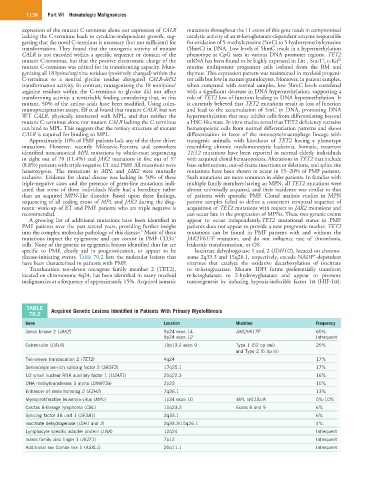
        disease-initiating events. Table 70.2 lists the molecular lesions that   some 2q33.3 and 15q26.1, respectively, encode NADP -dependent
        have been characterized in patients with PMF.         enzymes  that  catalyze  the  oxidative  decarboxylation  of  isocitrate
           Translocation  ten-eleven  oncogene  family  member  2  (TET2),   to  α-ketoglutarate.  Mutant  IDH  forms  preferentially  transform
        located on chromosome 4q24, has been identified in many myeloid   α-ketoglutarate  to  2-hydroxyglutarate  and  appear  to  promote
        malignancies at a frequency of approximately 15%. Acquired somatic   tumorigenesis  by  inducing  hypoxia-inducible  factor  1α  (HIF-1α).


          TABLE   Acquired Genetic Lesions Identified in Patients With Primary Myelofibrosis
          70.2
         Gene                                          Location               Mutation                  Frequency
         Janus kinase 2 (JAK2)                         9p24 exon 14           JAK2V617F                 65%
                                                       9p24 exon 12                                     Infrequent
         Calreticulin (CALR)                           19p13.2 exon 9         Type 1 (52 bp del)        25%
                                                                              and Type 2 (5 bp in)
         Ten-eleven translocation 2 (TET2)             4q24                                             17%
         Serine/arginine-rich splicing factor 2 (SRSF2)  17q25.1                                        17%
         U2 small nuclear RNA auxillary factor 1 (U2AF1)  21q22.3                                       16%
         DNA methyltransferase 3 alpha (DNMT3a)        2p23                                             15%
         Enhancer of zeste homolog 2 (EZH2)            7q36.1                                           13%
         Myeloproliferative leukemia virus (MPL)       1p34 exon 10           MPL W515L/K               5%-10%
         Casitas B-lineage lymphoma (CBL)              11q23.3                Exons 8 and 9             6%
         Splicing factor 3B unit 1 (SF3B1)             2q33.1                                           6%
         Isocitrate dehydrogenase (IDH1 and 2)         2q33.3/15q26.1                                   4%
         Lymphocyte specific adapter protein (LNK)     12q24                                            Infrequent
         Ikaros family zinc finger 1 (IKZF1)           7p12                                             Infrequent
         Additional sex Combs-like 1 (ASXL1)           20q11.1                                          Infrequent

