


Page 1284 - Hematology_ Basic Principles and Practice ( PDFDrive )
P. 1284
1130   Part VII  Hematologic Malignancies


             Hematopoietic                    MPN initiation   MPN diagnosis    Chronic MPN
               stem cells
                                              Unknown driver                                  No observed mutations
                                                                                              20/197(10%)


                                          CALR                                                CALR only
                                                                                              22/197(11%)

                                      JAK2 V617F                                              JAK2 only
                                                                                              84/197(43%)


                                                                                              CALR with additional
                                          CALR                                                mutations
                                                                                              7/197(4%)
                                                     Mutations in other
                              Fertile ground      genes, e.g., TET2, DNMT3A
                                                      EZH2 or ASXL1
                                              Unknown driver                                  JAK2/CALR negative
                                                                                              with other mutations
                                                                                              13/197(7%)
                     Early mutations:
                   e.g., TET2, DNMT3A
                                      JAK2 V617F                                           Increasing risk  JAK2 with
                                                                                              additional mutations
                                                                                              37197(19%)
                                                                   e.g., ASXL1, EZH2
                                                                   CBL or TP53 etc
                                                                               High-risk MPN
                               Leukemogenic
                               hits, e.g., TP53                                               Several non-driver
                                                                                              mutations
                                                                                              14/197(7%)
                                                              e.g., TP53 LOH
                                                              or additional hits
                                                                               Transformation
                                                                                  to AML


                                                  JAK2 V617F-           JAK2 V617F-positive
                                                  negative AML           AML with late hits
                                                               JAK2 V617F-
                                                               positive AML
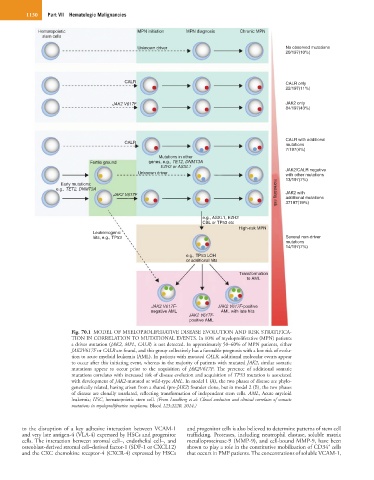
                        Fig. 70.1  MODEL OF MYELOPROLIFERATIVE DISEASE EVOLUTION AND RISK STRATIFICA-
                        TION IN CORRELATION TO MUTATIONAL EVENTS. In 10% of myeloproliferative (MPN) patients
                        a driver mutation (JAK2, MPL, CALR) is not detected. In approximately 50–60% of MPN patients, either
                        JAK2V617F or CALR are found, and this group collectively has a favorable prognosis with a low risk of evolu-
                        tion to acute myeloid leukemia (AML). In patients with mutated CALR, additional molecular events appear
                        to occur after this initiating event, whereas in the majority of patients with mutated JAK2, similar somatic
                        mutations  appear  to  occur  prior  to  the  acquisition  of  JAK2V617F.  The  presence  of  additional  somatic
                        mutations correlates with increased risk of disease evolution and acquisition of TP53 mutation is associated
                        with development of JAK2-mutated or wild-type AML. In model 1 (A), the two phases of disease are phylo-
                        genetically related, having arisen from a shared (pre-JAK2) founder clone, but in model 2 (B), the two phases
                        of disease are clonally unrelated, reflecting transformation of independent stem cells. AML, Acute myeloid
                        leukemia; HSC, hematopoietic stem cell. (From Lundberg et al: Clonal evolution and clinical correlates of somatic
                        mutations in myeloproliferative neoplasms. Blood 123:2220, 2014.)


        to  the  disruption  of  a  key  adhesive  interaction  between VCAM-1   and progenitor cells is also believed to determine patterns of stem cell
        and very late antigen-4 (VLA-4) expressed by HSCs and progenitor   trafficking.  Proteases,  including  neutrophil  elastase,  soluble  matrix
        cells. The interaction between stromal cell–, endothelial cell–, and   metalloproteinase-9 (MMP-9), and cell-bound MMP-9, have been
                                                                                                            +
        osteoblast-derived stromal cell–derived factor-1 (SDF-1 or CXCL12)   shown to play a role in the constitutive mobilization of CD34  cells
        and the CXC chemokine receptor-4 (CXCR-4) expressed by HSCs   that occurs in PMF patients. The concentrations of soluble VCAM-1,

