


Page 1285 - Hematology_ Basic Principles and Practice ( PDFDrive )
P. 1285
Chapter 70  Primary Myelofibrosis  1131


            a degradation product of VCAM-1, is elevated in the plasma of PMF   Summary of Symptoms and Physical Findings of
            patients,  and  these  levels  correlate  with  the  absolute  numbers  of   TABLE   Patients With Primary Myelofibrosis Detected at
                 +
            CD34  cells in the peripheral blood. In addition, these elevated levels   70.3  Diagnosis
            of proteases have been shown to be responsible for degradation of the
                                                          +
            chemokine CXCL12, which plays a role in retention of CD34  cells   Symptom or Finding         Incidence (%)
            within the BM because the degradations products lack the ability to   Asymptomatic              16–30
                      +
            attract CD34  cells, thereby favoring their mobilization. By contrast,
            the amount of intact CXCL12 present within the spleen is increased,   Fatigue                   47–71
            likely favoring the homing and localization of HPC/HSC to extra-  Fever                          5–15
            medullary sites such as the spleen. Furthermore, CXCR-4 expression   Weight loss                 7–39
                        +
            by  PMF  CD34   cells  is  epigenetically  downregulated,  which  may
            account for altered CXCL12–CXCR-4 interactions, participating in   Night sweats                  6–21
                 +
            CD34  cell mobilization. This downregulation of CXCR4 expression   Symptoms due to enlarged spleen  11–48
            can be reversed in vitro by treatment with chromatin-modifying agents.   Bleeding                5–20
            Furthermore, the expression levels of CXCR4 were significantly lower
            in patients with a high burden of JAK2V617F (allele frequency: 75%)   Gout or renal stones       6–13
            compared with patients with low-burden JAK2V617F, suggesting the   Pallor                         60
            dependence of gene expression on the frequency of the mutated allele.   Petechiae or ecchymoses  15–20
                              +
            Similar degrees of CD34  cell mobilization are observed in post-ET   Splenomegaly               89–99
            and post-PV MF, as occurs in PMF. In PV patients, Passamonti and
            coworkers  have  demonstrated  a  relationship  between  JAK2V617F   Hepatomegaly               39–70
                                                              +
            allele burden and the degree of constitutive mobilization of CD34    Peripheral edema             13
            cells, suggesting that such mobilization may be a consequence of the   Evidence of portal hypertension  2–6
            transition from JAK2V617F heterozygosity to homozygosity that is
            accompanied by granulocyte activation. Drugs that target the prote-  Lymphadenopathy             1–10
                                        +
            ases responsible for constitutive CD34  cell mobilization may present   Jaundice                 0–4
            a possible strategy to prevent the establishment of extramedullary sites
            of hematopoiesis in patients with PMF.
              The kinetics of engraftment of normal stem cells after aSCT in
            PMF  patients  and  the  slow  regression  of  fibrosis  after  transplant
            lead  one  to  question  if  the  distorted  BM  architecture  associated   Thrombotic episodes are rarely a presenting feature of the disease
            with  fibrosis  in  PMF  actually  disrupts  the  functions  of  the  BM   but may occur during its course, with a probability of 9.6% at 5 years,
            microenvironment.  In  PMF  patients,  normal  stem  cells  engraft   a  rate  higher  than  in  the  control  general  population. Thromboses
            after  transplant  and  hematopoietic  cell  recovery  occurs  before  the   may be venous (cerebral venous sinus thrombosis, splanchnic vein
            BM  fibrosis  has  resolved. These  observations  raise  some  questions   thrombosis, deep venous thrombosis, pulmonary thromboembolism)
            concerning the prospects for success with strategies for the treatment   or arterial (stroke, transient ischemic attacks, retinal artery occlusion,
            of patients with PMF that are directed solely toward reversing the BM   myocardial infarction, angina pectoris, and peripheral arterial disease).
            fibrosis rather than eliminating the malignant clone and its progeny.   The  cellular  phase  of  PMF  with  thrombocytosis  and  presence  of
            Furthermore,  in  mouse  models  of  MF,  inhibition  of TGF-β1  was   cardiovascular risk factors such as hypertension, smoking, hypercho-
                                                                                                                    7
            capable of preventing the development of BM fibrosis but did not   lesterolemia, and diabetes are independent predictors of thrombosis.
            rescue animals from a fatal MPN.                      The prefibrotic phase of MF as defined by WHO criteria is associated
                                                                  with  a  higher  thrombotic  risk  than  that  observed  in  ET  patients.
                                                                  After splenectomy, the rate of thrombosis increases and is associated
            CLINICAL MANIFESTATIONS                               with the development of thrombocytosis after the procedure. A sys-
                                                                  tematic review of JAK2V617F-positive PMF patients failed to clearly
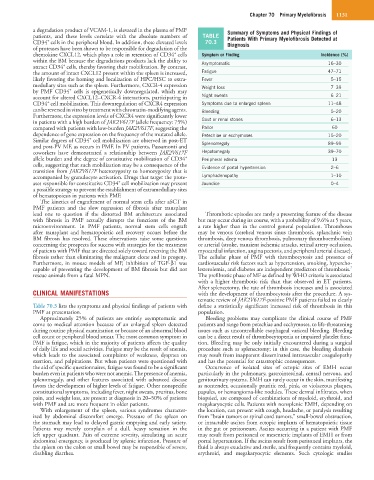
            Table 70.3 lists the symptoms and physical findings of patients with   define a statistically significant increased risk of thrombosis in this
            PMF at presentation.                                  population.
              Approximately  25%  of  patients  are  entirely  asymptomatic  and   Bleeding  problems  may  complicate  the  clinical  course  of  PMF
            come  to  medical  attention  because  of  an  enlarged  spleen  detected   patients and range from petechiae and ecchymoses, to life-threatening
            during routine physical examination or because of an abnormal blood   issues such as uncontrollable esophageal variceal bleeding. Bleeding
            cell count or peripheral blood smear. The most common symptom in   can be a direct result of thrombocytopenia or impaired platelet func-
            PMF is fatigue, which in the majority of patients affects the quality   tion. Bleeding may be only initially encountered during a surgical
            of daily life and social activities. Fatigue may be the result of anemia,   procedure such as splenectomy; in this case, the bleeding diathesis
            which leads to the associated complaints of weakness, dyspnea on   may result from inapparent disseminated intravascular coagulopathy
            exertion, and palpitations. But when patients were questioned with   and has the potential for catastrophic consequences.
            the aid of specific questionnaires, fatigue was found to be a significant   Occurrence  of  isolated  sites  of  ectopic  sites  of  EMH  occur
            burden even in patients who were not anemic. The presence of anemia,   particularly in the pulmonary, gastrointestinal, central nervous, and
            splenomegaly,  and  other  features  associated  with  advanced  disease   genitourinary systems. EMH can rarely occur in the skin, manifesting
            favors the development of higher levels of fatigue. Other nonspecific   as nontender, occasionally pruritic red, pink, or violaceous plaques,
            constitutional symptoms, including fever, night sweats, pruritus, bone   papules, or hemangioma-like nodules. These dermal infiltrates, when
            pain, and weight loss, are present at diagnosis in 20–50% of patients   biopsied, are composed of combinations of myeloid, erythroid, and
            with PMF and are more frequent in older patients.     megakaryocytic cells. Patients with nonsplenic EMH, depending on
              With  enlargement  of  the  spleen,  various  syndromes  character-  the location, can present with cough, headache, or paralysis resulting
            ized  by  abdominal  discomfort  emerge.  Pressure  of  the  spleen  on   from “brain tumors or spinal cord tumors,” small-bowel obstruction,
            the stomach may lead to delayed gastric emptying and early satiety.   or intractable ascites from ectopic implants of hematopoietic tissue
            Patients  may  merely  complain  of  a  dull,  heavy  sensation  in  the   in the gut or peritoneum. Ascites occurring in a patient with PMF
            left  upper  quadrant.  Pain  of  extreme  severity,  simulating  an  acute   may result from peritoneal or mesenteric implants of EMH or from
            abdominal emergency, is produced by splenic infarction. Pressure of   portal hypertension. If the ascites result from peritoneal implants, the
            the spleen on the colon or small bowel may be responsible of severe,   fluid is always exudative and sterile, and frequently contains myeloid,
            disabling diarrhea.                                   erythroid,  and  megakaryocytic  elements.  Such  cytologic  studies

