


Page 1287 - Hematology_ Basic Principles and Practice ( PDFDrive )
P. 1287
Chapter 70  Primary Myelofibrosis  1133


                      A                B                         C            D                 E


                                                                  H


                      F                            G              I                      J
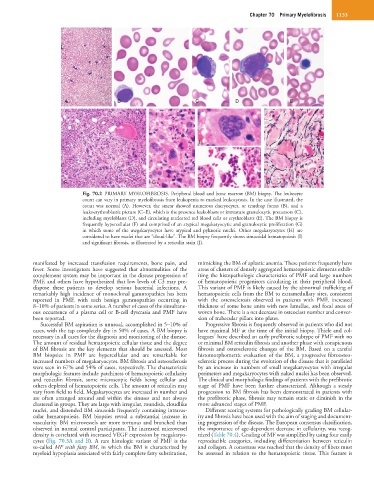
                            Fig. 70.2  PRIMARY MYELOFIBROSIS. Peripheral blood and bone marrow (BM) biopsy. The leukocyte
                            count can vary in primary myelofibrosis from leukopenia to marked leukocytosis. In the case illustrated, the
                            count  was  normal  (A).  However,  the  smear  showed  numerous  dacryocytes,  or  teardrop  forms  (B),  and  a
                            leukoerythroblastic picture (C–E), which is the presence leukoblasts or immature granulocytic precursors (C),
                            including myeloblasts (D), and circulating nucleated red blood cells or erythroblasts (E). The BM biopsy is
                            frequently hypercellular (F) and comprised of an atypical megakaryocytic and granulocytic proliferation (G)
                            in  which  some  of  the  megakaryocytes  have  atypical  and  pyknotic  nuclei.  Other  megakaryocytes  (H)  are
                            considered to have nuclei that are “cloud-like”. The BM biopsy frequently shows sinusoidal hematopoiesis (I)
                            and significant fibrosis, as illustrated by a reticulin stain (J).


            manifested  by  increased  transfusion  requirements,  bone  pain,  and   mimicking the BM of aplastic anemia. These patients frequently have
            fever.  Some  investigators  have  suggested  that  abnormalities  of  the   areas of clusters of densely aggregated hematopoietic elements exhib-
            complement system may be important in the disease progression of   iting the histopathologic characteristics of PMF and large numbers
            PMF, and others have hypothesized that low levels of C3 may pre-  of  hematopoietic  progenitors  circulating  in  their  peripheral  blood.
            dispose  these  patients  to  develop  serious  bacterial  infections.  A   This variant of PMF is likely caused by the abnormal trafficking of
            remarkably high incidence of monoclonal gammopathies has been   hematopoietic cells from the BM to extramedullary sites, consistent
            reported  in  PMF,  with  such  benign  gammopathies  occurring  in   with  the  osteosclerosis  observed  in  patients  with  PMF,  increased
            8–10% of patients in some series. A number of cases of the simultane-  thickness of some bone units with new lamellae, and focal areas of
            ous occurrence of a plasma cell or B-cell dyscrasia and PMF have   woven bone. There is a net decrease in osteoclast number and conver-
            been reported.                                        sion of trabecular pillars into plates.
              Successful BM aspiration is unusual, accomplished in 5–10% of   Progressive fibrosis is frequently observed in patients who did not
            cases, with the tap completely dry in 50% of cases. A BM biopsy is   have maximal MF at the time of the initial biopsy. Thiele and col-
                                                                       7
            necessary in all cases for the diagnosis and monitoring of the disease.   leagues  have described an early prefibrotic subtype of PMF with no
            The amount of residual hematopoietic cellular tissue and the degree   or minimal BM reticulin fibrosis and another phase with conspicuous
            of BM fibrosis are the key elements that should be assessed. Most   fibrosis  and  osteosclerotic  changes  of  the  BM.  Based  on  a  careful
            BM  biopsies  in  PMF  are  hypercellular  and  are  remarkable  for   histomorphometric evaluation of the BM, a progressive fibroosteo-
            increased numbers of megakaryocytes. BM fibrosis and osteosclerosis   sclerotic process during the evolution of the disease that is paralleled
            were seen in 67% and 54% of cases, respectively. The characteristic   by  an  increase  in  numbers  of  small  megakaryocytes  with  irregular
            morphologic features include patchiness of hematopoietic cellularity   perimeters and megakaryocytes with naked nuclei has been observed.
            and  reticulin  fibrosis,  some  microscopic  fields  being  cellular  and   The clinical and morphologic findings of patients with the prefibrotic
            others depleted of hematopoietic cells. The amount of reticulin may   stage  of  PMF  have  been  further  characterized.  Although  a  steady
            vary from field to field. Megakaryocytes are increased in number and   progression to BM fibrosis has been demonstrated in patients with
            are  often  arranged  around  and  within  the  sinuses  and  not  always   the prefibrotic phase, fibrosis may remain static or diminish in the
            clustered in groups. They are large with irregular, roundish, cloudlike   more advanced stages of PMF.
            nuclei, and distended BM sinusoids frequently containing intravas-  Different scoring systems for pathologically grading BM cellular-
            cular  hematopoiesis.  BM  biopsies  reveal  a  substantial  increase  in   ity and fibrosis have been used with the aim of staging and document-
            vascularity. BM microvessels are more tortuous and branched than   ing progression of the disease. The European consensus classification,
            observed in normal control participants. The increased microvessel   the importance of age-dependent decrease in cellularity, was recog-
            density is correlated with increased VEGF expression by megakaryo-  nized (Table 70.4). Grading of MF was simplified by using four easily
            cytes  (Fig.  70.3A  and  B).  A  rare  histologic  variant  of  PMF  is  the   reproducible  categories,  including  differentiation  between  reticulin
            so-called MF with fatty BM, in which the BM is characterized by   and collagen. A consensus was reached that the density of fibers must
            myeloid hypoplasia associated with fairly complete fatty substitution,   be  assessed  in  relation  to  the  hematopoietic  tissue. This  feature  is

